
Punch’s Pocket Book (1843-1881) – Introduction to the Collection
While inherited from a long-lasting tradition of almanacs, diaries, and gift books, Punch’s Pocket Book (1843-1881) quickly established its identity and place in the publishing market through a distinct blend of information, entertainment, and art which became its hallmark over the forty years or so of its existence. Its dual structure offered up-to-date business information, data on royalty, parliament, banks, public companies and other trivia, as well as light reading—short fiction, ballads—and humorous anecdotes, jokes and cartoons. In-between these two distinct yet complementary sections were the usual pocket book features: a calendar, cash account segment, and a diary and memoranda section. Published in sextodecimo, a printing mode in which a sheet of paper is folded and cut into sixteen pages, it was “equally adapted for the Reticule of the Sovereign and the pocket of the Lord Mayor.” Its launch, in the unstable setting of the early 1840s, was meant to provide further revenue to the fledgling Punch magazine which, after a promising start, was in considerable financial difficulties. For William Bradbury and Frederick Evans, who were the printers, publishers, and proprietors of the magazine from 1842, this new addition to the Punch brand represented a commercial opportunity not to be missed.
Punch’s art on display
Although Punch’s Pocket Book was a collectible that could be stored and displayed in a bespoke gilded leather bookcase, each almanac was produced and marketed as a unique object. A seasonal publication intended to boost the Christmas sales, it came in different binding styles, colours, and leather varieties, ranging from morocco to ordinary goatskin, with or without a pencil and ribbon bookmarks. As fully recorded in the Bradbury & Evans ledgers, the typical pocketbook contained two coloured etchings and half-a-dozen wood-engravings. Some volumes, however, carried extra tinted sketches, with or without tissue paper to protect them. More significantly, some Pocket Book covers were embossed with a distinctive “Mister Punch” design that made the book a unique piece. Despite their resemblance, all copies are therefore original pieces.
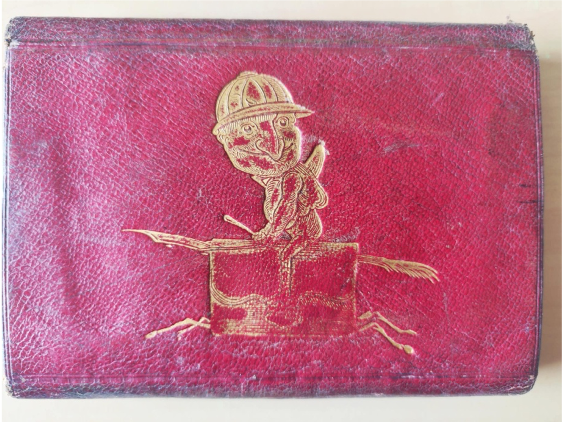
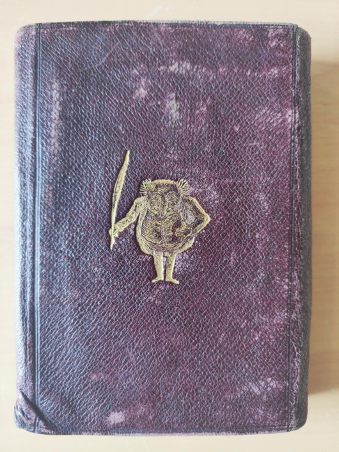
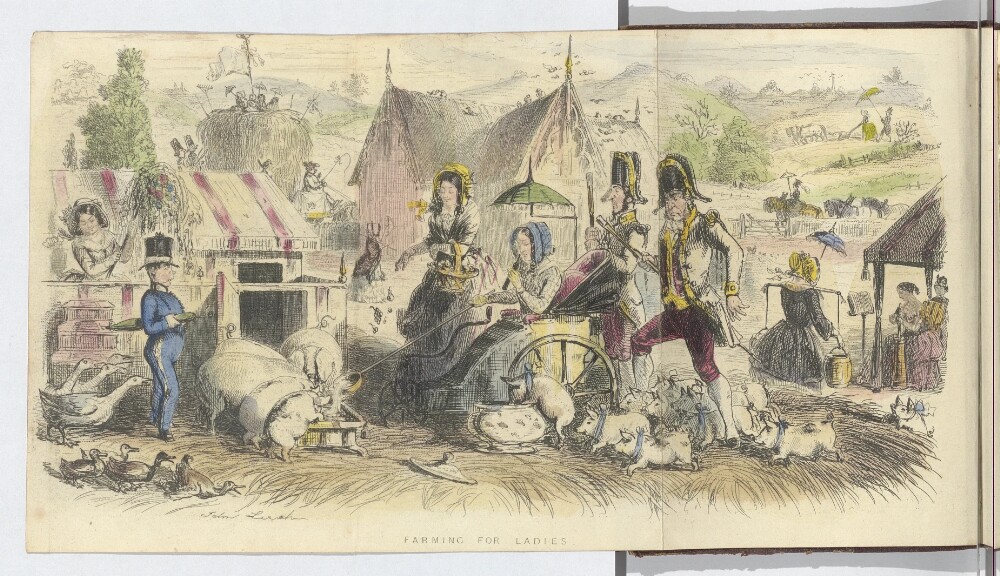
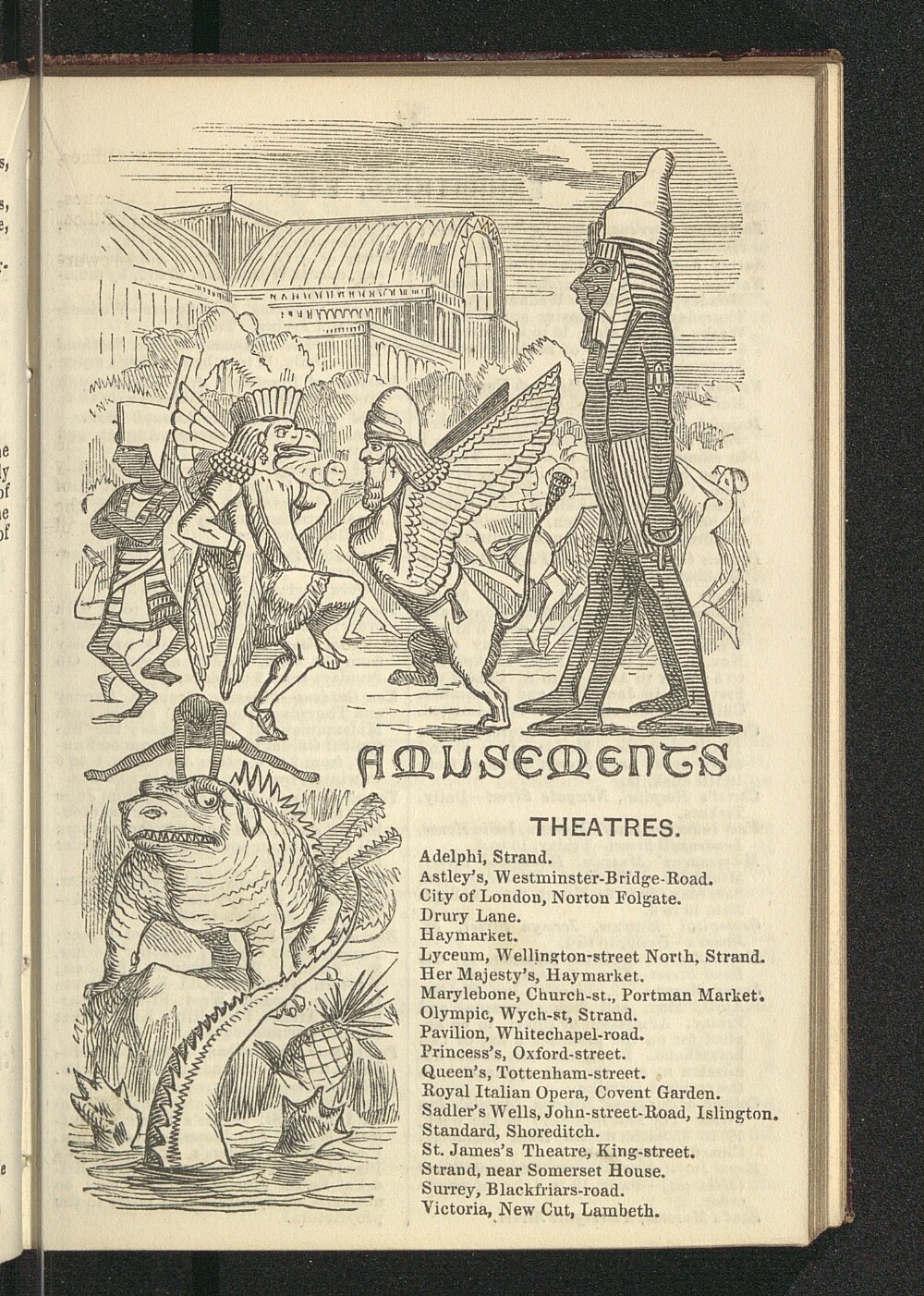
Punch’s Pocket Book also asserted its artistic ambition through its unique visual content. Ranging from full page etchings to wood-engraved illustrations, ornaments, and decorated initials, pictures were omnipresent in the volumes. The publication’s main selling point and key attraction was a distinctive fold-out hand-coloured frontispiece drawn by Punch’s senior cartoonists, who received substantial end-of-year bonuses for their work. Over the years, John Leech, Richard Doyle, Charles Keene, and later John Tenniel and Linley Sambourne all designed these stunning items, which offered critical commentary on their accompanying texts. Much advertised by Bradbury & Evans, these etchings were the firm’s main strategy to boost its sales and those of the entire Punch brand. At a time when graphic artists were rarely permitted into higher social circles, such productions also offered them a unique opportunity to advertise their talent and seek acknowledgement from the art establishment. Punch’s Pocket Book therefore also functioned as a networking artefact. After Leech’s death, in 1864, an anthology of his frontispieces was published under the title Follies of The Year: A Series of Coloured Etchings from Punch's Pocket Books 1844 – 1864, confirming the centrality of these unique items in the firm’s commercial strategy. The aesthetic sophistication of these vividly coloured images allowed the annual to stand out from the rest of the pocket book offer.
‘Spirits buoyant and wit sparkling’
“With spirits buoyant and wit sparkling as when he first appeared, Punch diffuses merriment throughout every circle to which he comes.” The Globe, 5 November 1844, p. 1.In the words of Charles Knight, Punch, or the London Charivari (1841-1992) was “the shrewdest observer, the most good-humoured satirist, the most inoffensive promoter of merriment, and one of the most trustworthy of portrait-painters, that ever brought the pencil to the aid of the pen, for harmless entertainment and real moral instructionCelina Fox, Graphic Journalism in England during the 1830s and 1840s, London: Garland, 1988, p. 237..” As superintendent for the publications of the Society for the Diffusion of Utilitarian Knowledge (SDUK) and publisher of the lavishly illustrated Penny Magazine (1832-1846), the conservative Knight certainly saw in Bradbury & Evans’s new title yet another tool against the spread of “subversive” political ideas. As an offspring of Punch, the Pocket Book was meant to echo the magazine’s editorial line, offering its readers “comicalities leavened with satirical commentary that could safely be read and passed around within the family circlePatrick Leary, The Punch Brotherhood Table Talk and Print Culture in Mid-Victorian London. The British Library, 2010, p. 11..” Part II typically contained a selection of thirty to forty anecdotes, poems, stories and ballads, most of which were written by Mark Lemon, Gilbert Abbott à Beckett, William Makepeace Thackeray, Percival Leigh, Horace Mayhew, Sterling Coyne, and others of the staff. Later on, Shirley Brooks came to be in charge of much of the writing. The themes covered often hinged around domestic issues, with a significant proportion of the items inspired by the family circle, lifestyles and relationships. Punch’s humour also encompassed subjects like accents and languages, politics, government and the law, print culture and literature, and science and medicine. Every year, extracts from some of these stories were circulated in the press, locally and nationally, as a way to advertise the productThe so-called “taxes on knowledge” were duties on newspapers, their advertising content, and the paper they were printed on. In order to avoid the advertising charges, publishers circulated extracts from their products, without indicating a price. The advertisement duty was finally abolished in 1853, followed by newspaper stamp duty in 1855. The paper duty was removed in 1861. Punch’s Pocket Book for 1845, for instance, was publicised through extracts from two stories: “The Stranger’s Guide to the Metropolis” and “Guy’s Modern Geography,” which mocks the Young England movement.
As a magazine, Punch based its appeal on a playful approach to contemporary social and political events. Although the Pocket Book was a yearly publication and thus less in touch with day-to-day events, it nevertheless shared this interest for topicality. The three editions presented in this pilot version of Punch’s Pocket Book Archive Project all attest to this interest. The 1855 edition, for instance, uses comedy, visual and verbal, to attack ‘baby contests,’ a type of competition organised for the first time in 1854, in which babies were put on display and awarded prizes according to set criteria. Picture and story humorously denounce the hypocrisy of a society in which some infants are displayed for money while others are left to their fate, killed by alcohol and opiates (laudanum, then commonly sold to soothe teething children). The Part II story compares baby contests - ‘the great annual feast of fat’ - with livestock shows like the Smithfield annual exhibitionAnon., “A Prize Baby Show,” Punch’s Pocket Book for 1855, p. 141.. Similarly, Tom Taylor contributed a story entitled “The Andro-Gynecaeum. (A Dream of the Future)” For Punch’s Pocket Book for 1875. Set in the specific context of a club, then a quintessentially homoscial space, the text conveys male apprehensions as to the progressive entry of women into the public sphere. Keene's corresponding crowded and chatty frontispiece echoes this fear of female infringement upon male prerogatives, political in particular. Both items are based on stereotypical gender roles, women being deemed superficial, manipulative and therefore dangerous.
A London publication
Although Punch’s Pocket Book was “sold by all booksellers” across the United Kingdom and abroad—several volumes of the collection presented here indeed belonged to readers in Europe and the United-States—it was quintessentially a London product. Like Punch (subtitled The London Charivari) and its cluster of related products, the little volumes were steeped in London contexts, which they reflected and constructed. Their major selling point, the hand-coloured frontispieces, often represented venues in the capital, such as Hyde Park (1846), Tattersalls’ (1847), and the Serpentine (1856), or referred to urban drawing-rooms (1859) and ballrooms (1857 and 1863). The geography of the Pocket Book sales, carefully recorded in the Bradbury and Evans ledgers, confirms this metropolitan identity. For instance, between 1867 and 1877, a decade when the product’s yearly circulation decreased from approximately 9,000 to 8,000, 75–80 percent of the pocket books were sold in London, either through Bradbury and Evans or the Punch Office in Fleet Street. The rest of the books were sold through an extended and complex distribution network comprising such major publishers as W. H. Smith or Chapman and Hall as well as a number of regional and local outlets covering the country. The Pocket Book, then, reflected the centripetal circulatory system of the nineteenth-century British journalistic sceneRecent scholarship has shown the prescriptive effects of such a centripetal perspective, stressing the importance of the local and regional in the circulation of information throughout the Victorian era. See for instance Andrew Hobbs’s A Fleet Street in Every Town. The Provincial Press in England (Open Publishers, 2018), or William Hamish Fraser’s Edinburgh History of Scottish Newspapers, 1850-1950 (EUP, 2023).
‘Readers of the necessary kitchen stuff’
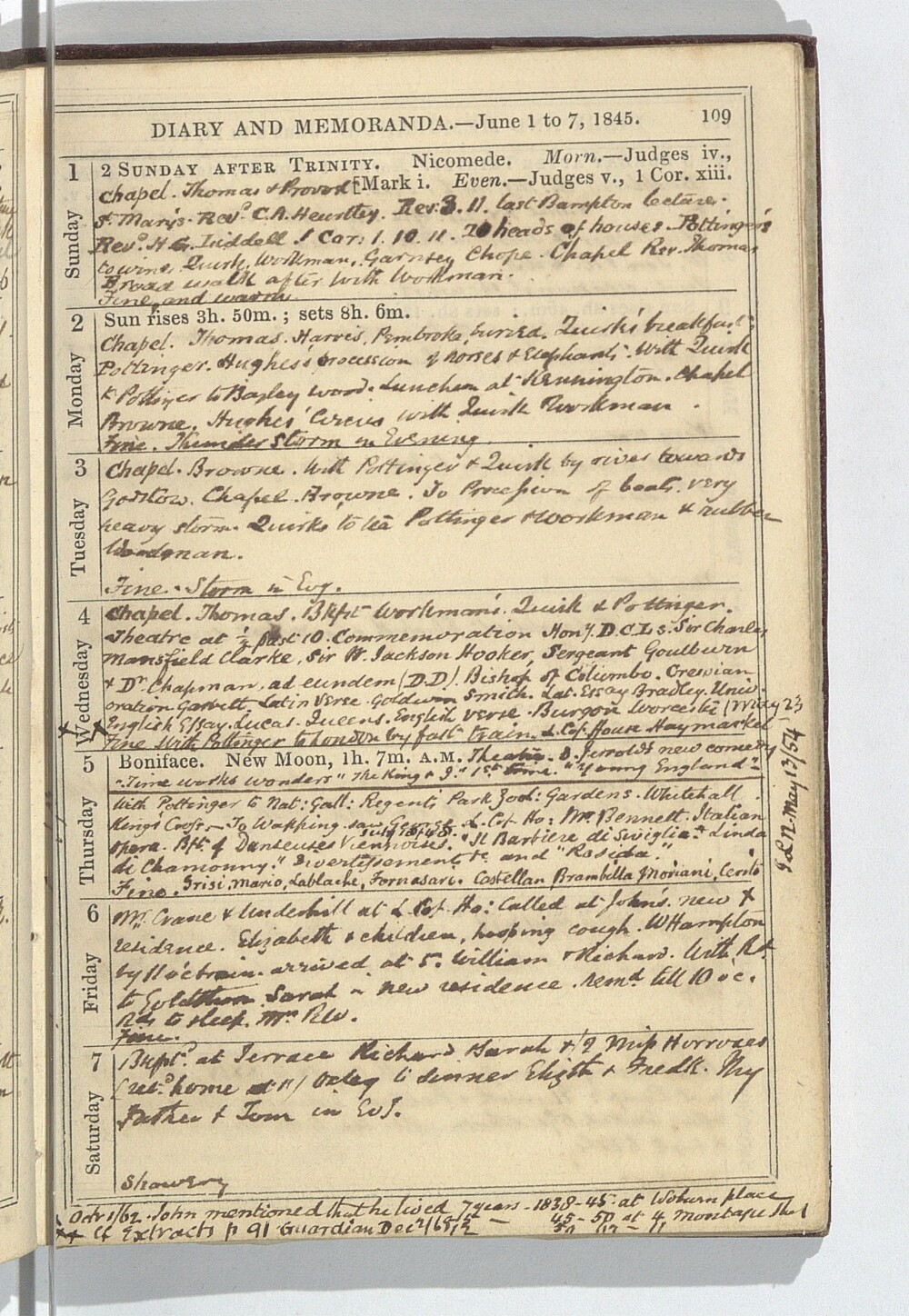
Punch’s Pocket Book’s signature two-part structure addressed a target audience of affluent, informed, and mobile businessmen as well as “readers of the necessary kitchen stuff,” as Henry Silver called them, that is their wives, children, servants, and suppliersHenry Silver. Complete transcript of Henry Silver’s diary by R. G. G. Price. Punch Archive. British Library, London. Entry for 18 November 1863.. Besides its recurrent mentions in the Morning Post (a Tory publication whose imperialist stance strengthened after Borthwick’s son, Algernon, assumed the editorship in 1852) and the Morning Advertiser (organ of the Licenced Victuallers’ Association), the Pocket Book was regularly advertised in such titles as the Atlas (1826–69), which included foreign and British news, parliamentary debates, literary correspondence, scientific notes, and finance; the Globe (1803–1921), a general coverage newspaper promoting the interests of the publishing trade; and the Pall Mall Gazette (1865–1923), “written by gentlemen for gentlemen” and largely aimed at an “elite readership concentrated in clubland.” The number of advertisements published in the Daily News, a Liberal publication advocating reform in social, political, and economic legislation, testifies to Bradbury and Evans’s large and politically diverse target audience. Out of the thirty volumes of the present collection, seven belonged to Sir Robert Chandler, a civil servant based at Stafford House (today Lancaster House), London, while another was owned by John Winston Spencer Churchill, seventh duke of Marlborough (1822-1883), a high-profile Conservative politician, former Lord President of the Council in Disraeli’s government (1867-1868) and father of Lord Randolph Henry Spencer-Churchill (1849-1895). A few volumes of this collection were owned by women, including the 1875 edition presented here, which belonged to an anglophone lady living in Paris, Mrs G. A. Anstey. Other collections include volumes formerly owned by women. Edith Agnew (1843-1910), daughter of Sarah and William Bradbury, was a Pocket Book user. Three of her volumes are today part of the Punch Archive at the British Library. As they transpire from handwritten entries, the occupations of pocket book owners encompassed all sectors of the Victorian middle- and upper-class, ranging from Eton student to military officer, physician, Fleet Street tailor, civil servant, and clergyman. Although a precise typology of users remains to be established, the archive testifies to a variety of responses to printed text. Many users wrote about the weather, social activities, and letters sent and received, dutifully respecting the space provided in the “Diary and Memoranda” section. Among the recurrent themes of such entries was public transport, railways in particular. Departure and arrival times are precisely recorded, reflecting both the efficiency of the developing network and the exactitude of the writer.
‘A way to invade a nation of shopkeepers, which Bonaparte never discovered’
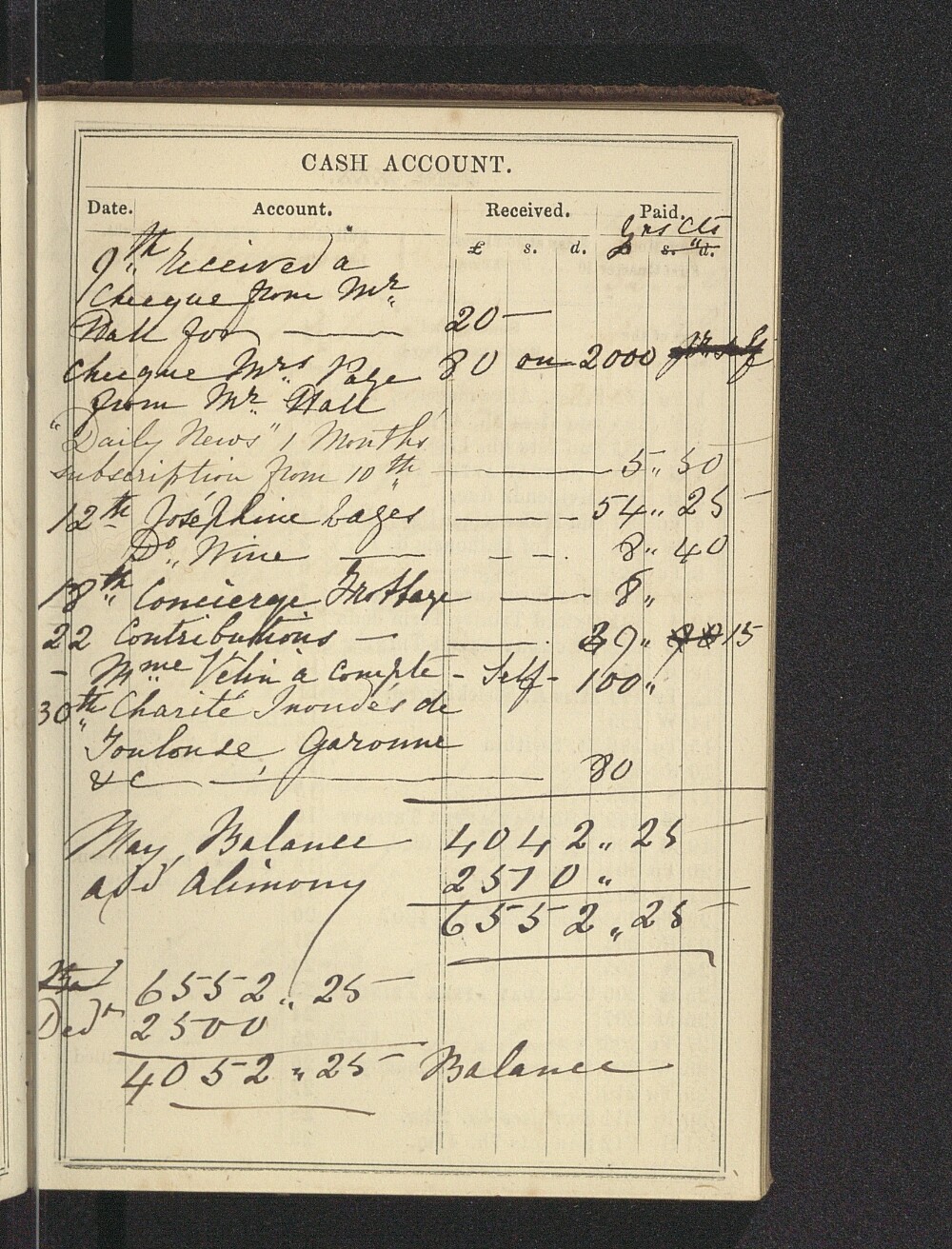
In a brief column about Punch’s Pocket Book, the Examiner wrote: “Punch is becoming a very important person; the scale of his designs grows manifestly larger and larger. To wait upon hours of leisure does not satisfy him; he must have his hunch in affairs of business. He thrusts his mirthful face into our diaries and memoranda, and with his jovial baton rules our cash accounts. It is the way to invade a nation of shopkeepers, which Bonaparte never discovered (…)“Punch’s Pocket Book for 1844,” The Examiner, 9 December 1843, p. 6..” The almanac-cash-account-memorandum sections certainly held a significant place in the pocket book, and went through several changes over time. In the early years of the pocketbook, 1843-1845, these pages were combined with Part II, suggesting a possible connection between light reading, entertainment, and private records. In the 1844 volume, for instance, the diary and memoranda pages are disseminated throughout a copious Part II (pp. 87-192). Between 1846 and 1871, the cash account, calendar, and diary and memoranda sections formed a substantial central booklet, emphasizing the distinction between “business and pleasure,” to quote F. C. BurnandFrancis C. Burnand, “The Punch Pocket Books.” Pall Mall Magazine 36 (August 1905): 190–97, p. 190.. The 1870s marked a break in the architecture and actual contents of Punch’s Pocket Book. The overall structure which had been remarkably stable for a quarter-century went through a noticeable period of instability, with repeated changes affecting the calendar, cash account, and diary and memoranda sections throughout the decade. From 1872, these hitherto distinct rubrics became combined into a single “time-keeping” segment. For each month, a double page spread displayed calendar, cash account, and diary and memoranda, all presented as double-column items. The daily slots of the former diary pages were now replaced by a weekly overview indicating only Sundays, and leaving very little room for users’ entries. This shift spectacularly reduced the volume of the segment, which, from a fleshy 77-page notebook between 1846 and 1871, suddenly dwindled to a 23-page jotter. A final change was made in the last four years of the pocketbook’s circulation, 1877-1881, during which period the diary and memoranda section recovered its initial layout, each page offering enough writing space for each day of the week. Accounting for this editorial decision is uneasy, but it does coincide with a marked decline in Punch’s Pocket Book’s sales. In these final years, figures show that about a fifth of the books printed remained unsoldBradbury, Agnew and Co., paper and print ledgers (1878–1890), Add MS 88937/19/13..
‘Joking in business is de trop’
Punch’s Pocket Book was finally abandoned in 1881, due to the high cost of publication combined with insufficient sales. The records for the late 1870s reflect a dwindling yearly production, which fell from 8,000 in 1876 to 7,100 in 1877, 6,000 in 1878, 4,500 in 1879, and finally less than 4,000 in 1880 and 1881. In his Records and Reminiscences, Francis C. Burnand suggests that the Pocket Book’s visual lavishness may have represented too heavy a financial burden at a time when similar but cheaper products were becoming available on the market: “The pocket-book was sold at half a crown, and cheap at the price in those days; but Punch’s Almanack gradually elbowed it out; and portable pocket-books containing all the information that businessmen might require could be had at a fifth of the price, though of course these latter made no sort of attempt at lightening dry facts with any humorous and artistic fancies. Where Mr Gradgrind rules, the best witticism is inopportune. Joking in business is de tropFrancis C. Burnand, Records and Reminiscences, Personal and General. Vol. 1. London : Methuen, 1904, p. 169..” Too expensive to be competitive with other pocket-sized books containing similar information, it was eventually absorbed into Punch’s Almanack, another product aimed at the end-of-year gift market. A unique publication with a wide appeal, Punch’s Pocket Book successfully responded to the expectations of the Victorian public for nearly forty years. Its “happy blending of the useful with the ornamental, business with amusement” struck a specific editorial note that met the needs of an evolving and mobile readership while allowing its authors and publishers to promote their work“Punch’s Pocket Book for 1846.” Naval & Military Gazette and Weekly Chronicle of the United Service, November 8, 1845, p. 12.. Ephemeral yet enduring and collectable, it filled a gap between fleeting cultural objects, such as the innumerable flyers and posters that covered urban Victorian walls, and long-lasting commodities. And while its shape and dimensions likened it to a notebook, its journalistic and literary contents aligned it with the illustrated press of the day, an echo and an utterance of the Victorian discursive community.
1.“With spirits buoyant and wit sparkling as when he first appeared, Punch diffuses merriment throughout every circle to which he comes.” The Globe, 5 November 1844, p. 1.
2.Celina Fox, Graphic Journalism in England during the 1830s and 1840s, London: Garland, 1988, p. 237.
3.Patrick Leary, The Punch Brotherhood Table Talk and Print Culture in Mid-Victorian London. The British Library, 2010, p. 11.
4.The so-called “taxes on knowledge” were duties on newspapers, their advertising content, and the paper they were printed on. In order to avoid the advertising charges, publishers circulated extracts from their products, without indicating a price. The advertisement duty was finally abolished in 1853, followed by newspaper stamp duty in 1855. The paper duty was removed in 1861.
5.Anon., “A Prize Baby Show,” Punch’s Pocket Book for 1855, p. 141.
6.Recent scholarship has shown the prescriptive effects of such a centripetal perspective, stressing the importance of the local and regional in the circulation of information throughout the Victorian era. See for instance Andrew Hobbs’s A Fleet Street in Every Town. The Provincial Press in England (Open Publishers, 2018), or William Hamish Fraser’s Edinburgh History of Scottish Newspapers, 1850-1950 (EUP, 2023).
7.Henry Silver. Complete transcript of Henry Silver’s diary by R. G. G. Price. Punch Archive. British Library, London. Entry for 18 November 1863.
8.“Punch’s Pocket Book for 1844,” The Examiner, 9 December 1843, p. 6.
9.Francis C. Burnand, “The Punch Pocket Books.” Pall Mall Magazine 36 (August 1905): 190–97, p. 190.
10.Bradbury, Agnew and Co., paper and print ledgers (1878–1890), Add MS 88937/19/13.
11.Francis C. Burnand, Records and Reminiscences, Personal and General. Vol. 1. London : Methuen, 1904, p. 169.
12.“Punch’s Pocket Book for 1846.” Naval & Military Gazette and Weekly Chronicle of the United Service, November 8, 1845, p. 12.