
Punch’s Pocket Book for 1875 – Introduction
The 1870s was a formative decade, both for Punch as a brand and for the structure and design of the Pocket Books; it was a decade of change for England too. From 1870, Shirley Brooks (1816 – 1874) succeeded Mark Lemon as Editor of Punch. From this time, the Pocket Books become longer, perhaps motivated by a desire to boost sales of the annual publication. Changes came with the organisation and management of the Punch office, with the Contributor Ledgers beginning to record contributors to the Pocket Book from 1872; a practice that continued until Brook’s death in 1874, through the tenure of Tom Taylor as Commander-in-Chief, until the appointment of F. C. Burnand as Editor in 1880. The Pocket Book ceased publication with the 1881 volume as the magazine and brand took new directions under the stricter controls of the new Editor. Correspondence from the Sambourne House and Archive shows Burnand’s relationship with contributors and artists was an authoritarian one, that he had a very specific idea of how he wanted things to run.
The contributors to the 1875 volume of the Pocket Book were Percival Leigh, Francis Cowley Burnand, Gilbert à Beckett, Henry Silver, Mortimer Collins, Richard Forster Sketchley and Tom Taylor. Of note is how little Sketchley contributed compared to earlier volumes. Collins was a new contributor to the Pocket Books from the small sample of attributions we have available at both the British Library and the LJMU Punch Contributor Ledgers Project; he continues to contribute a handful of pieces for 1876 and 1877, but is then no longer listed. Mortimer Collins, as Marion Spielmann identifies him in The History of Punch (1895), was by no means a prolific contributor. Collins began to contribute verse to the magazine from 1874, his final contribution being in 1876 before his premature death at the age of 49 in the summer of 1876. Spielmann does not mention the five pieces I have identified in the 1875 Pocket Book, thereby providing an opportunity to analyse previously unknown examples of Collins’ work. One of the main illustrators for the 1875 Pocket Book was Linley Sambourne who contributed to the Pocket Books from 1869 to 1881. Copies of his sketches are framed and displayed as part of the Sambourne House Archive and Museum in Kensington, London (see example below). The title page of the 1875 Pocket Book identifies it as illustrated by John Tenniel, Charles Keene, L. Sambourne &c., with the pull-out colour plate ‘The Androgynaceum Club’ initialled and attributed to Charles Keene. Sambourne’s illustrations were signed and those from the House and Archive correlate with those published in Part one of the Pocket Book. In Part two, all of the one-page plates are signed by Tenniel. The smaller illustration and decorative initial letters are not signed, therefore we are unable to assert who drew them.
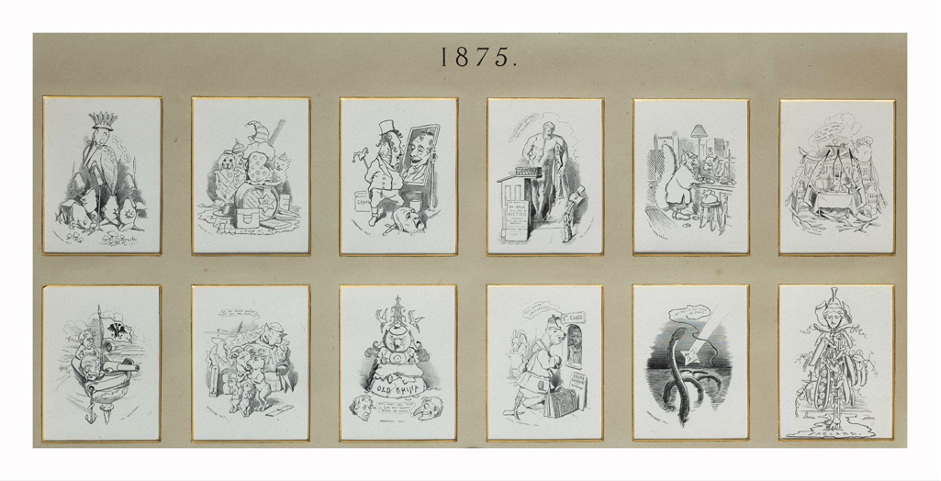
From the Contributor Ledgers we learn that production for the Pocket Books usually began in the October and November of the previous year. This correlates with data for 1875 taken from the Bradbury and Evans Publishing Account Ledger (British Library, Add MS 88937/19/6) which details that 1500 Show Cards were printed on 28 November to begin advertising the new Pocket Book. The practice of using show cards replaced the initial advertisements that ran in Punch magazine itself from 1842 to 1843, when the magazine continued advertising for the Almanack only. A mutual relationship was created between the Almanack and the Pocket Book from the 1840s with the Almanack taking the role of the more popular annual, designed to entertain the masses. The Pocket Book was a comparatively niche publication, created for “the reticule of the sovereign” and “the pocket of the Lord Mayor” (- ”Punch’s Pocket Book for 1843”! Punch, 3 (July-December 1842), p. 258); a distinct class of audience. This is reinforced by the cost of production for the small volume, with the ‘Paper and Print’ ledgers recording that the cost of 8,000 colour frontispieces in 1875, with composing, corrections, marking, pressing and working woodcuts cost £196 6s 9d.
As has become common practice, the title page of the Pocket Book is also illustrated in colour with Mr Punch himself introducing the volume; in this image he courteously holds a coat up on the shoulders of a lady in evening wear, his faithful companion, Toby, at his side. Distinct from the other volumes in our sample, here the contents page for Part One and Part Two lists both together. A section on the Sovereigns and Heads of Governments replaces the Sovereigns of Europe section in 1855, suggesting a shift in world politics and views post Crimean War. Compared with the earlier pilot website volumes (1845 and 1855), 1875 marks a distinct shift in illustrative approach. There are fewer small headers to introduce topics, favouring occasional full-page cuts instead. Opposite page 13, The Legislature, is a cut of Benjamin Disraeli, then Prime Minister, illustrated by Sambourne. Following the alphabetical list of the House of Commons, the 1875 provides an informative summary of Legislation of 1874 (the year in which the Pocket Book was published for the following year of 1875). Detailing Building Societies Acts, Working Men’s Dwellings Acts, the Licensing Act and key Metropolis Acts which informed the 1875 Centralisation Act the following year, this is an important contextual record for researchers of the period; the summaries span an impressive eight pages in total. The total of part one ranges over 73 pages, 20 longer than 1855. An alternation in formatting is apparent for 1875 - alongside the key dates for each month is a page for cash accounts. In 1855 these are detailed after the calendar dates of significance for each month. This suggests a conscious editing for efficiency and organisation. The Diary and Memoranda section concludes with a Marketing Table as it has from the earlier volumes.
For 1875, Part Two commences with the piece that directly corresponds to the frontispiece, a tradition continued from its origin. The only difference is that the contents page is now at the start of the volume. There is the usual mix of prose and verse and the practice of initial letters continues in Part Two, along with smaller illustrations, which were notably absent from the first section. Many of the initial letters appear to have a small cross in the bottom left corner. Cross referencing this with Spielmann’s (1895) Appendix of Signatures of Punch’s Artists in his history of Punch, would suggest that the illustrator was Charles Keene. This presents a distinct division of labour amongst the artists with Sambourne illustrating the large cuts for the first part, Tenniel the large cuts for the second part and Keene working on the frontispiece and majority of the illustrated letters. If other artists did contribute as the title page of the Pocket Book indicates by saying &c after these three main names, then they are not easily discernible from either the ledgers or the text itself. The volume closes with an “Adieu-Au Revoir’ from Mr Punch and Toby the Dog; the image, complete with a sketch of a closed Pocket Book, is signed by Charles Keene.