
Keywords
(Related Items)
To view the complete facsimile of this volume, click here
PUNCHS POCKET BOOK FOR 1845.
CONTAINING
RULED PAGES FOR CASH ACCOUNTS AND MEMORANDA
FOR EVERY DAY IN THE YEAR ;
An Almanack ;
and a variety of useful and valuable business information.
Illustrated with a coloured Frontispiece, six Steel Engravings by Leech and numerous Woodcuts.
IN TWO PARTS
PART I.
LONDON : PUNCH OFFICE, 194, STRAND.
AND SOLD BY ALL BOOKSELLERS.
[Price 2s. 6d.]
- [1v] -
{f.1v}
 [Interest table]
To see the content of the page, click here.
↑
- [3] -
{f.3}
 PART I.
THE STATE.
THE ROYAL FAMILY OF ENGLAND.
| Born. | |
| QUEEN ALEXANDRINA VICTORIA (Acc. June 20, 1837) | May 24, 1819 |
| Prince Albert Francis Augustus Charles Emanuel | Aug. 26, 1819 |
| Albert Edward, Prince of Wales | Nov. 9, 1841 |
| Albert Ernest Alfred | Aug. 6, 1844 |
| Victoria Adelaide Mary Louisa, Princess Royal | Nov. 21, 1840 |
| Alice Maud Mary | Apr. 25, 1843 |
| Dowager Queen Adelaide Amelia Louisa Teresa Caroline | Aug. 13, 1792 |
| Ernest Augustus, King of Hanover | June 5, 1771 |
| His Son, George Frederick | May 27, 1819 |
| Adolphus Frederick, Duke of Cambridge | Feb. 24, 1774 |
| His Son, George William Frederick | Mar. 26, 1819 |
| His Daughter, Augusta Caroline | July 19, 1822 |
| His Daughter, Mary Adelaide | Nov. 27, 1833 |
| Princess Mary, Duchess of Gloucester | Apr. 25, 1776 |
| Princess Sophia | Nov. 3, 1777 |
| Princess Sophia Matilda of Gloucester | May 29, 1773 |
| Victoria Maria Louisa, Duchess of Kent | Aug. 17, 1786 |
| Augusta Wilhelmina Louisa, Duchess of Cambridge | July 25, 1797 |
SOVEREIGNS OF EUROPE.
| Born. | Acces. | |||
| Austria-Bohemia | Ferdinand I. | Emperor | 1793 | 1835 |
| Baden | Charles Leopold | Grand Duke | 1790 | 1830 |
| Bavaria | Louis Charles | King | 1786 | 1826 |
| Belgium | Leopold I. | King | 1790 | 1831 |
|
- 4 -
↑
{f.4}
| Christian VIII. | King | 1786 | 1839 |
| England | Victoria | Queen | 1819 | 1837 |
| France | Louis Philippe I. | King | 1773 | 1830 |
| Greece | Otho | King | 1815 | 1832 |
| Hanover | Ernest | King | 1771 | 1837 |
| Hesse Darmstadt | Louis II. | Grand Duke | 1777 | 1830 |
| Hesse Cassel | William II. | Elector | 1777 | 1821 |
| Lucca | Charles Louis | Duke | 1799 | 1824 |
| Modena | Francis IV. | Duke | 1779 | 1815 |
| Naples and Sicily | Ferdinand II. | King | 1810 | 1830 |
| Netherlands | William II. | King | 1792 | 1840 |
| Parma | Maria Louisa | Duchess | 1791 | 1814 |
| Portugal | Maria da Gloria | Queen | 1819 | 1826 |
| Prussia-Brandenburg | Frederic IV. | King | 1795 | 1840 |
| Rome | Gregory XVI. | Pope | 1765 | 1830 |
| Russia and Poland | Nicholas I. | Emperor | 1796 | 1825 |
| Sardinia | Charles Albert | King | 1800 | 1831 |
| Saxony | Frederick Augustus | King | 1797 | 1836 |
| Spain | Isabella II. | Queen | 1830 | 1833 |
| Sweden and Norway | Oscar | King | 1844 | |
| Switzerland | Confederate Cantons | Landamman | — | |
| Turkey | Abdul Medjid | Grand Signior | 1823 | 1839 |
| Tuscany | Leopold II. | Grand Duke | 1797 | 1824 |
| Wurtemberg | William I. | King | 1781 | 1816 |
THE QUEEN’S MINISTERS.
The above form the Cabinet.
OFFICERS OF STATE IN SCOTLAND.
OFFICERS OF STATE IN IRELAND.
THE QUEEN’S HOUSEHOLD, &c.
PRINCE ALBERT’S HOUSEHOLD.
THE PRINCE OF WALES’S ESTABLISHMENT.
THE QUEEN DOWAGER’S HOUSEHOLD.
DUCHESS OF KENT’S HOUSEHOLD.
AMBASSADORS AND MINISTERS ABROAD.
| Austria | Rt. Hon. Sir R. Gordon |
| Bavaria | J. R. Milbanke, Esq. |
| Belgium | Sir G. H. Seymour |
| Brazil | H. C. J. Hamilton, Esq. |
| Colombia | W. Turner, Esq. |
| Denmark | Sir H. W. W. Wynn |
| France | Lord Cowley |
| Frankfort | Hon. W. T. H. Strangways |
| Greece | Sir E. Lyons, Bt. |
| Hanover | Hon. J. D. Bligh |
| Mexico | Chas. Bankhead, Esq. |
| Naples | Hon. W. Temple |
| Netherlands | Sir E. C. Disbrowe |
| Peru | W. Pitt Adams, Esq. |
| Portugal | Ld. Howard de Walden |
| Prussia | Earl of Westmoreland |
| Rio de la Plata | J. H. Mandeville, Esq. |
| Russia | Ld. Stuart de Rothesay |
| Sardinia | Hon. R. Abercromby |
| Saxony | Hon. F. R. Forbes |
| Spain | H. L. Bulwer, Esq. |
| Sweden | Sir T. Cartwright |
| Switzerland | D. R. Morier, Esq. |
| Turkey | Sir S. Canning |
| Tuscany | Lord Holland |
| United States | Rich. Pakenham, Esq. |
| Venezuela | B. H. Wilson, Esq. |
| Wurtemberg | Sir Alexander Males |
↑
- 7 -
{f.7}
 AMBASSADORS AND MINISTERS IN ENGLAND.
| Austria | Prince Esterhazy |
| Bavaria | Baron de Cetto |
| Belgium | M. Van de Weyer |
| Brazil | Marquess Lisboa |
| Colombia | |
| Denmark | Count Bille Brahe |
| France | Comte de St. Aulaire |
| Greece | Mons. Tricoupi |
| Hanover | Count Kielmansegge |
| Mexico | T. Murphy, Esq. |
| Netherlands | Chevalier Dedel |
| Portugal | Baron de Moncorvo |
| Prussia | Baron Bülow |
| Rio de la Plata | Don M. Moreno |
| Russia | Baron de Brunow |
| Sardinia | Count Pollon |
| Saxony | M. de Gersdorff |
| Sicilies | Prince de Castelcicala |
| Spain | Don de Pampillo |
| Sweden | Count Bjornstjerna |
| Switzerland | J. L. Prevost, Esq. |
| Turkey | Ali Effendi |
| United States | Edw. Everett, Esq. |
| Venezuela | M. Alejo Fortique |
| Wurtemberg | Count de Mandelsloh |
LORDS LIEUTENANT, &c., OF THE SEVERAL COUNTIES OF ENGLAND AND WALES.
ENGLAND.
WALES.
LORDS LIEUTENANT OF SCOTLAND.
LORDS LIEUTENANT OF IRELAND.
GOVERNMENT OFFICES AND OFFICERS.
treasury.
exchequer.
home office.
foreign office.
colonial office.
irish office.
board of trade.
board of control.
admiralty.
civil department.
Somerset House.
admiralty court.
judge advocate-general’s office.
war office.
paymaster-general’s office.
com. in chief’s office.
adjutant-general’s office.
quarter-master-general’s office.
board of ordnance.
woods and forests.
Rangers, Keepers, &c.
queen’s mint.
state paper office.
privy seal.
signet office.
general post-office.
custom house.
excise office.
stamp and tax office.
poor law commission.
tithe commission.
colonial land and emigration commissioners.
Government Emigration Office.
metropolis roads.
registry of metropolitan buildings.
general register office.
THE LEGISLATURE.
THE HOUSE OF PEERS
⁂ The titles here given are those by which the noblemen sit in the House of Peers.| Princes of the Blood Royal | 2 |
| Dukes | 20 |
| Marquises | 18 |
| Earls | 112 |
| Viscounts | 21 |
| Barons | 195 |
| Peers of Scotland (elected 1841) | 16 |
| Peers of Ireland (elected for life) | 28 |
| English Archbishops and Bishops | 26 |
| Irish representative Archbishops and Bishops | 4 |
| Total | 442 |
archbishops.
dukes.
marquises.
earls.
viscounts.
bishops.
barons.
PEERESSES.
PEERS WHO ARE MINORS.
OFFICERS OF THE HOUSE OF PEERS.
THE HOUSE OF COMMONS.
Speaker, Rt. Hon. Charles Shaw Lefevre.
ENGLAND AND WALES.
| English | County Members | 144 | 469 |
| Universities | 4 | ||
| Cities and Boroughs | 321 | ||
| Welsh | County Members | 15 | 29 |
| Cities and Boroughs | 14 | ||
| Scotch | County Members | 30 | 53 |
| Cities and Boroughs | 23 | ||
| Irish | County Members | 64 | 105 |
| University | 2 | ||
| Cities and Boroughs | 39 | ||
| Total Number of Members | 656 |
IRELAND
SCOTLAND.
ALPHABETICAL LIST OF THE HOUSE OF COMMONS.
(The figures refer to the previous list.)
| Acheson, Viscount | 285 |
| Ackers, Jas. | 148 |
| Acland, T. D. | 220 |
| Acland, Sir T. D., Bart. | 76 |
| A’Court, Capt. E. H. | 239 |
| Acton, Col. W. | 348 |
| Adare, Viscount | 96 |
| Adderley, C. B. | 224 |
| Aglionby, H. A. | 60 |
| Ainsworth, P. | 23 |
| Aldam, W. | 135 |
| Alexander, N. | 284 |
| Alford, Viscount | 14 |
| Allix, J. P. | 38 |
| Anson, Lt.-Col. Hon. G. | 225 |
| Antrobus, E. | 234 |
| Arbuthnot, Maj.-Gen. Hon. H. | 379 |
| Archbold, R. | 316 |
| Archdall, M. E. | 312 |
| Arkwright, Geo. | 139 |
| Armstrong, Sir. A., Bart. | 319 |
| Arundel and Surrey, Earl of | 5 |
| Ashley-Cooper, Hon. A. H. | 78 |
| Ashley, Lord | 79 |
| Astell, W. | 14 |
| Attwood, J. | 107 |
| Attwood, M. | 265 |
| Bagge, W. | 174 |
| Bagot, Hon. W. | 69 |
| Baillie, Col. H. D. | 115 |
| Baillie, H. J. jun. | 376 |
| Bailey, J. | 277 |
| Bailey, J. jun. | 112 |
| Baird, W. | 369 |
| Baldwin, C. B. | 246 |
| Balfour, J. M. jun. | 375 |
| Bankes, G. | 79 |
| Bannerman, A. | 351 |
| Barclay, D. | 233 |
| Baring, Maj. H. B. | 157 |
| Baring, Rt. Hon. F. T. | 197 |
| Baring, Hon. W. B. | 243 |
| Barnard, E. G. | 102 |
| Barneby, J. | 275 |
| Barrington, Visc. | 16 |
| Barron, Sir H. W., Bt. | 344 |
| Baskerville, Th. B. M. | 112 |
| Bateson, T. | 325 |
| Beckett, W. | 135 |
| Bell, J. | 244 |
| Bell, M. | 180 |
| Bellew, R. M. | 328 |
| Benbow, John | 82 |
| Benett, J. | 270 |
| Bentinck, Lord G. | 127 |
| Beresford, Major W. | 107 |
| Berkeley, Hon. G. C. G. F. | 98 |
| Berkeley, Hon. C. F. | 51 |
| Berkeley, Hon. F. H. F. | 32 |
| Berkeley, Capt. M. F. | 99 |
| Bernal, Ralph | 263 |
| Bernard, Viscount | 288 |
| Blackburne, J. I. | 254 |
| Blackstone, W. S. | 251 |
| Blake, M. J. | 314 |
| Blake, Sir V., Bart. | 314 |
| Blake, M. | 330 |
| Blakemore, R. | 258 |
| Blandford, Marquis of | 274 |
| Blewitt, R. J. | 165 |
| Bodkin, J. J. | 313 |
| Bodkin, W. H. | 206 |
| Boldero, Capt. H. G. | 56 |
| Borthwick, P. | 88 |
| Botfield, B. | 148 |
| Bouverie, —. | 378 |
| Bowes, John | 84 |
| Bowles, Admiral W. | 134 |
| Bowring, J., LLD. | 23 |
| Boyd, John | 297 |
| Bradshaw, J. | 41 |
| Bramston, T. W. | 87 |
| Bridgeman, H. | 310 |
| Bright, John | 85 |
| Brisco, Musgrave | 108 |
| Broadley, H. | 280 |
| Broadwood, H. | 29 |
| Brocklehurst, J. | 151 |
| Brooke, Sir A. B. Bart. | 312 |
| Brotherton, Joseph | 209 |
| Browne, R. D. | 330 |
| Browne, Hon. W. | 315 |
| Brownrigg, J. S. | 24 |
| Bruce, Lord E. A. C. B. | 157 |
| Bruce, C. L. C. | 367 |
| Bruen, Col. H. | 290 |
| Bruges, Ludlow | 74 |
| Buck, L. W. | 76 |
| Buckley, E. | 170 |
| Bulkeley, Sir R. B. W. Bart. | 93 |
| Buller, C. jun. | 145 |
| Buller, E. | 226 |
| Buller, Sir J. B. Y. Bart. | 77 |
| Bunbury, T. | 290 |
| Burrell, Sir C. M. Bt. | 215 |
| Burroughes, H. N. | 173 |
| Busfeild, W. | 25 |
| Butler, Hon. P. | 317 |
| Butler, P. S. | 317 |
| Byng, George | 162 |
| Byng, Rt. Hon. G. S. | 50 |
| Callaghan, D. | 299 |
| Campbell, J. H. | 210 |
| Campbell, Sir H. Bart. | 358 |
| Cardwell, Edw. | 59 |
| Carew, Hon. R. S. | 343 |
| Carnegie, Hon. S. T. | 226 |
| Cartwright, W. R. | 177 |
| Castlereagh, Visc. | 302 |
| Cave, Hon. R. O. | 340 |
| Cavendish, Hon. G. H. | 71 |
| Cavendish, Hon. C. C. | 349 |
| Cayley, E. S. | 282 |
| Chapman, Aaron | 264 |
| Chapman, B. J. | 345 |
| Charteris, Hon. F. | 97 |
| Chelsea, Visc. | 201 |
| Chetwode, Sir J. Bart. | 34 |
|
- 21 -
{f.21}
| 155 |
| Cholmondeley, Hon. Hugh | 167 |
| Christie, Wm. D. | 263 |
| Christopher, R. A. | 142 |
| Chute, W. L. W. | 174 |
| Clay, Sir W. Bart. | 247 |
| Clayton, R. R. | 8 |
| Clements, Visc. | 321 |
| Clerk, Sir G. Bart. | 227 |
| Clifton, Jno. Talbot, | 131 |
| Clive, Visc. | 217 |
| Clive, Hon. R. H. | 218 |
| Clive, E. B. | 111 |
| Cobden, R. | 228 |
| Cochrane, A. D. R. W. | 30 |
| Cockburn, Sir G. | 204 |
| Codrington, C. W. | 97 |
| Colborne, Hon. W. N. R. | 203 |
| Cole, Hon. H. A. | 311 |
| Colebrooke, Sir T. E. Bt. | 241 |
| Collett, John | 287 |
| Collett, W. R. | 144 |
| Collins, W. | 257 |
| Colquhoun, J. C. | 170 |
| Colville, C. R. | 72 |
| Compton, H. C. | 106 |
| Conolly, Col. E. M. | 300 |
| Coote, Sir C. H. Bart. | 336 |
| Copeland, Ald. W. T. | 229 |
| Corbally, M. E. | 331 |
| Corry, Rt. Hon. H. T. | 342 |
| Courtenay, Lord | 77 |
| Cowper, Hon. W. F. | 114 |
| Craig, W. G. | 366 |
| Crawford, W. S. | 205 |
| Cresswell, A. J. B. | 179 |
| Cripps, W. | 58 |
| Currie, Raikes | 178 |
| Curteis, H. B. | 208 |
| Dalmeny, Lord | 396 |
| Dalrymple, Capt. J. | 399 |
| Damer, Rt. Hon. Col. G. L. D. | 335 |
| Darby, George | 236 |
| Dashwood, G. H. | 278 |
| Davies, D. A. S. | 46 |
| Dawnay, Hon. W. H. | 207 |
| Dawson, Hon. T. V. | 328 |
| Denison, W. J. | 235 |
| Denison, E. B. | 281 |
| Denison, J. E. | 155 |
| Dennistoun, J. | 372 |
| D’Eyncourt, Rt. Hon. C. T. | 130 |
| Dick, Q. | 153 |
| Dickinson, F. H. | 220 |
| Disraeli, Benj. | 216 |
| Divett, Edward | 89 |
| Dodd, George | 152 |
| Douglas, J. D. S. | 206 |
| Douglas, Sir C. E. | 257 |
| Douglas, Sir Howard | 146 |
| Douro, Marquis of | 181 |
| Dowdeswell, W. | 242 |
| Drax, J. S. W. S. E. | 253 |
| Drummond, H. H. | 389 |
| Duff, J. | 356 |
| Dugdale, W. S. | 255 |
| Duke, Sir J. | 24 |
| Duncan, Visc. | 12 |
| Duncan, G. | 364 |
| Duncombe, Hon. O. | 282 |
| Duncombe, Capt. Hon. Arth. | 11 |
| Duncombe, T. S. | 91 |
| Dundas, Hon. J. C. | 203 |
| Dundas, David | 397 |
| Dundas, F. | 386 |
| Dundas, Capt. J. W. | 102 |
| Dunn-Gardner, John | 22 |
| Dupré, C. G. | 33 |
| East, J. B. | 271 |
| Easthope, Sir J. Bart. | 138 |
| Eastnor, Visc. | 202 |
| Eaton, Capt. R. J. | 38 |
| Ebrington, Visc. | 194 |
| Egerton, W. T. | 52 |
| Egerton, Lord F. L. | 132 |
| Egerton, Sir P. de Malpas G. Bart. | 53 |
| Eliot, Lord | 63 |
| Ellice, Rt. Hon. E. | 64 |
| Ellice, E. jun. | 352 |
| Ellis, W. | 138 |
| Elphinstone, H. | 140 |
| Entwisle, J. | 132 |
| Emlyn, Visc. | 189 |
| Escott, B. | 271 |
| Esmonde, Sir T. Bart. | 347 |
| Estcourt, T. G. B. | 188 |
| Etwall, Ralph | 3 |
| Evans, W. | 71 |
| Ewart, W. | 363 |
| Farnham, E. B. | 136 |
| Feilden, W. | 21 |
| Fellowes, E. | 118 |
| Ferguson, Sir R. A. Bt. | 326 |
| Ferguson, Lt.-Col. R. | 380 |
| Ferrand, W. B. | 129 |
| Ffolliott, John | 338 |
| Fielden, John | 185 |
| Filmer, Sir E. Bt. | 125 |
| Fitzmaurice, Hon. Capt. W. E. | 33 |
| Fitzroy, Rt. Hon. Ld. C. | 36 |
| Fitzroy, Hon. H. | 140 |
| Fitzwilliam, Hon. G. W. | 192 |
| Fleetwood, Sir H. Bt. | 198 |
| Flower, Sir J. Bart. | 243 |
| Follett, Sir W. W. | 89 |
| Forbes, W. | 395 |
| Forester, Capt. Hon. G. C. W. | 259 |
| Forman, T. S. | 29 |
| Forster, M. | 17 |
| Fox, Col. C. R. | 247 |
| Fox, Sackville Lane | 121 |
| Fremantle, Sir T. F. Bt. | 34 |
| French, F. | 337 |
| Fuller, A. E. | 236 |
| Gaskell, J. M. | 259 |
| Gibson, T. M. | 156 |
| Gill, T. | 194 |
| Gisborne, jun. T. | 184 |
| Gladstone, Capt. J. N. | 121 |
| Gladstone, Rt. Hon. W. E. | 169 |
| Glynne, Sir S. R. | 92 |
| Godson, R. | 126 |
| Gordon, Capt. Hon. W. | 350 |
| Gore, M. | 10 |
| Gore, Hon. R. | 334 |
| Gore, W. O. | 217 |
| Gore, W. R. O. | 338 |
| Goring, C. | 215 |
| Goulburn, Rt. Hon. H. | 39 |
| Graham, Rt. Hon. Sir J. R. G. Bart. | 78 |
| Granby, Marquis of | 227 |
| Graneer, T. C. | 85 |
| Grattan, H. | 331 |
| Greenall, P. | 266 |
| Greenaway, C. | 139 |
| Greene, T. | 133 |
| Gregory, Wm. H. | 305 |
| Grey, Rt. Hon. Sir G. Bt. | 75 |
| Grimsditch, T. | 151 |
| Grimston, Visc. | 113 |
| Grogan, E. | 305 |
| Grosvenor, Lord R. | 54 |
| Guest, Sir J. J. Bart. | 161 |
| Hale, R. B. | 98 |
| Halford, H. | 137 |
| Hall, Sir. B. Bart. | 159 |
| Hallyburton, Ld. J. F. G. | 371 |
| Hamilton, Lord C. | 342 |
| Hamilton, Capt. C. J. B. | 8 |
| Hamilton, G. A. | 306 |
| Hamilton, J. H. | 304 |
| Hamilton, W. J. | 172 |
| Hampden, R. | 158 |
| Hanmer, Sir J. Bart. | 128 |
| Harcourt, G. G. | 186 |
| Hardy, J. | 25 |
| Harris, Capt. | 57 |
| Hastie, A. | 387 |
| Hatton, Capt. V. F. | 346 |
| Hawes, Benj. jun. | 130 |
| Hay, Sir A. L. | 368 |
| Hayes, Sir E. S. Bart. | 300 |
| Hayter, W. G. | 258 |
| Heathcoat, John | 245 |
| Heathcote, G. J. | 207 |
| Heathcote, Sir W. Bart. | 105 |
| Heneage, E. | 101 |
| Heneage, G. H. W. | 74 |
| Henley, J. W. | 186 |
| Henniker, Lord | 231 |
| Hepburn, Sir T. B. Bt. | 374 |
| Herbert, Hon. S. | 270 |
| Heron, Sir R. Bart. | 192 |
| Hervey, Lord A. | 31 |
| Hill, Lord M. | 88 |
| Hillsborough, E. of | 302 |
| Hinde, J. Hodgson | 171 |
|
- 22 -
{f.22}
| 7 |
| Hobhouse, Rt. Hon. Sir J. C. Bart. | 184 |
| Hodgson, F. | 10 |
| Hodgson, R. | 17 |
| Hogg, J. W. | 18 |
| Hollond, R. | 108 |
| Holmes, Hon. W. H. A. à Court | 267 |
| Hope, Hon. Charles | 384 |
| Hope, A. J. B. | 152 |
| Hope, G. Wm. | 221 |
| Hornby, John | 21 |
| Horsman, E. | 60 |
| Hoskins, K. | 112 |
| Hotham, Lord | 280 |
| Houldsworth, T. | 182 |
| Howard, Sir R. Bart. | 348 |
| Howard, P. H. | 45 |
| Howard, Capt. Hon. E. G. G. | 168 |
| Howard, Hon. C. W. G. | 66 |
| Howard, Capt. Hon. H. | 65 |
| Howard, Hon. J. K. | 154 |
| Howard, Lord | 213 |
| Howick, Visc. | 233 |
| Hughes, W. B. | 49 |
| Hume, Joseph | 385 |
| Humphery, John | 223 |
| Hurst, Robt. H. | 116 |
| Hussey, Ambrose | 210 |
| Hussey, Thomas | 149 |
| Hutt, William | 95 |
| Ingestre, Visc. | 225 |
| Inglis, Sir R. H. Bart. | 188 |
| Irton, S. | 67 |
| Irving, J. | 284 |
| James, W. | 66 |
| James, Sir W. C. Bart. | 128 |
| Jermyn, Earl | 36 |
| Jervis, J. | 54 |
| Jocelyn, Visc. | 127 |
| Johnson, Maj.-Gen. | 185 |
| Johnstone, J. J. H. | 362 |
| Johnstone, Sir J. V. B. Bart. | 212 |
| Jolliffe, Sir W. G. Bart. | 193 |
| Jones, Capt. T. | 325 |
| Kelly, Fitzroy | 40 |
| Kelly, James | 323 |
| Kemble, H. | 234 |
| Kerr, D. S. | 301 |
| Kerrison, Sir E. Bart. | 90 |
| Kirk, P. | 292 |
| Knatchbull, Rt. Hon. Sir E. Bart. | 124 |
| Knight, H. G. | 182 |
| Knight, F. W. | 276 |
| Knightley, Sir C. Bart. | 177 |
| Labouchere, Rt. Hon. H. | 241 |
| Lambton, H. | 83 |
| Langston, J. H. | 187 |
| Langton, Col. W. G. | 219 |
| Lascelles, Hon. W. S. | 250 |
| Law, Hon. C. E. | 39 |
| Lawson, A. | 129 |
| Layard, Capt. B. V. | 291 |
| Leader, J. T. | 261 |
| Lefevre, Rt. Hon. C. S. (Speaker) | 105 |
| Lefroy, Anthony | 327 |
| Legh, G. C. | 52 |
| Lemon, Sir C. Bart. | 62 |
| Lennox, Lord A. | 55 |
| Leslie, C. Powell | 332 |
| Leveson, Lord | 141 |
| Liddell, Hon H. T. | 83 |
| Lincoln, Earl of | 183 |
| Lindsay, H. H. | 211 |
| Listowel, Earl of | 2 |
| Loch, James | 398 |
| Lockhart, W. | 382 |
| Long, W. | 269 |
| Lopes, Sir R. Bart. | 260 |
| Lowther, Lt.-Col. Hon. H. C. | 262 |
| Lowther, J. H. | 283 |
| Lyall, G. | 147 |
| Lygon, Maj. Gen. Hon. H. B. | 276 |
| Macaulay, Rt. Hon. T. B. | 366 |
| MacGeachy, F. A. | 115 |
| Mackenzie, T. | 392 |
| Mackenzie, W. F. | 388 |
| Mackinnon, W. A. | 150 |
| Maclean, D. | 187 |
| Macnamara, Maj. W. | 295 |
| McNeill, Rt. Hon. D. | 353 |
| McTaggart, Sir J. Bart. | 400 |
| Maher, N. | 340 |
| Mahon, Viscount | 114 |
| Mainwaring, T. | 70 |
| Mangles, Capt. R. D. | 103 |
| Manners, Lord C. S. | 136 |
| Manners, Lord J. | 169 |
| March, Earl of | 237 |
| Marjoribanks, S. | 120 |
| Marshall, W. | 45 |
| Marsham, Visc. | 125 |
| Marsland, H. | 228 |
| Martin, C. W. | 172 |
| Martin, J. | 242 |
| Martin, T. B. | 313 |
| Marton, G. | 133 |
| Masterman, J. | 147 |
| Matheson, James | 6 |
| Maule, Rt. Hon. F. | 389 |
| Maunsell, T. P. | 176 |
| Maxwell, Hon. Capt. J. P. | 294 |
| Meynell, Capt. H. | 324 |
| Mildmay, H. St. John | 221 |
| Miles, P. W. S. | 32 |
| Miles, W. | 219 |
| Milnes, R. M. | 195 |
| Mitcalfe, H. | 249 |
| Mitchell, T. A. | 30 |
| Mordaunt, Sir J. Bart. | 256 |
| Morgan, C. M. R. | 27 |
| Morgan, Ch. O. S. | 164 |
| Morison, Major-Gen. W. | 360 |
| Morris, D. | 47 |
| Morrison, James | 377 |
| Mundy, E. M. | 72 |
| Muntz, G. F. | 20 |
| Murphy, F. S. | 299 |
| Murray, Alex. | 381 |
| Murray, C. R. S. | 33 |
| Napier, Sir C. | 159 |
| Neeld, Joseph | 56 |
| Neeld, John | 65 |
| Neville, R. | 272 |
| Newdegate, Charles Newdegate | 255 |
| Newport, Viscount | 218 |
| Newry & Morne, Visc. | 333 |
| Nicholl, Rt. Hon. J. | 42 |
| 329 | |
| Norreys, Lord | 186 |
| Northland, Viscount | 308 |
| O’Brien, W. S. | 322 |
| O’Brien, C. | 295 |
| O’Brien, A. S. | 176 |
| O’Brien, J. | 323 |
| O’Connell, D. | 298 |
| O’Connell, M. | 341 |
| O’Connell, J. | 318 |
| O’Connell, M. J. | 315 |
| O’Connor, D. | 337 |
| O’Ferrall, R. M. | 316 |
| Ogle, S. C. H. | 179 |
| Ord, W. | 171 |
| Osborne, Capt. R. | 278 |
| Ossulston, Lord | 179 |
| Oswald, Alex. | 354 |
| Oswald, James | 372 |
| Owen, Sir J. Bart. | 190 |
| Packe, C. W. | 137 |
| Paget, Lt.-Col F. | 13 |
| Paget, Lord A. H. | 141 |
| Paget, Lord W. | 3 |
| Pakington, J. S. | 81 |
| Palmer, R. | 16 |
| Palmer, G. | 87 |
| Palmerston, Viscount | 245 |
| Parker, John | 214 |
| Patten, J. W. | 131 |
| Pattison, James | 147 |
| Pechell, Capt. G. R. | 31 |
| Peel, Rt. Hon. Sir R. Bt. | 239 |
| Peel ; Colonel J. | 119 |
| Pendarves, E. W. W. | 62 |
| Pennant, Hon. E. G. D. | 48 |
| Philips, M. | 156 |
| Philips, G. R. | 196 |
| Philipps, Sir R. B. P. Bt. | 109 |
| Phillpotts, J. | 99 |
| Pigot, Sir R. Bart. | 28 |
| Pigot, Rt. Hon. D. R. | 296 |
| Plumptre, J. P. | 124 |
| Plumridge, Capt. J. H. | 191 |
| Polhill, Captain F. | 15 |
| Pollington, Viscount | 195 |
| Pollock, Sir F. | 119 |
|
- 23 -
↑
{f.23}
| 73 |
| Ponsonby, Hon. C. F. A. C. | 196 |
| Powell, Col. W. E. | 43 |
| Powell, C. | 322 |
| Power, J. | 346 |
| Praed, W. T. | 122 |
| Price, R. | 200 |
| Pringle, A. | 394 |
| Protheroe, E. | 104 |
| Pryse, P. | 44 |
| Pulsford, R. | 111 |
| Pusey, P. | 16 |
| Ramsay, W. R. | 365 |
| Ramsbottom, J. | 272 |
| Rashleigh, W. | 63 |
| Rawdon, Lt.-Col. J. D. | 286 |
| Redington, T. N. | 307 |
| Reid, Sir J. R. Bart. | 80 |
| Rendlesham, Lord | 231 |
| Repton, G. W. J. | 2 |
| Ricardo, J. L. | 229 |
| Rice, E. R. | 80 |
| Richards, R. | 160 |
| Roche, E. B. | 298 |
| Roebuck, J. A. | 12 |
| Rolleston, Col. L. | 183 |
| Ross, David R. | 289 |
| Round, J. | 153 |
| Round, C. G. | 86 |
| Rous, Capt. Hon. H. J. | 261 |
| Rumbold, C. E. | 279 |
| Rushbrooke, Lt.-Col. R. | 232 |
| Russell, Lord J. | 147 |
| Russell, C. | 201 |
| Russell, Lord E. | 240 |
| Russell, J. D. W. | 224 |
| Rutherfurd, A. | 383 |
| Ryder, Hon. G. D. | 113 |
| Sanderson, R. | 61 |
| Sandon, Viscount | 146 |
| Scott, R. | 252 |
| Scott, Hon. F. | 393 |
| Scrope, G. P. | 230 |
| Seale, Sir J. H. Bart. | 68 |
| Seymour, Lord | 246 |
| Seymour, Sir H. B. | 163 |
| Shaw, Rt. Hon. F. | 306 |
| Sheil, Rt. Hon. R. L. | 309 |
| Shelburne, Earl of | 37 |
| Sheppard, T. | 94 |
| Shirley, E. J. | 256 |
| Shirley, E. P. | 332 |
| Sibthorp, Colonel | 144 |
| Smith, A., | 113 |
| Smith, B., | 181 |
| Smith, J. A. | 55 |
| Smith, R. V. | 178 |
| Smith, Rt. Hon. T. B. C. | 204 |
| Smollett, Alexander | 361 |
| Smyth, Sir G. H. Bart. | 61 |
| Smythe, Hon. G. S. | 41 |
| Somers, John Patrick | 339 |
| Somerset, Lord Granville | 164 |
| Somerton, Viscount | 268 |
| Somerville, Sir W. M. Bt. | 303 |
| Sotheron, T. H. S. | 269 |
| Spooner, R. | 20 |
| Spry, Sir S. T. | 22 |
| Standish, Chas. | 266 |
| Stanley, Edw. | 67 |
| Stanley, Hon. W. O. | 4 |
| Stansfield, W. R. C. | 117 |
| Stanton, W. H. | 230 |
| Staunton, Sir G. T. Bt. | 197 |
| Stewart, John | 150 |
| Stewart, P. W. | 391 |
| Stock, Joseph, LL. D. | 293 |
| Strickland, Sir G. Bart. | 198 |
| Strutt, Edw. | 73 |
| Stuart, Henry | 15 |
| Stuart, Lord J. C. | 355 |
| Stuart, Wm. Villiers | 343 |
| Sturt, H. C. | 79 |
| Sutton, Hon. J. Manners | 40 |
| Talbot, C. R. M. | 96 |
| Tancred, H. W. | 9 |
| Taylor, James Arthur | 275 |
| Taylor, Capt. T. E. | 304 |
| Tennent, J. Emerson | 289 |
| Thesiger, Sir Frederick | 1 |
| Thompson, Ald. W. | 262 |
| Thorneley, Thomas | 273 |
| Thornhill, George | 118 |
| Tollemache, F. J. | 100 |
| Tollemache, John | 53 |
| Tomline, George | 216 |
| Towneley, John | 18 |
| Traill, George | 359 |
| Trelawney, John S. | 240 |
| Trench, Maj.-Gen. Sir F. | 212 |
| Trevor, Hon. G. R. R. | 46 |
| Trollope, Sir John, Bart. | 143 |
| Trotter, John | 235 |
| Troubridge, Sir E. T. Bt. | 211 |
| Tufnell, Henry | 75 |
| Tuite, Hugh Morgan | 345 |
| Turner, Edmund | 248 |
| Turnor, Christopher | 143 |
| Tyrell, Sir J. T. Bart. | 86 |
| Vane, Lord Harry | 84 |
| Verner, Lt.-Col. | 285 |
| Vernon, G. H. | 11 |
| Vesey, Hon. Thomas | 336 |
| Villiers, Hon. Chas. P. | 273 |
| Villiers, Lord | 58 |
| Vivian, Capt. J. C. W. | 191 |
| Vivian, John Henry | 238 |
| Vivian, John Ennis | 248 |
| Vyvyan, Sir R. R. Bart. | 110 |
| Waddington, H. S. | 232 |
| Wakley, Thos. | 91 |
| Walker, Richard | 35 |
| Wall, Chas. B. | 103 |
| Wallace, Robt. | 373 |
| Walsh, Sir J. B. Bart. | 199 |
| Warburton, H. | 123 |
| Ward, H. G. | 214 |
| Watson, W. H. | 320 |
| Wawn, J. T. | 222 |
| Welby, G. E. | 100 |
| Wellesley, Lord Chas. | 106 |
| Wemyss, Capt. J. E., R. N. | 370 |
| Westenra, Lt.-Col. Hon. J. C. | 319 |
| White, Samuel | 321 |
| White, Col. Henry | 327 |
| Whitmore, T. C. | 28 |
| Wilde, Sir Thomas | 277 |
| Williams, T. P. | 158 |
| Williams, William | 64 |
| Wilshere, William | 279 |
| Winnington, Sir T. E. Bt. | 19 |
| Wodehouse, Edmond | 173 |
| Wood, Col. Thomas | 26 |
| Wood, Lt.-Col. T. jun. | 162 |
| Wood, Benjamin | 223 |
| Wood, Charles | 104 |
| Worsley, Lord | 142 |
| Wortley, Hon. John S. | 281 |
| Wortley, Hon. Jas. S. | 357 |
| Wrightson, W. B. | 175 |
| Wyndham, Col. Chas. | 237 |
| Wynn, Rt. Hon. C. W. W. | 166 |
| Wynn, Sir W. W. Bart. | 69 |
| Wyse, Thomas | 344 |
| Yorke, Hon. E. T. | 33 |
| Yorke, H. G. R. | 283 |
| Young, John | 294 |
OFFICERS OF THE HOUSE OF COMMONS.
THE POPULATION.[Comment by SL] : This section was introduced in the 1844 pocket book but only continued for one year. It is worth noting that 1845 marked the onset of the Great Irish Famine (also known in Ireland as 'An Gorta Mór'). Between 1845 and 1852, the long-standing negligence of British government policy in Ireland resulted in national catastrophe when Irish potato crops began to fail due to an infection known as blight. Described by Kevin Whelan as 'the single most important event in Ireland in the modern period' (137), the Famine resulted in the death of over 1 million people and the emmigration of over 2 million. Within this context, it is possible that the publishers chose to omit census data from their pocket books from 1846 onwards, especially as such data could contradict Punch's polemical representations of The Famine across its various publications. For further information, see Kevin Whelan, 'The Cultural Effects of the Famine,' in The Cambridge Companion to Modern Irish Culture, eds. Joe Cleary and Claire Connolly (Cambridge University Press, 2005), 137-54; Leslie A. Williams, Daniel O'Connell, The British Press and The Irish Famine: Killing Remarks (Ashgate, 2003).
TOTAL OF POPULATION IN COUNTIES.
ENGLAND.
| Bedford | 107,937 |
| Berks | 160,226 |
| Buckingham | 155,989 |
| Cambridge | 164,509 |
| Chester | 395,300 |
| Cornwall | 341,269 |
| Cumberland | 177,912 |
| Derby | 272,202 |
| Devon | 533,731 |
| Dorset | 174,743 |
| Durham | 324,277 |
| Essex | 344,995 |
| Gloucester | 431,307 |
| Hereford | 114,438 |
| Hertford | 157,237 |
| Huntingdon | 58,699 |
| Kent | 548,161 |
| Lancaster | 1,667,064 |
| Leicester | 215,855 |
| Lincoln | 362,717 |
| Middlesex | 1,576,616 |
| Monmouth | 134,349 |
| Norfolk | 412,621 |
| Northampton | 199,061 |
| Northumberland | 250,268 |
| Nottingham | 249,773 |
| Oxford | 161,573 |
| Rutland | 21,340 |
| Salop | 239,014 |
| Somerset | 436,002 |
| 354,940 | |
| Stafford | 510,206 |
| Suffolk | 315,129 |
| Surrey | 582,613 |
| Sussex | 299,770 |
| Warwick | 402,121 |
| Westmoreland | 56,469 |
| Wilts | 260,007 |
| Worcester | 233,484 |
| York (E. Riding) | 193,676 |
| City of York & Ainstey | 38,322 |
| York (N. Riding) | 204,662 |
| York (W. Riding) | 1,154,924 |
| Total Population of England | 14,995,508 |
WALES.
| Anglesey | 50,890 |
| Brecon | 53,295 |
| Cardigan | 68,380 |
| Caermarthen | 106,482 |
| Caernarvon | 81,068 |
| Denbigh | 89,291 |
| Flint | 66,547 |
| Glamorgan | 173,462 |
| Merioneth | 39,238 |
| Montgomery | 69,220 |
| Pembroke | 88,262 |
| Radnor | 25,186 |
| Total Population of Wales | 911,321 |
↑
- 25 -
{f.25}
 SCOTLAND.
| Aberdeen* | 192,283 |
| Argyll | 97,140 |
| Ayr* | 164,522 |
| Banff | 50,076 |
| Berwick | 34,427 |
| Bute | 15,695 |
| Caithness | 36,197 |
| Clackmannan | 19,116 |
| Dumbarton* | 44,295 |
| Dumfries | 72,825 |
| Edinburgh* | 225,623 |
| Elgin (Moray) | 34,994 |
| Fife* | 140,310 |
| Forfar* | 170,400 |
| Haddington | 35,781 |
| Inverness* | 97,615 |
| Kincardine | 33,052 |
| Kinross | 8,763 |
| Kircudbright, Stewartry of | 41,099 |
| Lanark* | 427,113 |
| Linlithgow* | 26,848 |
| Nairn | 9,218 |
| Orkney & Shetland* | 60,796 |
| Peebles | 10,520 |
| Perth* | 138,151 |
| Renfrew* | 154,755 |
| Ross and Cromarty | 78,980 |
| Roxburgh | 46,003 |
| Selkirk | 7,989 |
| Stirling* | 82,179 |
| Sutherland | 24,666 |
| Wigtown | 39,179 |
| Total Population of Scotland | 2,620,610 |
Note. — In the Totals of Counties thus marked, (*) are included 4,715 persons who were resident in Barracks on the night of the 6th June, 1841 ; also 1,775 persons on board vessels in harbours.
IRELAND.
| Carlow | 86,228 |
| Drogheda Town | 16,261 |
| Dublin City | 232,726 |
| Dublin | 140,047 |
| Kildare | 114,488 |
| Kilkenny City | 19,071 |
| Kilkenny | 183,349 |
| King’s | 146,857 |
| Longford | 115,491 |
| Louth | 111,979 |
| Meath | 183,828 |
| Queen’s | 153,930 |
| Westmeath | 141,300 |
| Wexford | 202,033 |
| Wicklow | 126,143 |
| Total | 1,973,731 |
| Clare | 286,394 |
| Cork City | 80,720 |
| Cork | 773,398 |
| Kerry | 293,880 |
| Limerick City | 48,391 |
| Limerick | 281,638 |
| Tipperary | 435,553 |
| Waterford City | 23,216 |
| Waterford | 172,971 |
| Total | 2,396,161 |
| Galway Town | 17,275 |
| Galway | 422,923 |
| Leitrim | 155,297 |
| Mayo | 388,887 |
| Roscommon | 253,589 |
| Sligo | 181,002 |
| Total | 1,418,973 |
| Antrim | 276,188 |
| Armagh | 232,393 |
| Belfast Town | 75,308 |
| Carrickfergus | 9,379 |
| Cavan | 243,158 |
| Donegal | 296,448 |
| Down | 361,446 |
| Fermanagh | 156,481 |
| Londonderry | 222,174 |
| Monaghan | 200,442 |
| Tyrone | 312,956 |
| Total | 2,386,373 |
| Total Population of Ireland | 8,175,238 |
ISLANDS IN THE BRITISH SEAS.
| Guernsey, Alderney, Sark, Herm and Jethou | 28,538 |
| Jersey | 47,556 |
| Man | 47,985 |
| Total Population | 124,079 |
REGISTRATION OF BIRTHS, &c.
Births. — Persons should cause their children to be registered within forty-two days after birth, by giving personal notice to the registrar of their district, without any fee whatever. Registration may be effected after the expiration of the forty-two days, and within six months, on payment of a fee of 7s. 6d. ; but after six months, no birth can be registered.
Deaths. — Intimation should be given of deaths in the same manner as births. This is of importance to be done early, as the undertaker must have a certificate to give to the minister who reads the funeral service, without which he may refuse to bury the body.
As the cause of death[Comment by FB] : 'The Deaths Registration Act in 1836 established a national network of registrars and centralised registration. Although Parliament had taken this important step, the accuracy of registration remained well below what would be expected today. It was still fairly easy, for example, to conceal deaths in suspicious circumstances. The 1836 Act did not require the cause of death to be certified by a medical practitioner, and stillbirths often went unrecorded. This was because until the Medical Register Act of 1858, doctors' qualifications were not defined, and so proper medical certification was impossible.' Source: 'Recording and Registering Death,' UK Parliament. See also: Bill for registering Births, Deaths and Marriages in England (as amended by Lords) 1836. is to be entered, sound discretion should be exercised in ascertaining the real nature of the deceased’s death, for which important purpose every facility should be given.
↑
- 26 -
{f.26}
 SUMMARY OF THE POPULATION AND HOUSES IN GREAT BRITAIN AND
IRELAND, AND ISLANDS IN THE BRITISH SEAS.*
| Persons. 1841. | Houses. 1841. | Increase of Population as compared with the returns of 1831. | |||||||
| Males. | Females. | Total. | Inhabited. | Uninhabited | Building. | 1831. | Incr. | 1841. | |
| England | 7,321,875 | 7,673,633 | 14,995,508 | 2,753,295 | 162,756 | 25,882 | 13,091,005 | 14.5 | 14,995,508 |
| Wales | 447,533 | 463,788 | 911,321 | 188,196 | 10,133 | 1,769 | 806,182 | 13.0 | 911,321 |
| Persons ascertained to have been travelling by Railways and Canals during the night of 6th June, 1841 | 4,003 | 893 | 4,896 | 4,896 | |||||
| Eng. & Wls. | 7,773,411 | 8,138,314 | 15,911,725 | 2,941,491 | 172,889 | 27,651 | 13,897,187 | 14.5 | 15,911,725 |
| Scotland | 1,241,276 | 1,379,334 | 2,620,610 | 503,451 | 24,295 | 2,763 | 2,365,114 | 11.1 | 2,620,610 |
| Islds. in the Brit. Seas | 57,598 | 66,481 | 124,079 | 19,159 | 865 | 220 | 103,710 | 19.6 | 124,079 |
| Great Britain | 9,072,285 | 9,584,129 | 18,656,414 | 3,464,101 | 198,049 | 30,634 | 16,366,011 | 14.0 | 18,656,414 |
| Ireland | 4,019,629 | 4,155,609 | 8,175,238 | 1,328,889 | 52,219 | 3,313 | No return | ||
| United King | 13,091,914 | 13,739,738 | 26,831,652 | 4,792,990 | 250,268 | 33,947 |
* This Return includes only such part of the Army, Navy, and Merchant Seamen, as were at the time of the Census within the Kingdom on shore.
↑
- 27 -
{f.27}
 SUMMARY OF THE OCCUPATIONS OF THE POPULATION OF GREAT BRITAIN,[Comment by FB] : ‘1841 was the first ‘modern’ census, led by the General Registrar ‘Mr Lister’, with forms filled out by households directly. Many people couldn’t read or write and getting all the returns was a challenge but the exercise of people filling in their own census was deemed a success. It was also the first census form available in Welsh.’ From, 'Story of the Census,’ Office for National Statistics, 2022.
comprised in the census of 1841.
| OCCUPATIONS.[Comment by FB] : This ‘Occupations’ column calls for reflection about Victorian-era classifications of occupations. For instance, the ‘other educated persons’ section remains unclear as to the activities it actually encompasses. The ‘Almspeople, Pensioners, Paupers, and Lunatics’ section is in line with the 1834 New Poor Law (Poor Law Amendment Act), listing workhouse and jail inmates together. | England and Wales. | Scotland. | Islands in the British Seas. | Army abroad and in Ireland. | Navy & Mrchnt, Seamen afloat. | Total |
| Commerce, Trade, and Manufactures | 2,619,206 | 473,581 | 17,589 | — | — | 3,110,376 |
| Agriculture, including Graziers and Gardeners | 1,261,448 | 229,337 | 8,493 | — | — | 1,499,278 |
| Labourers a | 673,922 | 84,573 | 3,373 | — | — | 761,868 |
| Army at home and abroad, including Army half-pay and E. I. C.’s Service | 36,763 | 4,631 | 840 | 89,230 | 96,799 | 131,463 |
| Navy and Merchant Seamen on shore and afloat, including Half-pay and Marines, Fishermen, Watermen, &c. b | 95,193 | 24,359 | 2,279 | — | — | 218,631 |
| Professional Persons, Clerical, Legal, and Medical | 53,041 | 9,709 | 434 | — | — | 63,184 |
| Other educated persons | 123,878 | 18,099 | 859 | — | — | 142,836 |
| Government Civil Service c | 14,088 | 2,777 | 94 | — | — | 16,959 |
| Parochial, Police, and Church Officers, &c. d | 22,125 | 3,085 | 65 | — | — | 25,275 |
| Domestic Servants | 999,048 | 158,650 | 7,535 | — | — | 1,165,233 |
| Persons returned as Independent | 445,973 | 58,291 | 7,176 | — | — | 511,440 |
| Almspeople, Pensioners, Paupers, and Lunatics e | 176,206 | 21,690 | 1,173 | — | 957 f | 200,026 |
| Total returned under the foregoing heads | 6,520,891 | 1,088,782 | 49,910 | 89,230 | 97,756 | 7,846,569 |
| Residue of Population | 9,390,866 | 1,531,402 | 74,130 | — | 1,467 g | 10,997,865 h |
| General Total | 15,911,757 | 2,620,184 | 124,040 | 89,230 | 99,223 | 18,844,434 i |
↑
- 28 -
{f.28}
 RIGHT OF VOTING.
COUNTIES.
1. Freeholders. — Of inheritance of the yearly value of 40s. above rents and charges.
For life or lives of the yearly value of 10l. above rents and charges.
For life or lives of the yearly value of 40s. above rents and charges, occupied by such freeholders ; or, although not occupied, which would have entitled them to vote on the 7th of June, 1832 : or acquired after that time by marriage, devise, or by promotion to a benefice or office.
Freeholds for life may be acquired in right of a benefice or an office — as clergymen, parish clerks, dissenting ministers, &c., with salaries derived from lands, the freehold of which is in the voter, or in other parties subject to a trust, in writing, entitling the voter to receive the salary either for life, or for an indefinite period : they may also arise from tithes, rent-charges, &c.
2. Copyholders. — For life or larger estate of copyhold, or any other tenure except freehold, of the yearly value of 10l. above rents and charges.
3. Leaseholders. — Lessee of 10l. clear yearly value, above rents and charges, for not less than sixty years, occupied or not.
Lessee of 50l. clear yearly value, above rents and charges, for not less than twenty years.
Assignee of the residue of such terms.
Sub-lessee, or his assignee, of such terms — if occupying.
Tenant actually occupying lands, &c., at yearly rent not less than 50l.
Freeholders and copyholders must have been in possession or in receipt of their profits for six calendar months, and leaseholders for twelve months, and tenants must have occupied twelve months before the last day of July in each year — except in cases of descent, devise, marriage, or promotion.
CITIES AND BOROUGHS
1. Owners or tenants actually occupying any house, shop, &c., of 10l. yearly value ; or of such value, together with land of which they are owners, or which they hold under the same landlord ; or of premises held in immediate succession.
Joint occupiers of such premises, and of such value, as shall give 10l. yearly to each occupier.
The premises must be occupied for twelve calendar months, and the voter have resided for six months, before the last day of July, in the borough, or within seven miles. He must have been rated for the poor during such twelve months, and must have paid the rates due to the 6th of April preceding on or before the 20th of July. If persons otherwise qualified are not rated, a claim may be made upon the overseers to put their names on the rate ; and thereupon, and on payment or tender of the rates, they are to be deemed rated from the date of the then existing rate.
2. Freemen made after the 1st of March, 1831, if by any other right than birth or servitude, are not to be registered ; nor in right of birth, unless it was derived from a freeman entitled before that time, or thereafter becoming free by servitude.
3. A saving of the rights of persons otherwise entitled to vote on the 7th of June, 1832.
CITIES AND TOWNS.
counties of themselves.
1. Freeholders — as for Counties.
2. Burgage tenants in possession of rents and profits for twelve months (unless qualified by descent, marriage, devise, or promotion), and resident for six months before the last day of July within the city, or seven miles thereof.
3. Occupiers and freemen as in other cities and boroughs.
↑
- 29 -
{f.29}
 LAW.
LAW.
ENGLISH COURTS OF LAW.
court of chancery.
courts of law.
law officers.
ecclesiastical courts.
↑
- 30 -
{f.30}
 admiralty court.
court of bankruptcy.
insolvent debtors’ court.
marshalsea and palace courts.
courts of request.
metropolitan police courts.
N. B. The City Police is under the control of the city authorities, directed by D. W. Harvey, Esq. ; and the Metropolitan Police under that of the Commissioners, Lieut.-Col. Rowan and Richard Mayne, Esq., whose office is in Scotland-yard, Charing Cross.
SCOTTISH COURTS OF LAW.
court of session.
Inner House — First Division.
- 31 -
↑
{f.31}
 Second Division.
court of exchequer.
law officers.
IRISH COURTS OF LAW.
court of chancery.
court of queen’s bench.
court of common pleas.
court of exchequer.
ecclesiastical courts.
court of admiralty.
insolvent debtors’ court.
bankrupt court.
law officers.
LAW TERMS AND RETURNS
The first General Return Day for every term is the fourth day before the first day of the term, both days being reckoned in the computation. There were also three other General Return Days in the term upon which certain writs were returnable ; but now, by the statute 1 Will. IV. cap. 3, sec. 2, “all writs now usually returnable before any of his Majesty’s Courts of King’s Bench, Common Pleas, or Exchequer, respectively, on General Return Days, that shall be made returnable after the 1st of January, 1831, may be made returnable on the third day exclusive before the commencement of each term, or on any day (not being Sunday) between that day and the third day exclusive before the last day of the term ; and the day for appearance shall, as heretofore, be the third day after such return, exclusive of the day of return ; or in case such third day shall fall on a Sunday, then on the fourth day after such return, exclusive of such day of return.” When the terms themselves commence on a Sunday the term is dated from such day, although the sittings do not commence till the following day.
Quarter Sessions.
By the Act 1 Will. IV. c. 70, it is enacted, that “in the year 1831, and afterwards, the justices of the peace in every county, riding, or division, for which Quarter Sessions of the Peace by law ought to be held, shall hold their general Quarter Sessions of the Peace in the first week after the 11th of October, in the first week after the 28th of December, in the first week after the 31st of March, and in the first week after the 24th of June.”
UNIVERSITY TERMS.
| oxford. | cambridge. | ||||
| Begins | Ends | Begins | Divides | Ends | |
| Lent | Jan. 14 | Mar. 15 | Jan. 13 | Feb. 12, noon | Mar. 14 |
| Easter | April 2 | May 10 | April 2 | May 18, midn. | July 4 |
| Trinity | May 14 | July 5 | |||
| Michaelmas | Oct. 10 | Dec. 17 | Oct. 10 | Nov. 12, midn. | Dec. 16 |
| Oxford Act, and Camb. Commencement, July 1. |
RATE OF ALLOWANCE TO WITNESSES.
| For Attendance and Expenses. | Per day. | ||
| £ | s. | d. | |
| Surgeons, Surveyors, & Attorneys | 2 | 2 | 0 |
| Merchants | 1 | 1 | 0 |
| Tradesmen | 0 | 15 | 0 |
| Journeymen Mechanics | 0 | 7 | 0 |
| For Travelling | 1s. | 0d. | per mile. |
| The Attorney in the cause | 1 | 3 |
↑
- 33 -
{f.33}
 PUBLIC OFFICES,
with hours of attendance.
TAXES.
ASSESSED TAXES.
By 3 & 4 Victoria, cap. 17, an additional ten per cent. to be charged on all the Assessed Taxes.
ARMORIAL BEARINGS. — Any person keeping a coach or other carriage, and using or wearing any armorial bearing, to pay annually 2l. 8s. Any person not keeping a coach, &c., but liable to the window duty, to pay annually 1l. 4s., and every other description of persons 12s. annually.
CARRIAGES. — For every coach, chariot, landau, chaise, caravan, &c. with four wheels (except carriages or coaches licensed by the Commissioners for managing the Stamp Duties), is to be paid as follows : —
| £ | s. | d. | |
| For 1, | 6 | 0 | 0 |
| 2, | 13 | 0 | 0 |
| 3, | 21 | 0 | 0 |
| 4, | 30 | 0 | 0 |
| 5, | 39 | 7 | 6 |
| 6, | 49 | 4 | 0 |
| 7, | 59 | 10 | 0 |
| 8, | 70 | 8 | 0 |
| 9, and upwards | 81 | 13 | 6 |
And so on at the same rate for any number of such carriages.
|
- 36 -
{f.36}
| £ 3 | 3 | 0 |
| For every carriage kept for the purpose of being let to hire without horses, for any period of time less than one year | £ 3 | 0 | 0 |
| For every such carriage let to hire for travelling post, by the day, or by the mile, by any post-master or inn-keeper, &c., duly licensed ; and for every stage coach or diligence, with four wheels, duly entered | £ 5 | 5 | 0 |
| Carriages travelling at less than four miles in the hour not to be deemed stage carriages. | |||
| For every carriage with four wheels drawn only by one horse, let to hire | £ 4 | 10 | 0 |
| For every calash, chair, &c., with two or three wheels, drawn by one horse | £ 3 | 5 | 0 |
| Ditto, if drawn by two or more horses or mules | £ 4 | 10 | 0 |
| And for every additional body successively used on calashes, chaises, curricles, chairs, or cars, with less than four wheels | £ 1 | 11 | 6 |
Carriages with less than four wheels, drawn by one horse, not exceeding 21l. in value ; are exempt.
DOGS.[Comment by FB] : For more information about taxes on dogs, see Ingrid H. Tague, ‘Eighteenth-Century English Debates on a Dog Tax,’ The Historical Journal 51, no. 4 (2008). — For every greyhound kept by any person, whether his property or not, 1l. For every other species of dog, where more than one is kept, 14s.
And every person who shall inhabit any dwelling-house, assessed to any of the duties on inhabited houses, or on windows or lights, and shall keep one dog and no more, not being of the above description, 8s. for such dog.
But this duty is not to extend to dogs not six months old ; the proof of which to lie on the owner, on an appeal to the commissioners.
Persons compounding for their hounds to be charged 36l.
Farmers, with farm under 100l. value, and shepherds having a direct interest in the flocks tended by them, are exempt from dogs kept for the care of the sheep.
GAME. — Every deputed gamekeeper must take a certificate from the clerk of the peace, and pay annually 1l. 5s. — Every other person, 3l. 13s. — Fee for the certificate, 1s. — Any person killing game without a certificate, forfeits 20l. — Persons refusing to show their certificates, or to tell their names and places of abode to a person having a certificate, forfeits 50l.
Certificates do not exempt unqualified persons from the former laws.
Gamekeeper hunting out of his manor, is deemed to have no certificate.
DEALERS. — Persons licensed to deal in Game are to take out a certificate, charged with a duty of 2l. ; but certificated persons may sell Game to licensed dealers, if paying the duty of 3l. 13s. 6d.
HAIR POWDER. — Every person who wears it to pay annually 1l. 3s. 6d. No person to pay for more than two unmarried daughters.
HORSES. — For every horse, mare, or gelding, used for riding or drawing carriages, pay annually —
| No. | £ | s. | d. |
| 1 | 1 | 8 | 9 |
| 2 | 4 | 14 | 6 |
| 3 | 7 | 16 | 9 |
| 4 | 11 | 0 | 0 |
| 5 | 13 | 18 | 9 |
| 6 | 17 | 8 | 0 |
| 7 | 20 | 18 | 3 |
| 8 | 23 | 18 | 0 |
| 9 | 27 | 6 | 9 |
| 10 | 31 | 15 | 0 |
| 11 | 34 | 18 | 6 |
| 12 | 38 | 2 | 0 |
| 13 | 41 | 8 | 9 |
| 14 | 44 | 12 | 6 |
| 15 | 47 | 16 | 3 |
| 16 | 51 | 0 | 0 |
| 17 | 54 | 8 | 0 |
| 18 | 58 | 1 | 0 |
| 19 | 61 | 15 | 0 |
| 20 | 66 | 0 | 0 |
For horses let to hire, each 1l. 8s. 9d. — Race-horses, each, 3l. 10s.
Butchers’ Horses. — Where one is kept only for his trade, 1l. 8s. 9d. ; and where two are kept, 10s. 6d. for the second.
- 37 -
↑
{f.37}
Horses not exceeding 13 hands high, used for riding or drawing any carriage, 1l. 1s. each.
Horses used by bailiffs solely in the concern of any farm are exempt.
Other horses of 13 hands high, and mules, pay each annually 10s. 6d.
All mares kept for the sole purpose of breeding, to be wholly exempt from duty whilst so kept.
Farmers allowed to use one of their husbandry horses, free of the riding horse duty, to ride to market, church, elections, or to commission of appeal.
A husbandry horse, occasionally ridden by any one occupying a farm of less annual value than 100l. is exempt ; as are also horses employed by market-gardeners in their business. Also horses of clergymen, of every persuasion, with a stipend under 120l., one horse each duty free. Husbandry horses, though rode occasionally, and one horse, where the farm is less than 500l. Horses rode by bailiff or herdsman ; hackney coach horses, and horses which have not at any time been used, are wholly exempt.
INCOME AND PROPERTY TAX. — By an Act of 6 Victoria, an assessment of 3½ per cent. is to be charged on profits arising from property, professions, trades, and offices ; and dividends payable out of the revenue of Foreign States, until the 6th of April, 1845.
SERVANT-MEN. — Masters to pay yearly for one, 1l. 4s. — Two, 1l. 11s. each. — Three, 1l. 18s. each. — Four, 2l. 3s. 6d. each. — Five, 2l. 9s. each. — Six, 2l. 11s. 6d. each. — Seven, 2l. 12s. 6d. each. — Eight, 2l. 16s. each. — Nine, 3l. 1s. each. — Ten, 3l. 6s. 6d. each. — Eleven and upwards, 3l. 16s. 6d. each.
SERVANTS’ CHARACTERS. — By an Act passed in the year 1794, persons giving characters false are liable to a penalty of 20l.
WINDOWS.
Windows opened since April 5, 1835, not to be charged.
| No. | Duty. | ||
| £ | s. | d. | |
| 8 | 0 | 16 | 6 |
| 9 | 1 | 1 | 0 |
| 10 | 1 | 8 | 0 |
| 11 | 1 | 16 | 3 |
| 12 | 2 | 4 | 9 |
| 13 | 2 | 13 | 3 |
| 14 | 3 | 1 | 9 |
| 15 | 3 | 10 | 0 |
| 16 | 3 | 18 | 6 |
| 17 | 4 | 7 | 0 |
| 18 | 4 | 15 | 3 |
| 19 | 5 | 3 | 9 |
| 20 | 5 | 12 | 3 |
| 21 | 6 | 0 | 6 |
| 22 | 6 | 9 | 0 |
| 23 | 6 | 17 | 6 |
| 24 | 7 | 5 | 9 |
| 25 | 7 | 14 | 3 |
| 26 | 8 | 2 | 9 |
| 27 | 8 | 11 | 0 |
| 28 | 8 | 19 | 6 |
| 29 | 9 | 8 | 0 |
| 30 | 9 | 16 | 3 |
| 31 | 10 | 4 | 9 |
| 32 | 10 | 13 | 3 |
| 33 | 11 | 1 | 6 |
| 34 | 11 | 10 | 0 |
| 35 | 11 | 18 | 3 |
| 36 | 12 | 6 | 9 |
| 37 | 12 | 15 | 3 |
| 38 | 13 | 3 | 6 |
| 39 | 13 | 12 | 0 |
| 40 to 44 | 14 | 8 | 9 |
| 45 to 49 | 15 | 16 | 9 |
| 50 to 54 | 17 | 5 | 0 |
| 55 to 59 | 18 | 13 | 0 |
| 60 to 64 | 19 | 17 | 9 |
| 65 to 69 | 21 | 0 | 3 |
| 70 to 74 | 22 | 2 | 6 |
| 75 to 79 | 23 | 5 | 0 |
| 80 to 84 | 24 | 7 | 6 |
| 85 to 89 | 25 | 10 | 3 |
| 90 to 94 | 26 | 12 | 3 |
| 95 to 99 | 27 | 14 | 9 |
| 100 to 109 | 29 | 8 | 6 |
| 110 to 119 | 31 | 13 | 3 |
| 120 to 129 | 33 | 18 | 3 |
| 130 to 139 | 36 | 3 | 0 |
| 140 to 149 | 38 | 8 | 0 |
| 150 to 159 | 40 | 12 | 9 |
| 160 to 169 | 42 | 17 | 9 |
| 170 to 179 | 45 | 2 | 6 |
| 180 … | 46 | 11 | 3 |
And for every window exceeding 180, 1s. 6d.
Every window that exceeds 11 feet by 4 feet 6 in., to be charged as two windows, except those so made before April 5, 1785, and shops, warehouses, &c.
↑
- 38 -
{f.38}
 property and
 income taxincome-tax table.
| Income. | Tax. | ||
| £ | £ | s. | d. |
| 1 | 0 | 0 | 7 |
| 2 | 0 | 1 | 2 |
| 3 | 0 | 1 | 9 |
| 4 | 0 | 2 | 4 |
| 5 | 0 | 2 | 11 |
| 6 | 0 | 3 | 6 |
| 7 | 0 | 4 | 1 |
| 8 | 0 | 4 | 8 |
| 9 | 0 | 5 | 3 |
| 10 | 0 | 5 | 10 |
| 11 | 0 | 6 | 5 |
| 12 | 0 | 7 | 0 |
| 13 | 0 | 7 | 7 |
| 14 | 0 | 8 | 2 |
| 15 | 0 | 8 | 9 |
| 16 | 0 | 9 | 4 |
| 17 | 0 | 9 | 11 |
| 18 | 0 | 10 | 6 |
| 19 | 0 | 11 | 1 |
| 20 | 0 | 11 | 8 |
| 21 | 0 | 12 | 3 |
| 22 | 0 | 12 | 10 |
| 23 | 0 | 13 | 5 |
| 24 | 0 | 14 | 0 |
| 25 | 0 | 14 | 7 |
| 26 | 0 | 15 | 2 |
| 27 | 0 | 15 | 9 |
| 28 | 0 | 16 | 4 |
| 29 | 0 | 16 | 11 |
| 30 | 0 | 17 | 6 |
| 40 | 1 | 3 | 4 |
| 50 | 1 | 9 | 2 |
| 60 | 1 | 15 | 0 |
| 70 | 2 | 0 | 10 |
| 80 | 2 | 6 | 8 |
| 90 | 2 | 12 | 6 |
| 100 | 2 | 18 | 4 |
| 200 | 5 | 16 | 8 |
| 300 | 8 | 15 | 0 |
| 400 | 11 | 13 | 4 |
| 500 | 14 | 11 | 8 |
| 600 | 17 | 10 | 0 |
| 700 | 20 | 8 | 4 |
| 800 | 23 | 6 | 8 |
| 900 | 26 | 5 | 0 |
| 1000 | 29 | 3 | 4 |
| 1500 | 43 | 15 | 0 |
| 2000 | 58 | 6 | 8 |
Fractional parts of a Pound — Shillings only.
Fractional parts of a Pound, including Pence.
STAMPS.
| Not exceeding 2 months after date, or 60 days after sight. | Exceeding 2 months after date, or 60 days after sight. | |||||||
| £ | s. | d. | £ | s. | d. | |||
| If 40s. above | and not exceeding | 5l. 5s. | 0 | 1 | 0 | 0 | 1 | 6 |
| 5l. 5s. | 20l. | 0 | 1 | 6 | 0 | 2 | 0 | |
| £ 20 | 30 | 0 | 2 | 0 | 0 | 2 | 6 | |
| £ 30 | 50 | 0 | 2 | 6 | 0 | 3 | 6 | |
| £ 50 | 100 | 0 | 3 | 6 | 0 | 4 | 6 | |
| £ 100 | 200 | 0 | 4 | 6 | 0 | 5 | 0 | |
| £ 200 | 300 | 0 | 5 | 0 | 0 | 6 | 0 | |
| £ 300 | 500 | 0 | 6 | 0 | 0 | 8 | 6 | |
| £ 500 | 1000 | 0 | 8 | 6 | 0 | 12 | 6 | |
| £ 1000 | 2000 | 0 | 12 | 6 | 0 | 15 | 0 | |
| £ 2000 | 3000 | 0 | 15 | 0 | 1 | 5 | 0 | |
| £ 3000 | — | 1 | 5 | 0 | 1 | 10 | 0 |
Penalty for post-dating bills, 100l.
| Bills of Lading | 3s. |
| s. | d. | ||
| For every Bill of each set, not exceeding | £ 100 | 1 | 6 |
| Above £ 100 & not exceeding | £ 200 | 3 | 0 |
| Above £ 200 & not exceeding | £ 500 | 4 | 0 |
| Above £ 500 & not exceeding | £ 1000 | 5 | 0 |
| Above £ 1000 & not exceeding | £ 2000 | 7 | 6 |
| Above £ 2000 & not exceeding | £ 3000 | 10 | 0 |
| Above £ 3000 & not exceeding | … | 15 | 0 |
| s. | d. | ||
| If £ 5 and under | £ 10 | 0 | 3 |
| If £ 10 and under | £ 20 | 0 | 6 |
| If £ 20 and under | £ 50 | 1 | 0 |
| If £ 50 and under | £ 100 | 1 | 6 |
| If £ 100 and under | £ 200 | 2 | 6 |
| If £ 200 and under | £ 300 | 4 | 0 |
| If £ 300 and under | £ 500 | 5 | 0 |
| If £ 500 and under | £ 1000 | 7 | 6 |
| If £ 1000 or upwards | 10 | 0 | |
| For any sum expressed “in full of all demands” | 10 | 0 |
- 39 -
{f.39}
Penalty for giving receipts without a stamp, 10l. under 100l. ; and 20l. above that sum.
| £ | s. | d. | ||
| When the premium is under | £ 30 | 1 | 0 | 0 |
| If 30 and under | £ 50 | 2 | 0 | 0 |
| If 50 and under | £ 100 | 3 | 0 | 0 |
| If 100 and under | £ 200 | 6 | 0 | 0 |
| If 200 and under | £ 300 | 12 | 0 | 0 |
| If 300 and under | £ 400 | 20 | 0 | 0 |
| If 400 and under | £ 500 | 25 | 0 | 0 |
| If 500 and under | £ 600 | 30 | 0 | 0 |
| If 600 and under | £ 800 | 40 | 0 | 0 |
| If 800 and under | £ 1000 | 50 | 0 | 0 |
| If 1000 and upwards | 60 | 0 | 0 |
If no premium 1l., or 1l. 15s. if more than 1080 words.
AGREEMENT.
Of the value of 20l. and upwards, containing only 1,080 words, 1l. ; more than 1,080 words, 1l. 15s. ; and for every further 1,080 words, 1l. 5s.
| s. | d. | ||
| Not exceeding | £ 50 | 2 | 6 |
| Above £ 50 & not exceed. | £ 100 | 5 | 0 |
| Above £ 100 & not exceed. | £ 200 | 10 | 0 |
| Above £ 200 & not exceed. | £ 500 | 15 | 0 |
| Above £ 500 & not exceed. | — | 20 | 0 |
| £ | s. | d. | ||
| Not exceeding | £ 50 | 1 | 0 | 0 |
| Above £ 50 & not ex. | £ 100 | 1 | 10 | 0 |
| Above £ 100 & not ex. | £ 200 | 2 | 0 | 0 |
| Above £ 200 & not ex. | £ 300 | 3 | 0 | 0 |
| Above £ 300 & not ex. | £ 500 | 4 | 0 | 0 |
| Above £ 500 & not ex. | £ 1,000 | 5 | 0 | 0 |
| Above £ 1,000 & not ex. | £ 2,000 | 6 | 0 | 0 |
| Above £ 2,000 & not ex. | £ 3,000 | 7 | 0 | 0 |
| Above £ 3,000 & not ex. | £ 4,000 | 8 | 0 | 0 |
| Above £ 4,000 & not ex. | £ 5,000 | 9 | 0 | 0 |
| Above £ 5,000 & not ex. | £ 10,000 | 12 | 0 | 0 |
| Above £ 10,000 & not ex. | £ 15,000 | 15 | 0 | 0 |
| Above £ 15,000 & not ex. | £ 20,000 | 20 | 0 | 0 |
| Above £ 20,000 & not ex. | — | 25 | 0 | 0 |
Progressive duty, 25s.
Mortgages same duty as Bonds.
| with a will. | without a will. | ||||
| Above the value of | and under | ||||
| £ | £ | £ | s. | £ | s. |
| 20 | 50 | … | 0 | 10 | |
| 50 | 100 | … | 1 | ||
| 20 | 100 | 0 | 10 | — | |
| 100 | 200 | 2 | 3 | ||
| 200 | 300 | 5 | 8 | ||
| 300 | 450 | 8 | 11 | ||
| 450 | 600 | 11 | 15 | ||
| 600 | 800 | 15 | 22 | ||
| 800 | 1,000 | 22 | 30 | ||
| 1,000 | 1,500 | 30 | 45 | ||
| 1,500 | 2,000 | 40 | 60 | ||
| 2,000 | 3,000 | 50 | 75 | ||
| 3,000 | 4,000 | 60 | 90 | ||
| 4,000 | 5,000 | 80 | 120 | ||
| 5,000 | 6,000 | 100 | 150 | ||
| 6,000 | 7,000 | 120 | 180 | ||
| 7,000 | 8,000 | 140 | 210 | ||
| 8,000 | 9,000 | 160 | 240 | ||
| 9,000 | 10,000 | 180 | 270 |
Continuing to increase up to 1,000,000
DUTIES ON LEGACIES.
Of the Value of 20l. or upwards, out of Personal Estate, or charged upon Real Estate, &c. ; and upon every share of Residue : —
To a child or parent, or any lineal descendant or ancestor of the deceased, 1l. per cent. — To a brother or sister, or their descendants, 3l. per cent. — To an uncle or aunt, or their descendants, 5l. per cent. — To a great uncle or great aunt, or their descendants, 6l. per cent. — To any other relation, or any stranger in blood, 10l. per cent. — Legacy to husband or wife, exempt.
SPOILED STAMPS.
The days for claiming the allowance at Somerset-house, are Tuesdays, Thursdays, and Saturdays, from 12 to 2 o’clock. If parties reside within ten miles of London, application must be made within six calendar months
- 40 -
↑
{f.40}
from the time the stamps became spoiled, when not upon executed instruments ; and when upon such instruments, within six months from their date. If parties reside beyond the said limit of ten miles, the application must also be made within six months from the date, when the stamps are upon executed instruments ; but in all other cases, within twelve months from the date of the stamps becoming spoiled. The affidavit in support of the application, when not made before a Commissioner at Somerset-house, or a Distributor of Stamps in the country, when such Distributor is authorised to administer the same, must be upon a stamp of 2s. 6d., and made before a Master
COMMERCE.
CORPORATION OF THE CITY OF LONDON.
LORD MAYOR.
ALDERMEN.
RECORDER …… Hon. C. E. Law.
SHERIFFS AND UNDER-SHERIFFSUNDER SHERIFFS .
EAST INDIA COMPANY.* The alterations in the Bank Direction, and that of the East India Company, take place in April.
Six Directors go out by rotation every year. The figure prefixed denotes the number of years they have each to serve.
directors.
BANK OF ENGLAND.* The alterations in the Bank Direction, and that of the East India Company, take place in April.
branch banks of the bank of england.
Birmingham — Bristol — Gloucester — Hull — Leeds — Liverpool — Manchester — Newcastle-upon-Tyne — Norwich — Portsmouth — Plymouth — Swansea.
BANKERS IN LONDON AND WESTMINSTER.
ARMY AGENTS.
NAVY AND PRIZE AGENTS IN LONDON.
For Petty Officers and Seamen — Hutton and Sons, 25, Watling Street.
- 44 -
↑
{f.44}
Marines — Cox and Son, 44, Hatton Garden.
TRANSFER DAYS OF THE PUBLIC FUNDS.
| Stock. | Transfer Days. | Dividends Due. |
| Bank Stock | Tu. Wed. Thurs. and Fri. | April 5, Oct. 10. |
| 3 per Cent. Consols | Tu. Wed. Thurs. and Fri. | Jan. 5, July 5. |
| 3 per Cent. Reduced | Tu. Wed. Thurs. and Fri. | April 5, Oct. 10. |
| 3 per Cent. 1726 | Tu. Wed. Thurs. and Fri. | Jan. 5, July 5. |
| 3½ per Cent. Reduced | Tu. Wed. Thurs. and Fri. | April 5, Oct. 10. |
| 3½ per Cent. 1818 | Tu. Wed. Thurs. and Fri. | April 5, Oct. 10. |
| New 3½ per Cent. Annuities | Tu. Wed. Thurs. and Fri. | Jan. 5, July 5. |
| New 5 per Cent. Annuities | Tu. Wed. Thurs. and Fri. | Jan. 5, July 5. |
| Consols Long Annuities | Tu. Wed. Thurs. and Fri. | April 5, Oct. 10. |
| Annuities for Terms of Years, ending 10th Oct. 1859, pursuant to 10th Geo. IV | Tu. Wed. Thurs. and Fri. | April 5, Oct. 10. |
| Annuities for Terms of Years, ending 5th Jan. 1860, pursuant to 10th Geo. IV | Tu. Wed. Thurs. and Fri. | Jan. 5, July 5. |
| Life Annuities | if purchased between Jan. 5 and April 4, or between July 5 and October 9. | Jan. 5, July 5. |
| if purchased between April 4 and July 5, between October 10 and January 4. | April 5, Oct. 10. | |
| South Sea Stock | Mon. Wed. and Friday | Jan. 5, July 5. |
| 3 per Cent. Old Annuities | Mon. Wed. and Friday | April 5, Oct. 10. |
| 3 per Cent. New Annuities | Tues. Thur. and Saturday | Jan. 5, July 5. |
| 3 per Cent. 1751 | Tuesday and Thursday | Jan. 5, July 5. |
| East India Stock | Tues. Thur. and Saturday | Jan. 5, July 5. |
| Interest on India Bonds | March 31, Sept. 30. |
WEIGHTS AND MEASURES.
AVOIRDUPOIS WEIGHT.
| Drachms | Ounce | Pound | Quarter | Hundred | Ton |
| 16 | 1 | ||||
| 256 | 16 | 1 | |||
| 7,168 | 448 | 28 | 1 | ||
| 28,672 | 1,792 | 112 | 4 | 1 | |
| 573,440 | 35,840 | 2,240 | 80 | 20 | 1 |
By a late Act the stone weight is to be 14lb., and 8 stone to be the cwt. ; and no contract is to be valid, if otherwise made.
TROY WEIGHT.
| Grains | Carat | Penny-weight | Ounce | Pound |
| 4 | 1 | |||
| 24 | 1 | |||
| 480 | 20 | 1 | ||
| 5760 | 240 | 12 | 1 |
LIQUID MEASURE.
| Pints | Quart | Gallon | Hogshead | Puncheon | Pipe | Tun |
| 2 | 1 | |||||
| 8 | 4 | 1 | ||||
| 504 | 252 | 63 | 1 | |||
| 672 | 336 | 84 | 1⅓ | 1 | ||
| 1,008 | 504 | 126 | 2 | 1½ | 1 | |
| 2,016 | 1,008 | 252 | 4 | 3 | 2 | 1 |
| Quarts | Gallon | Firkin | Kilderkin | Barrel | Hogshead | Puncheon | Butt |
| 4 | 1 | ||||||
| 36 | 9 | 1 | |||||
| 72 | 18 | 2 | 1 | ||||
| 144 | 36 | 4 | 2 | 1 | |||
| 216 | 54 | 6 | 3 | 1½ | 1 | ||
| 288 | 72 | 8 | 4 | 2 | 1⅓ | ||
| 432 | 108 | 12 | 6 | 3 | 2 | 1 |
↑
- 45 -
{f.45}
 DRY MEASURE.
| 2 pints | 1 quart |
| 2 qs. | 1 pottle |
| 2 pots. | 1 gallon |
| 2 galls. | 1 peck |
| 4 pks. | 1 bush |
| 2 bush. | 1 strike |
| 4 bush. | 1 sack |
| 8 bush. | 1 qutr. |
| 4 qurs. | 1 chdn. |
| 5 qurs. | 1 wey |
| 10 qurs. | 1 last. |
SQUARE OR LAND MEASURE.
| 144 inches | 1 square foot |
| 9 feet | 1 square yard |
| 272¼ feet | 1 rod brickw. |
| 100 feet | 1 sq. flooring |
| 16 poles | 1 chain |
| 40 poles | 1 rood |
| 4 roods, or 4840 s. y. | 1 acre |
| 640 acres | 1 square mile |
| 30 acres | 1 yard of land |
| 100 acres | 1 hide of land |
| 40 hides | 1 barony |
SOLID OR CUBE MEASURE.
| 1728 inches | 1 solid foot |
| 27 feet | 1 yard |
| 40 feet unhewn | 1 ton |
| 50 feet hewn timber | |
| 108 feet | 1 stack wood |
| 125 feet | 1 cord wood |
CLOTH MEASURE.
| Inches | Nail | Quarter of a Yard | Yard | Flemish Ell | English Ell |
| 2¼ | 1 | ||||
| 9 | 4 | 1 | |||
| 36 | 16 | 4 | 1 | ||
| 27 | 12 | 3 | 1 | ||
| 45 | 20 | 5 | 1 |
APOTHECARIES’ WEIGHT.
| Grains | Scruple | Drachm | Ounce | Pound |
| 20 | 1 | |||
| 60 | 3 | 1 | ||
| 480 | 24 | 8 | 1 | |
| 5,760 | 288 | 96 | 12 | 1 |
Medical men use this weight in mixing medicines, but buy and sell simple Drugs by avoirdupois Weight.
WINE MEASURE.
| Gals. | |
| Lisbon per pipe | 117 |
| Bucellas | 117 |
| Port | 115 |
| Sherry | 108 |
| Malaga | 105 |
| Teneriffe, per pipe | 100 |
| Vidonia | 100 |
| Sicilian | 93 |
| Madeira | 92 |
| Cape | 92 |
| Tent, per hhd | 52 |
| Claret | 46 |
| Hermitage | 46 |
| Hock, per aum | 30 |
| Spanish red, per tun | 210 |
LONG MEASURE.
| 3 b. corns | 1 in. |
| 3 inches | 1 bnd. |
| 9 inches | 1 spn. |
| 12 inches | 1 foot |
| 3 feet | 1 yrd. |
| 5 feet | 1 pace |
| 6 feet | 1 fm. |
| 5½ yards | 1 pole |
| 4 poles | 1 chn. |
| 40 poles | 1 |
| 8 furlgs. | 1 mile |
| 3 miles | 1 leag. |
| 69½ miles | 1 deg. |
TABLE TO CALCULATE WAGES, AND OTHER PAYMENTS.
| Year. | Per Mon. | Per Week. | Per Day. | |||||
| £ | £ | s. | d. | £ | s. | d. | s. | d. |
| 1 | 0 | 1 | 8 | 0 | 0 | 4¾ | 0 | 0¾ |
| 2 | 0 | 3 | 4 | 0 | 0 | 9¼ | 0 | 1¼ |
| 3 | 0 | 5 | 0 | 0 | 1 | 1¾ | 0 | 2 |
| 4 | 0 | 6 | 8 | 0 | 1 | 6½ | 0 | 2¾ |
| 5 | 0 | 8 | 4 | 0 | 1 | 11 | 0 | 3¼ |
| 6 | 0 | 10 | 0 | 0 | 2 | 3½ | 0 | 4 |
| 7 | 0 | 11 | 8 | 0 | 2 | 8¼ | 0 | 4½ |
| 8 | 0 | 13 | 4 | 0 | 3 | 0¾ | 0 | 5¼ |
| 9 | 0 | 15 | 0 | 0 | 3 | 5½ | 0 | 6 |
| 10 | 0 | 16 | 8 | 0 | 3 | 10 | 0 | 6½ |
| 11 | 0 | 18 | 4 | 0 | 4 | 2¾ | 0 | 7¼ |
| 12 | 1 | 0 | 0 | 0 | 4 | 7¼ | 0 | 8 |
| 13 | 1 | 1 | 8 | 0 | 4 | 11¾ | 0 | 8½ |
| 14 | 1 | 3 | 4 | 0 | 5 | 4¼ | 0 | 9¼ |
| 15 | 1 | 5 | 0 | 0 | 5 | 9 | 0 | 10 |
| 16 | 1 | 6 | 8 | 0 | 6 | 1¾ | 0 | 10½ |
| 17 | 1 | 8 | 4 | 0 | 6 | 6¼ | 0 | 11¼ |
| 18 | 1 | 10 | 0 | 0 | 6 | 10¾ | 0 | 11¾ |
| 19 | 1 | 11 | 8 | 0 | 7 | 3½ | 1 | 0½ |
| 20 | 1 | 13 | 4 | 0 | 7 | 8 | 1 | 1¼ |
If the wages be guineas, add one penny for every pound to each month, or one farthing for every pound to each week.
↑
- 46 -
{f.46}
 SHORT RULES FOR CALCULATION.
To find the Value of a Dozen Articles.
Take the price in pence as shillings, and if there are any farthings in the price, add threepence for each.
Example. — 1 dozen yards at 2s. 8d. per yard. 2s. 8d. = 32d., which taken as shillings, is 1l. 12s.
To find the Value of 100 Articles.
For every farthing take as many pence and twice as many shillings.
Example. — 100 at 1¼d. As many pence (5) + twice as many shillings (10) = 10s. 5d.
To find the Value of a Pound at any Price per Ounce.
Take the price in farthings as shillings, and divide by three.
Example. — 1 lb. of tea at 5¼d. per oz. 5¼d. is 21 farthings ; taken as shillings, 21 ÷ 3 = 7s.
To find the Value of an Ounce at any Price per Pound.
Take the shillings as farthings, and multiply by three.
Example. — At 6s. 6 × 3 = 18 farthings are 4½d.
POST AND TRANSIT.
POST OFFICEPOST-OFFICE REGULATIONS.
INLAND.
| p.m. | |
| The Receiving Houses till | 5½ |
| With the letter-carriers with bells (with a fee of 1d.), from | 4½ to 5½ |
| At Branch Offices at Charing Cross, Old Cavendish-street, and Blackman-street, Borough, till | 6 |
|
- 47 -
{f.47}
| ¼ to 7 |
| Lombard-street till 6 ; or, with fee, as above, till | 7 |
St. Martin’s-le-Grand till 6 ; with 1d. fee, and postage paid in advance, either in stamps or coin, to 7 ; and from 7 to half-past 7, with a fee of 6d.
| The Receiving Houses and Branch Offices at Charing Cross, Old Cavendish-street, and Borough | 8 a.m. |
| Lombard-street and St. Martin’s-le-Grand | 8½ a.m. |
LONDON DISTRICT POST.
Comprising a circle of twelve miles from the General Post Office in St. Martin’s-le-Grand, and extending to Hampton Court, Hampton, and Sunbury, although beyond that distance.
Letters must be posted at Receiving-houses in London,
At the Principal Office, St. Martin’s-le-Grand, Letters must be posted,
The deliveries in the country commence immediately upon the arrival of the dispatch from London, except the 8 o’clock night dispatch, which is not delivered till the next morning.
For places within the three mile circle, and to which there are six dispatches from London daily : — Morning, 8 and 10 ; Afternoon, 1 and 4 ; Evening, 6 and 8 o’clock.
Letters must be posted at Receiving-houses in London,
Letters must be posted at the Principal Office, St. Martin’s-le-Grand.
There are ten dispatches daily from one part of the metropolis to another, where letters —
If posted at Receiving-houses in the morning —
If posted at the Principal Office, St. Martin’s-le-Grand, in the morning —
These deliveries occupy about one hour and a half from the time of dispatch.
- 48 -
{f.48}
Rates of Postage, — From and to all parts of the United Kingdom, the Channel Islands, and the Isle of Man, if pre-paid, and not exceeding —
| Half an Ounce | One Penny. |
| One Ounce | Twopence. |
| Two Ounces | Fourpence. |
| Three Ounces | Sixpence. |
And so on, adding Twopence for each Ounce, up to 16 Ounces, above which no packet can be forwarded through the Post Office, but will be sent to the Dead Letter Office, and notice to that effect sent to the person to whom such packet is directed, with the following exception : — Deeds, if sent in covers, and open at the ends, or tied and sealed without covers, the Postage must be paid according to the above rates, adding Twopence for every Ounce to the full weight of the package ; the above rates must be paid in advance, or double the amount of Postage will be charged upon the whole, or any portion of the Postage that may be left unpaid.
Overcharges — In Postage may be recovered by producing the covers of Letters so overcharged.
Letters when offered for delivery at the late residence of parties who may have removed from one part of the Metropolis to another, and then forwarded to their new residence, are charged a second Postage to the same amount as the first, unless they send notice of removal to the Principal Office, St. Martin’s-le-Grand ; by so doing saving of time will also be effected.
Newspapers — To go by Evening Mails, must be posted at the Receiving and Branch Offices before half-past 5 ; or at St. Martin’s-le-Grand, before 6 ; but are received up to half-past 7 with a fee of One Halfpenny each. By the Morning Mails, at the Receiving Houses till 7 ; Charing Cross, Old Cavendish Street, and the Borough, till half-past 7 ; and at Lombard Street and St. Martin’s-le-Grand, a quarter before 8. If directed to persons who have removed, they may be re-directed and sent on free of charge.
British Newspapers sent to Foreign countries where they are permitted to go free through the Foreign Post, go free ; but if otherwise, they are charged a British Postage of Twopence each, or a rate equivalent to the Foreign rate. French Newspapers are subject to a Postage in England of One Halfpenny. English Papers pay in France a Postage of 4 Centimes. Foreign Newspapers, in like manner, if printed in the language of the country from which they are forwarded.
Newspapers passing through the London District Post are charged One Penny each, if posted and delivered within the three-mile circle, taking the Principal Office in St. Martin’s-le Grand as the centre ; but if posted to be delivered beyond that circle, or if posted beyond that circle to be delivered within it, they pass free.
Money Orders. — Money Orders for sums under Five Pounds are granted by every post-town upon every other post-town in the United Kingdom, on application at the various offices ; and also by and upon certain offices in the metropolis, of which the postmasters are furnished with a list. Orders for sums not exceeding Two Pounds, are charged Threepence ; not exceeding Five Pounds, Sixpence ; above Five Pounds no Money order can be obtained. They are granted and paid between the hours of Ten and Four daily : they are paid only to the person for whom they were obtained, but he may depute another person to receive the money by signing the order, and giving his deputy the so that the deputy may be enabled to give those particulars when he presents the Order at the office for payment. Persons residing in London should instruct their correspondents who may obtain Money Orders, to make them payable at the most convenient of the London Offices, as Money Orders granted, bearing London only, can be paid only at the Principal Office, St. Martin’s-le-Grand.
Money Letters, or Letters containing Notes or other valuable property, or not, may be registered at any of the Receiving-houses in the London District Post, for the sum of One Shilling each Letter, in addition to the Postage ; the shilling must be paid in cash and not in stamps : they must be posted half an hour earlier for each Dispatch than other Letters ; much risk is run in sending such Letters unregistered. Bank Notes and Cheques may be cut in half, and sent at two distinct times ; the second half not until the receipt of the first has been acknowledged : the numbers, dates, and amount should be carefully taken.
| Brighton, | Cambridge, | Edinburgh, |
| Birmingham & Preston, | Dover, | Glasgow, |
| Bristol, | Dublin, | Southampton, |
And the various post towns on these routes.
foreign and ship letter mails
Made up in London.
Letters (except those for India, viâ Marseilles, which must be posted at the same hours as Inland Letters) for the Foreign Mails are received at the Branch Offices, Charing Cross, Old Cavendish Street, and the Borough, until Eight at Night on Tuesday and Friday, and Ten at St. Martin’s-le-Grand and Lombard Street ; at St. Martin’s-le-Grand only they are received up to Eleven with One Penny fee, and to half-past Eleven with Sixpence fee.
| Destination. | When made up. | When due. |
| France | Daily | Daily |
| Belgium | Mon., Tues., Thurs., Fri. | Sun., Mon., Thurs., Fri. |
| Holland | Tuesday, Friday | Monday, Thursday |
| Hamburgh, Sweden, and Norway | Tuesday, Friday | Tues., Sat., but usually arrive on the previous day |
| Sweden and Norway (during the Summer Months) viâ Hull | Friday | Tuesday |
| Dublin | Twice a day | Twice a day |
| Waterford | Daily | Daily |
| Donaghadee | Daily | Daily |
| Guernsey and Jersey | Tuesday, Friday | Monday, Thursday. |
Lisbon, Madeira, Vigo, Cadiz, Oporto, and Gibraltar, every Thursday.
Malta, Greece, and Ionian Isles, viâ Southampton, on 1st, and the Thursday nearest to the 15th of each Month.
Syria, Egypt, and India, viâ Southampton, 1st of the Month, or 2nd when 1st falls on a Sunday.
Brazil, Buenos Ayres, Madeira, and Canary Isles, 1st Tuesday in each Month.
- 50 -
↑
{f.50}
British North America, Bermuda, and United States, 3rd and 18th of every Month, except in December, January, February, and March, when on 3rd only.
Jamaica, Leeward Isles, Hayti, Porto Rico, and Cuba, 2nd and 17th of every month.
Mexico, Panama, New Grenada, and Venezuela, 2nd of every Month.
☞ The French Mediterranean Packets leave Marseilles the 1st, 11th, and 2 st of each Month, at 5 p.m. ; and Alexandria the 6th, 16th, and 26th, at 4 p.m. Letters intended to be sent by these Packets must be addressed “viâ Marseilles, per French Packet.” Postage 1s. 3d. under a quarter of an ounce.
HACKNEY COACH AND CAB FARES.
By Distance. — For every hackney carriage drawn by two horses, for any distance within, and not exceeding, one mile, 1s. ; and for any distance exceeding one mile, after the rate of 6d. for every half mile, and for every fractional part of half a mile.
By Time. — For any time within and not exceeding thirty minutes, 1s. ; above thirty minutes, and not exceeding forty-five minutes, 1s. 6d. ; above forty-five minutes, and not exceeding one hour, 2s. ; and for any further time exceeding one hour, after the rate of 6d. for every fifteen minutes, and 6d. for any fractional part of fifteen minutes.
☞ For every hackney carriage drawn by one horse, two-thirds only of the above fares are to be taken.
Back Fare. — If discharged beyond the limits of the Metropolis, that is to say, beyond a circle of three miles from the General Post-Office, between 8 p.m. and 5 a.m., the full fare back to the nearest point of the limits of the Metropolis, or back to the stand where hired, at the option of the hirer ; if discharged between 5 a.m. and 8 p.m., more than four miles beyond the limits of the Metropolis (that is, seven miles from the General Post-Office), sixpence per mile (or fourpence per mile for Cabs) back to the limits or to the stand where hired.
Drivers are compellable to drive to any distance not exceeding five miles from the General Post-Office, or five miles from the place where hired. Penalty, 40s. — Hackney Carriages standing in any street to be deemed plying for hire. Penalty, 40s. — Agreement to pay more than legal fare, not binding ; to pay less, binding. — Drivers entitled to deposit for waiting ; penalty for refusing to wait or account for deposit, 40s. — Penalty for permitting persons to ride without consent of hirers, 40s. — Persons refusing to pay their hire, or for damage, may be committed to prison. — Property left in carriages to be deposited within four days at the Stamp Office. Penalty, 20l. If not claimed within a year, delivered to driver or sold.
WATERMEN’S FARES.
By Distance. — Every half-mile, scullers, 3d. ; oars, 6d. Scullers take four and oars six persons at those fares.
By Time. — Oars 1s. per half-hour ; scullers, 6d. By the day (which is from 7 to 8 o’clock from Michaelmas to Lady-day, and from that day to Michaelmas, from 6 to 6), oars, 12s., scullers, 6s.
Watermen are liable to a penalty of 5l. for not having a book of their fares.
↑
- 51 -
{f.51}
 AMUSEMENTS.
THEATRES IN LONDON.
AMUSEMENTS, EXHIBITIONS, ETC.
ASTRONOMICAL NOTICES.
GENERAL NOTES FOR THE YEAR 1845.
| Golden Number | 3 |
| Epact | 22 |
| Solar Cycle | 6 |
| Dominical Letter | E |
| Roman Indiction | 3 |
| Julian Period | 6558 |
| Epiphany | Jan. 6 |
| Septuagesima Sunday | Jan. 19 |
| Quinquagesima Sunday | Feb. 2 |
| Ash Wednesday | Feb. 5 |
| First Sunday in Lent | Feb. 9 |
| Easter Sunday | March 23 |
| Rogation Sunday | April 27 |
| Ascension Day | May 1 |
| Whitsunday | May 11 |
| Trinity Sunday | May 18 |
| Advent Sunday | Nov. 30 |
| Ember Days | Feb. 12, 14, 15 |
| Ember Days | May 14, 16, 17 |
| Ember Days | Sept. 17, 19, 20 |
| Ember Days | Dec. 17, 19, 20 |
| Sunday after Epiphany | 1 |
| Sundays after Trinity | 27 |
The year 5606 of the Jewish era commences on Oct. 2, 1845.
The year 1261 of the Mohammedan era commences on Jan. 10, 1845.
Ramâdan (Month of Abstinence observed by the Turks) commences on Sept. 3, 1845.
↑
- 53 -
{f.53}
 HIGH WATER AT LONDON BRIDGE.
| Day of the Month. | Morn. | After. | |||
| h. | m. | h. | m. | ||
| Jan. | 1 | 6 | 9 | 6 | 59 |
| 2 | 7 | 24 | 7 | 51 | |
| 3 | 8 | 21 | 8 | 57 | |
| 4 | 9 | 34 | 10 | 13 | |
| 5 | 10 | 51 | 11 | 28 | |
| 6 | — | 0 | 4 | ||
| 7 | 0 | 37 | 1 | 6 | |
| 8 | 1 | 35 | 2 | 1 | |
| 9 | 2 | 25 | 2 | 52 | |
| 10 | 3 | 16 | 3 | 39 | |
| 11 | 4 | 1 | 4 | 24 | |
| 12 | 4 | 46 | 5 | 6 | |
| 13 | 5 | 27 | 5 | 49 | |
| 14 | 6 | 7 | 6 | 29 | |
| 15 | 6 | 51 | 7 | 12 | |
| 16 | 7 | 35 | 8 | 0 | |
| 17 | 8 | 31 | 9 | 9 | |
| 18 | 9 | 45 | 10 | 22 | |
| 19 | 11 | 2 | 11 | 38 | |
| 20 | — | 0 | 15 | ||
| 21 | 0 | 41 | 1 | 5 | |
| 22 | 1 | 28 | 1 | 49 | |
| 23 | 2 | 6 | 2 | 26 | |
| 24 | 2 | 42 | 3 | 0 | |
| 25 | 3 | 17 | 3 | 32 | |
| 26 | 3 | 49 | 4 | 5 | |
| 27 | 4 | 21 | 4 | 37 | |
| 28 | 4 | 36 | 5 | 13 | |
| 29 | 5 | 31 | 5 | 51 | |
| 30 | 6 | 9 | 6 | 31 | |
| 31 | 6 | 54 | 7 | 19 | |
| Feb. | 1 | 7 | 45 | 8 | 19 |
| 2 | 8 | 59 | 9 | 42 | |
| 3 | 10 | 27 | 11 | 12 | |
| 4 | 11 | 53 | — | ||
| 5 | 0 | 26 | 1 | 0 | |
| 6 | 1 | 28 | 1 | 53 | |
| 7 | 2 | 18 | 2 | 40 | |
| 8 | 3 | 3 | 3 | 24 | |
| 9 | 3 | 44 | 4 | 3 | |
| 10 | 4 | 24 | 4 | 42 | |
| 11 | 5 | 1 | 5 | 19 | |
| 12 | 5 | 35 | 5 | 54 | |
| 13 | 6 | 13 | 6 | 30 | |
| 14 | 6 | 52 | 7 | 12 | |
| 15 | 7 | 38 | 8 | 7 | |
| 16 | 8 | 43 | 9 | 25 | |
| 17 | 10 | 8 | 10 | 51 | |
| 18 | 11 | 31 | — | ||
| 19 | 0 | 7 | 0 | 37 | |
| 20 | 1 | 1 | 1 | 22 | |
| 21 | 1 | 41 | 2 | 1 | |
| 22 | 2 | 19 | 2 | 36 | |
| 23 | 2 | 53 | 3 | 9 | |
| 24 | 3 | 26 | 3 | 42 | |
| 25 | 3 | 58 | 4 | 15 | |
| 26 | 4 | 34 | 4 | 52 | |
| 27 | 5 | 8 | 5 | 28 | |
| 28 | 5 | 47 | 6 | 8 | |
| Mar. | 1 | 6 | 31 | 6 | 58 |
| 2 | 7 | 26 | 8 | 2 | |
| 3 | 8 | 43 | 9 | 27 | |
| 4 | 10 | 15 | 10 | 59 | |
| 5 | 11 | 44 | — | ||
| 6 | 0 | 20 | 0 | 47 | |
| 7 | 1 | 15 | 1 | 40 | |
| 8 | 2 | 2 | 2 | 24 | |
| 9 | 2 | 44 | 3 | 2 | |
| 10 | 3 | 20 | 3 | 39 | |
| 11 | 3 | 57 | 4 | 14 | |
| 12 | 4 | 31 | 4 | 49 | |
| 13 | 5 | 5 | 5 | 21 | |
| 14 | 5 | 40 | 5 | 58 | |
| 15 | 6 | 16 | 6 | 39 | |
| 16 | 6 | 59 | 7 | 24 | |
| 17 | 7 | 56 | 8 | 33 | |
| 18 | 9 | 18 | 10 | 0 | |
| 19 | 10 | 42 | 11 | 20 | |
| 20 | 11 | 55 | — | ||
| 21 | 0 | 23 | 0 | 48 | |
| 22 | 1 | 8 | 1 | 29 | |
| 23 | 1 | 47 | 2 | 5 | |
| 24 | 2 | 20 | 2 | 39 | |
| 25 | 2 | 56 | 3 | 13 | |
| 26 | 3 | 34 | 3 | 51 | |
| 27 | 4 | 9 | 4 | 29 | |
| 28 | 4 | 49 | 5 | 9 | |
| 29 | 5 | 32 | 5 | 54 | |
| 30 | 6 | 22 | 6 | 49 | |
| 31 | 7 | 19 | 7 | 54 | |
| April | 1 | 8 | 36 | 9 | 22 |
| 2 | 10 | 5 | 10 | 48 | |
| 3 | 11 | 29 | — | ||
| 4 | 0 | 1 | 0 | 30 | |
| 5 | 0 | 53 | 1 | 16 | |
| 6 | 1 | 39 | 2 | 0 | |
| 7 | 2 | 17 | 2 | 37 | |
| 8 | 2 | 55 | 3 | 14 | |
| 9 | 3 | 31 | 3 | 47 | |
| 10 | 4 | 4 | 4 | 21 | |
| 11 | 4 | 37 | 4 | 53 | |
| 12 | 5 | 11 | 5 | 29 | |
| 13 | 5 | 49 | 6 | 8 | |
| 14 | 6 | 29 | 6 | 53 | |
| 15 | 7 | 20 | 7 | 53 | |
| 16 | 8 | 29 | 9 | 12 | |
| 17 | 9 | 49 | 10 | 27 | |
| 18 | 11 | 1 | 11 | 33 | |
| 19 | — | 0 | 1 | ||
| 20 | 0 | 23 | 0 | 46 | |
| 21 | 1 | 8 | 1 | 28 | |
| 22 | 1 | 47 | 2 | 6 | |
| 23 | 2 | 27 | 2 | 48 | |
| 24 | 3 | 8 | 3 | 29 | |
| 25 | 3 | 50 | 4 | 12 | |
| 26 | 4 | 34 | 4 | 58 | |
| 27 | 5 | 23 | 5 | 47 | |
| 28 | 6 | 14 | 6 | 44 | |
| 29 | 7 | 16 | 7 | 50 | |
| 30 | 8 | 28 | 9 | 9 | |
| May | 1 | 9 | 47 | 10 | 23 |
| 2 | 11 | 1 | 11 | 32 | |
| 3 | — | 0 | 1 | ||
| 4 | 0 | 28 | 0 | 50 | |
| 5 | 1 | 13 | 1 | 35 | |
| 6 | 1 | 54 | 2 | 13 | |
| 7 | 2 | 33 | 2 | 51 | |
| 8 | 3 | 7 | 3 | 26 | |
| 9 | 3 | 41 | 3 | 57 | |
| 10 | 4 | 15 | 4 | 32 | |
| 11 | 4 | 49 | 5 | 8 | |
| 12 | 5 | 24 | 5 | 44 | |
| 13 | 6 | 6 | 6 | 29 | |
| 14 | 6 | 52 | 7 | 18 | |
| 15 | 7 | 46 | 8 | 21 | |
|
- 54 -
{f.54}
| 8 | 58 | 9 | 31 | |
| 17 | 10 | 4 | 10 | 35 | |
| 18 | 11 | 7 | 11 | 36 | |
| 19 | — | 0 | 1 | ||
| 20 | 0 | 27 | 0 | 51 | |
| 21 | 1 | 17 | 1 | 38 | |
| 22 | 2 | 2 | 2 | 28 | |
| 23 | 2 | 49 | 3 | 13 | |
| 24 | 3 | 37 | 4 | 0 | |
| 25 | 4 | 26 | 4 | 50 | |
| 26 | 5 | 15 | 5 | 42 | |
| 27 | 6 | 7 | 6 | 36 | |
| 28 | 7 | 4 | 7 | 36 | |
| 29 | 8 | 6 | 8 | 38 | |
| 30 | 9 | 17 | 9 | 48 | |
| 31 | 10 | 20 | 10 | 52 | |
| June | 1 | 11 | 23 | 11 | 55 |
| 2 | — | 0 | 22 | ||
| 3 | 0 | 46 | 1 | 10 | |
| 4 | 1 | 31 | 1 | 53 | |
| 5 | 2 | 12 | 2 | 30 | |
| 6 | 2 | 49 | 3 | 5 | |
| 7 | 3 | 25 | 3 | 40 | |
| 8 | 3 | 58 | 4 | 14 | |
| 9 | 4 | 30 | 4 | 48 | |
| 10 | 5 | 6 | 5 | 25 | |
| 11 | 5 | 43 | 6 | 3 | |
| 12 | 6 | 24 | 6 | 47 | |
| 13 | 7 | 11 | 7 | 38 | |
| 14 | 8 | 6 | 8 | 40 | |
| 15 | 9 | 14 | 9 | 45 | |
| 16 | 10 | 16 | 10 | 48 | |
| 17 | 11 | 21 | 11 | 51 | |
| 18 | — | 0 | 22 | ||
| 19 | 0 | 49 | 1 | 17 | |
| 20 | 1 | 42 | 2 | 10 | |
| 21 | 2 | 36 | 3 | 2 | |
| 22 | 3 | 28 | 3 | 52 | |
| 23 | 4 | 15 | 4 | 40 | |
| 24 | 5 | 5 | 5 | 29 | |
| 25 | 5 | 54 | 6 | 18 | |
| 26 | 6 | 44 | 7 | 8 | |
| 27 | 7 | 35 | 8 | 3 | |
| 28 | 8 | 32 | 9 | 8 | |
| 29 | 9 | 38 | 10 | 9 | |
| 30 | 10 | 43 | 11 | 18 | |
| July | 1 | 11 | 51 | — | |
| 2 | 0 | 20 | 0 | 45 | |
| 3 | 1 | 8 | 1 | 30 | |
| 4 | 1 | 52 | 2 | 12 | |
| 5 | 2 | 29 | 2 | 49 | |
| 6 | 3 | 7 | 3 | 24 | |
| 7 | 3 | 39 | 3 | 57 | |
| 8 | 4 | 12 | 4 | 29 | |
| 9 | 4 | 45 | 5 | 2 | |
| 10 | 5 | 21 | 5 | 38 | |
| 11 | 5 | 59 | 6 | 19 | |
| 12 | 6 | 41 | 7 | 4 | |
| 13 | 7 | 28 | 7 | 55 | |
| 14 | 8 | 25 | 9 | 1 | |
| 15 | 9 | 37 | 10 | 12 | |
| 16 | 10 | 49 | 11 | 27 | |
| 17 | 12 | 0 | — | ||
| 18 | 0 | 34 | 1 | 3 | |
| 19 | 1 | 33 | 1 | 58 | |
| 20 | 2 | 25 | 2 | 51 | |
| 21 | 3 | 15 | 3 | 39 | |
| 22 | 4 | 1 | 4 | 22 | |
| 23 | 4 | 46 | 5 | 7 | |
| 24 | 5 | 29 | 5 | 51 | |
| 25 | 6 | 12 | 6 | 35 | |
| 26 | 6 | 58 | 7 | 22 | |
| 27 | 7 | 46 | 8 | 14 | |
| 28 | 8 | 50 | 9 | 24 | |
| 29 | 10 | 0 | 10 | 36 | |
| 30 | 11 | 16 | 11 | 50 | |
| 31 | — | 0 | 23 | ||
| Aug. | 1 | 0 | 49 | 1 | 12 |
| 2 | 1 | 32 | 1 | 53 | |
| 3 | 2 | 11 | 2 | 28 | |
| 4 | 2 | 47 | 3 | 2 | |
| 5 | 3 | 18 | 3 | 35 | |
| 6 | 3 | 49 | 4 | 5 | |
| 7 | 4 | 20 | 4 | 38 | |
| 8 | 4 | 55 | 5 | 11 | |
| 9 | 5 | 29 | 5 | 49 | |
| 10 | 6 | 9 | 6 | 30 | |
| 11 | 6 | 55 | 7 | 22 | |
| 12 | 7 | 50 | 8 | 26 | |
| 13 | 9 | 7 | 9 | 48 | |
| 14 | 10 | 30 | 11 | 14 | |
| 15 | 11 | 52 | — | ||
| 16 | 0 | 23 | 0 | 56 | |
| 17 | 1 | 23 | 1 | 49 | |
| 18 | 2 | 11 | 2 | 37 | |
| 19 | 2 | 58 | 3 | 20 | |
| 20 | 3 | 42 | 4 | 1 | |
| 21 | 4 | 22 | 4 | 41 | |
| 22 | 5 | 1 | 5 | 20 | |
| 23 | 5 | 40 | 5 | 59 | |
| 24 | 6 | 19 | 6 | 41 | |
| 25 | 7 | 3 | 7 | 29 | |
| 26 | 7 | 59 | 8 | 36 | |
| 27 | 9 | 16 | 9 | 57 | |
| 28 | 10 | 37 | 11 | 15 | |
| 29 | 11 | 51 | — | ||
| 30 | 0 | 21 | 0 | 43 | |
| 31 | 1 | 6 | 1 | 26 | |
| Sept. | 1 | 1 | 45 | 2 | 2 |
| 2 | 2 | 18 | 2 | 36 | |
| 3 | 2 | 51 | 3 | 7 | |
| 4 | 3 | 23 | 3 | 39 | |
| 5 | 3 | 55 | 4 | 12 | |
| 6 | 4 | 31 | 4 | 46 | |
| 7 | 5 | 5 | 5 | 25 | |
| 8 | 5 | 44 | 6 | 6 | |
| 9 | 6 | 32 | 6 | 58 | |
| 10 | 7 | 29 | 8 | 7 | |
| 11 | 8 | 52 | 9 | 37 | |
| 12 | 10 | 22 | 11 | 5 | |
| 13 | 11 | 43 | — | ||
| 14 | 0 | 14 | 0 | 42 | |
| 15 | 1 | 7 | 1 | 33 | |
| 16 | 1 | 56 | 2 | 15 | |
| 17 | 2 | 37 | 2 | 56 | |
| 18 | 3 | 16 | 3 | 36 | |
| 19 | 3 | 54 | 4 | 13 | |
| 20 | 4 | 31 | 4 | 48 | |
| 21 | 5 | 7 | 5 | 26 | |
| 22 | 5 | 45 | 6 | 5 | |
| 23 | 6 | 27 | 6 | 50 | |
| 24 | 7 | 17 | 7 | 50 | |
| 25 | 8 | 30 | 9 | 11 | |
| 26 | 9 | 53 | 10 | 32 | |
| 27 | 11 | 9 | 11 | 43 | |
| 28 | — | 0 | 11 | ||
| 29 | 0 | 32 | 0 | 53 | |
| 30 | 1 | 10 | 1 | 30 | |
|
- 55 -
↑
{f.55}
| 1 | 1 | 46 | 2 | 3 |
| 2 | 2 | 19 | 2 | 38 | |
| 3 | 2 | 53 | 3 | 12 | |
| 4 | 3 | 30 | 3 | 47 | |
| 5 | 4 | 6 | 4 | 25 | |
| 6 | 4 | 45 | 5 | 6 | |
| 7 | 5 | 27 | 5 | 53 | |
| 8 | 6 | 21 | 6 | 50 | |
| 9 | 7 | 23 | 7 | 59 | |
| 10 | 8 | 45 | 9 | 29 | |
| 11 | 10 | 13 | 10 | 52 | |
| 12 | 11 | 28 | 11 | 58 | |
| 13 | — | 0 | 24 | ||
| 14 | 0 | 47 | 1 | 12 | |
| 15 | 1 | 33 | 1 | 53 | |
| 16 | 2 | 13 | 2 | 32 | |
| 17 | 2 | 52 | 3 | 12 | |
| 18 | 3 | 30 | 3 | 48 | |
| 19 | 4 | 5 | 4 | 21 | |
| 20 | 4 | 40 | 4 | 58 | |
| 21 | 5 | 16 | 5 | 36 | |
| 22 | 5 | 56 | 6 | 18 | |
| 23 | 6 | 43 | 7 | 7 | |
| 24 | 7 | 42 | 8 | 20 | |
| 25 | 8 | 59 | 9 | 38 | |
| 26 | 10 | 14 | 10 | 49 | |
| 27 | 1 | 20 | 11 | 50 | |
| 28 | — | 0 | 11 | ||
| 29 | 0 | 33 | 0 | 53 | |
| 30 | 1 | 13 | 1 | 31 | |
| 31 | 1 | 50 | 2 | 9 | |
| Nov. | 1 | 2 | 29 | 2 | 47 |
| 2 | 3 | 8 | 3 | 28 | |
| 3 | 3 | 50 | 4 | 10 | |
| 4 | 4 | 33 | 4 | 56 | |
| 5 | 5 | 21 | 5 | 46 | |
| 6 | 6 | 11 | 6 | 42 | |
| 7 | 7 | 14 | 7 | 51 | |
| 8 | 8 | 30 | 9 | 11 | |
| 9 | 9 | 47 | 10 | 26 | |
| 10 | 11 | 3 | 11 | 34 | |
| 11 | — | 0 | 2 | ||
| 12 | 0 | 28 | 0 | 49 | |
| 13 | 1 | 13 | 1 | 34 | |
| 14 | 1 | 54 | 2 | 15 | |
| 15 | 2 | 34 | 2 | 51 | |
| 16 | 3 | 11 | 3 | 27 | |
| 17 | 3 | 45 | 4 | 1 | |
| 18 | 4 | 18 | 4 | 35 | |
| 19 | 4 | 53 | 5 | 12 | |
| 20 | 5 | 31 | 5 | 52 | |
| 21 | 6 | 13 | 6 | 36 | |
| 22 | 7 | 0 | 7 | 28 | |
| 23 | 7 | 59 | 8 | 35 | |
| 24 | 9 | 11 | 9 | 45 | |
| 25 | 10 | 16 | 10 | 47 | |
| 26 | 11 | 20 | 11 | 48 | |
| 27 | — | 0 | 13 | ||
| 28 | 0 | 35 | 1 | 0 | |
| 29 | 1 | 24 | 1 | 45 | |
| 30 | 2 | 6 | 2 | 29 | |
| Dec. | 1 | 2 | 52 | 3 | 15 |
| 2 | 3 | 37 | 4 | 0 | |
| 3 | 4 | 25 | 4 | 49 | |
| 4 | 5 | 13 | 5 | 39 | |
| 5 | 6 | 7 | 6 | 33 | |
| 6 | 6 | 59 | 7 | 30 | |
| 7 | 8 | 2 | 8 | 38 | |
| 8 | 9 | 13 | 9 | 47 | |
| 9 | 10 | 21 | 10 | 57 | |
| 10 | 11 | 31 | — | ||
| 11 | 0 | 1 | 0 | 27 | |
| 12 | 0 | 51 | 1 | 13 | |
| 13 | 1 | 36 | 1 | 56 | |
| 14 | 2 | 16 | 2 | 37 | |
| 15 | 2 | 55 | 3 | 12 | |
| 16 | 3 | 28 | 3 | 47 | |
| 17 | 4 | 3 | 4 | 20 | |
| 18 | 4 | 37 | 4 | 54 | |
| 19 | 5 | 11 | 5 | 31 | |
| 20 | 5 | 49 | 6 | 7 | |
| 21 | 6 | 27 | 6 | 48 | |
| 22 | 7 | 11 | 7 | 37 | |
| 23 | 8 | 5 | 8 | 39 | |
| 24 | 9 | 14 | 9 | 49 | |
| 25 | 10 | 23 | 10 | 58 | |
| 26 | 11 | 32 | — | ||
| 27 | 0 | 3 | 0 | 31 | |
| 28 | 0 | 56 | 1 | 23 | |
| 29 | 1 | 49 | 2 | 13 | |
| 30 | 2 | 38 | 3 | 5 | |
| 31 | 3 | 29 | 3 | 52 |
ECLIPSES IN 1845.
In the year 1845, there will be two Eclipses of the Sun, and two of the Moon.
1st. An annular Eclipse of the Sun, May 6, partially visible at Greenwich.
| Begins | 8 h 31 m a.m. |
| Greatest phase | 9 h 36 m a.m. |
| Ends | 10 h 47 m a.m. |
2nd. A total Eclipse of the Moon, May 21, invisible at Greenwich.
3rd. An annular Eclipse of the Sun, October 30, invisible at Greenwich.
4th. A partial Eclipse of the Moon, Nov. 13-14, visible at Greenwich.
| First contact with the penumbra | 9 h 57 m |
| First contact with the shadow | 11 h 10 m |
| Middle of the eclipse | 12 h 49 m |
| Last contact with the shadow | 2 h 28 m |
| Last contact with the penumbra | 3 h 61 m |
↑
- [56] -
{f.56}
 CALENDAR.
| Last Quarter 1 day at 3 21 after. | ||||
| New Moon 8 day at 7 12 morn. | ||||
| First Quarter 15 day at 8 50 morn. | ||||
| Full Moon 23 day at 2 20 after. | ||||
| Last Quarter 31 day at 3 55 morn. | ||||
| Days of the | Sundays, Saints’ Days, &c. | Moon’s Age. | ||
| M. | W. | Y. | ||
| 1 | W | 1 | Circumcision | 22 |
| 2 | Th | 2 | Day 7h. 50m. long | 23 |
| 3 | F | 3 | 24 | |
| 4 | S | 4 | 25 | |
| 5 | S | 5 | 2 Sun. af. Christ. | 26 |
| 6 | M | 6 | Epiph. Tw. Day O. C. D. | 27 |
| 7 | Tu | 7 | 28 | |
| 8 | W | 8 | Lucian | N |
| 9 | Th | 9 | 1 | |
| 10 | F | 10 | 2 | |
| 11 | S | 11 | Hilary Term beg. | 3 |
| 12 | S | 12 | 1 Sun. aft. Epiph. | 4 |
| 13 | M | 13 | Hilary. C. T. beg. | 5 |
| 14 | Tu | 14 | Oxford Term beg. | 6 |
| 15 | W | 15 | 7 | |
| 16 | Th | 16 | Day 8h. 17m. long | 8 |
| 17 | F | 17 | 9 | |
| 18 | S | 18 | Prisca. O. Tw. D. | 10 |
| 19 | S | 19 | Septuages. Sun. | 11 |
| 20 | M | 20 | Fabian | 12 |
| 21 | Tu | 21 | Agnes | 13 |
| 22 | W | 22 | Vincent | 14 |
| 23 | Th | 23 | F | |
| 24 | F | 24 | 16 | |
| 25 | S | 25 | Conv. of St. Paul | 17 |
| 26 | S | 26 | Sexagesima Sun. | 18 |
| 27 | M | 27 | 19 | |
| 28 | Tu | 28 | 20 | |
| 29 | W | 29 | 21 | |
| 30 | Th | 30 | K. Charles I. mar. | 22 |
| 31 | F | 31 | Hilary Term ends | 23 |
| New Moon 6 day at 6 35 after. | ||||
| First Quarter 14 day at 4 59 morn. | ||||
| Full Moon 22 day at 6 46 morn. | ||||
| Last Quarter 28 day at 10 13 morn. | ||||
| Days of the | Sundays, Saints’ Days, &c. | Moon’s Age. | ||
| M. | W. | Y. | ||
| 1 | S | 32 | Part. & Ph. sh. end | 24 |
| 2 | S | 33 | Quinquages. Sun. Purif. C. | 25 |
| 3 | M | 34 | Blaise | 26 |
| 4 | Tu | 35 | Shrove Tuesday | 27 |
| 5 | W | 36 | Ash Wed. Agatha | 28 |
| 6 | Th | 37 | Day 9h. 21m. l. | N |
| 7 | F | 38 | 1 | |
| 8 | S | 39 | 2 | |
| 9 | S | 40 | 1 Sun. in Lent | 3 |
| 10 | M | 41 | Q. Vict. m. 1840 | 4 |
| 11 | Tu | 42 | 5 | |
| 12 | W | 43 | Camb. div. n. Emb. Emb. D. | 6 |
| 13 | Th | 44 | 7 | |
| 14 | F | 45 | Val. O. Cand. D. | 8 |
| 15 | S | 46 | Tweed Fish. beg. | 9 |
| 16 | S | 47 | 2 Sun. in Lent | 10 |
| 17 | M | 48 | 11 | |
| 18 | Tu | 49 | 12 | |
| 19 | W | 50 | 13 | |
| 20 | Th | 51 | 14 | |
| 21 | F | 52 | Day 10h. 16m. l. | 15 |
| 22 | S | 53 | F | |
| 23 | S | 54 | 3 Sun. in Lent | 17 |
| 24 | M | 55 | St. Matthias. | 18 |
| 25 | Tu | 56 | 19 | |
| 26 | W | 57 | 20 | |
| 27 | Th | 58 | Hare hunting ends | 21 |
| 28 | F | 59 | 22 |
| New Moon 8 day at 6 36 morn. | ||||
| First Quarter 16 day at 1 52 morn. | ||||
| Full Moon 23 day at 8 18 even. | ||||
| Last Quarter 30 day at 5 0 after. | ||||
| Days of the | Sundays, Saints’ Days, &c. | Moon’s Age. | ||
| M. | W. | Y. | ||
| 1 | S | 60 | David | 23 |
| 2 | S | 61 | 4 Sun. in Lent Chad. | 24 |
| 3 | M | 62 | Day 10 h. 59 m. l. | 25 |
| 4 | Tu | 63 | 26 | |
| 5 | W | 64 | 27 | |
| 6 | Th | 65 | 28 | |
| 7 | F | 66 | Perpetua | 29 |
| 8 | S | 67 | N | |
| 9 | S | 68 | 5 Sun. in Lent | 1 |
| 10 | M | 69 | 2 | |
| 11 | Tu | 70 | 3 | |
| 12 | W | 71 | Gregory | 4 |
| 13 | Th | 72 | 5 | |
| 14 | F | 73 | Camb. Term ends | 6 |
| 15 | S | 74 | Oxford Term ends | 7 |
| 16 | S | 75 | Palm Sunday | 8 |
| 17 | M | 76 | St. Patrick. | 9 |
| 18 | Tu | 77 | Edw. K. W. S. | 10 |
| 19 | W | 78 | 11 | |
| 20 | Th | 79 | Maundy Thurs. | 12 |
| 21 | F | 80 | Good Friday Benedict | 13 |
| 22 | S | 81 | 14 | |
| 23 | S | 82 | Easter Sunday | F |
| 24 | M | 83 | Easter Monday | 16 |
| 25 | Tu | 84 | East. T. Annun. | 17 |
| 26 | W | 85 | Day 12 h. 31 m. l. | 18 |
| 27 | Th | 86 | 19 | |
| 28 | F | 87 | 20 | |
| 29 | S | 88 | 21 | |
| 30 | S | 89 | Low Sunday | 22 |
| 31 | M | 90 | 23 |
| New Moon 6 day at 7 40 even. | ||||
| First Quarter 14 day at 9 23 even. | ||||
| Full Moon 22 day at 7 12 morn. | ||||
| Last Quarter 28 day at 11 19 even. | ||||
| Days of the | Sundays, Saints’ Days, &c. | Moon’s Age. | ||
| M. | W. | Y. | ||
| 1 | Tu | 91 | Day 12h. 55.m lo. | 24 |
| 2 | W | 92 | Ox. & Ca. E. T. b. | 25 |
| 3 | Th | 93 | Rich. Bp. Chich. | 26 |
| 4 | F | 94 | St. Ambrose | 27 |
| 5 | S | 95 | 28 | |
| 6 | S | 96 | 2 Sun. af. Easter Old Lady Day | N |
| 7 | M | 97 | 1 | |
| 8 | Tu | 98 | 2 | |
| 9 | W | 99 | 3 | |
| 10 | Th | 100 | 4 | |
| 11 | F | 101 | 5 | |
| 12 | S | 102 | 6 | |
| 13 | S | 103 | 3 Sun. af. Easter | 7 |
| 14 | M | 104 | 8 | |
| 15 | Tu | 105 | Easter Term beg. | 9 |
| 16 | W | 106 | Day 13 h. 52 m. l. | 10 |
| 17 | Th | 107 | 11 | |
| 18 | F | 108 | 12 | |
| 19 | S | 109 | Alphege | 13 |
| 20 | S | 110 | 4 Sun. af. Easter | 14 |
| 21 | M | 111 | 15 | |
| 22 | Tu | 112 | F | |
| 23 | W | 113 | St. George | 17 |
| 24 | Th | 114 | 18 | |
| 25 | F | 115 | St. Mark. Prs. Al. born | 19 |
| 26 | S | 116 | 20 | |
| 27 | S | 117 | Rogation Sunday | 21 |
| 28 | M | 118 | Rog. Day | 22 |
| 29 | Tu | 119 | Rog. Day | 23 |
| 30 | W | 120 | Rog. Day | 24 |
| New Moon 6 day at 9 57 morn. | ||||
| First Quarter 14 day at 2 8 after. | ||||
| Full Moon 21 day at 3 58 after. | ||||
| Last Quarter 28 day at 6 25 even. | ||||
| Days of the | Sundays, Saints’ Days, &c. | Moon’s Age. | ||
| M. | W. | Y. | ||
| 1 | Th | 121 | Ascen. St. P. & J. | 25 |
| 2 | F | 122 | Beltane | 26 |
| 3 | S | 123 | Inv. of the Cross | 27 |
| 4 | S | 124 | Sun. aft. Ascen. | 28 |
| 5 | M | 125 | Day 15 h. 2 m. lo. | 29 |
| 6 | Tu | 126 | John Ev. à P. L. | N |
| 7 | W | 127 | 1 | |
| 8 | Th | 128 | Easter Term ends | 2 |
| 9 | F | 129 | 3 | |
| 10 | S | 130 | Oxford E. T. ends | 4 |
| 11 | S | 131 | Whit Sunday | 5 |
| 12 | M | 132 | Whit Monday | 6 |
| 13 | Tu | 133 | Wh. T. O. M. D. | 7 |
| 14 | W | 134 | Oxf. Tr. T. begins. Emb. Day | 8 |
| 15 | Th | 135 | 9 | |
| 16 | F | 136 | Ember Day | 10 |
| 17 | S | 137 | Ember Day | 11 |
| 18 | S | 138 | Tr. Sun. C. E. T.d. | 12 |
| 19 | M | 139 | Dunstan | 13 |
| 20 | Tu | 140 | Day 15 h. 47 m. l. Trinity Term. b. | 14 |
| 21 | W | 141 | F | |
| 22 | Th | 142 | Corpus Christi | 16 |
| 23 | F | 143 | 17 | |
| 24 | S | 144 | Queen Victoria b. | 18 |
| 25 | S | 145 | 1 Sun. aft. Trin. | 19 |
| 26 | M | 146 | Augustin | 20 |
| 27 | Tu | 147 | Van Bede | 21 |
| 28 | W | 148 | 22 | |
| 29 | Th | 149 | Rest. K. Chas. II. | 23 |
| 30 | F | 150 | All Day or Twilig. till July 25. | 24 |
| 31 | S | 151 | 25 |
| New Moon 5 day at 1 7 morn. | ||||
| First Quarter 13 day at 3 43 morn. | ||||
| Full Moon 19 day at 11 18 even. | ||||
| Last Quarter 26 day at 3 27 after. | ||||
| Days of the | Sundays, Saints’ Days, &c. | Moon’s Age. | ||
| M. | W. | Y. | ||
| 1 | S | 152 | 2 S. af. Tr. Nic. | 26 |
| 2 | M | 153 | Day 16 h. 6 m. l. | 27 |
| 3 | Tu | 154 | 28 | |
| 4 | W | 155 | 29 | |
| 5 | Th | 156 | Boniface | N |
| 6 | F | 157 | 1 | |
| 7 | S | 158 | 2 | |
| 8 | S | 159 | 3 Sun. aft. Trin. | 3 |
| 9 | M | 160 | 4 | |
| 10 | Tu | 161 | 5 | |
| 11 | W | 162 | St. Barnabas | 6 |
| 12 | Th | 163 | Trinity Term ends | 7 |
| 13 | F | 164 | 8 | |
| 14 | S | 165 | 9 | |
| 15 | S | 166 | 4 Sun. aft. Trin. | 10 |
| 16 | M | 167 | 11 | |
| 17 | Tu | 168 | St. Alban | 12 |
| 18 | W | 169 | Day 16h. 34m. l. Tr. Ed. K. W. S. | 13 |
| 19 | Th | 170 | F | |
| 20 | F | 171 | Queen Acc. 1837 | 15 |
| 21 | S | 172 | Q. Vic. Pro. L. D. | 16 |
| 22 | S | 173 | 5 Sun. aft. Trin. Mids. Day | 17 |
| 23 | M | 174 | 18 | |
| 24 | Tu | 175 | Nat. J. Baptist | 19 |
| 25 | W | 176 | 20 | |
| 26 | Th | 177 | 21 | |
| 27 | F | 178 | 22 | |
| 28 | S | 179 | Qu. Vic. cr. 1838 | 23 |
| 29 | S | 180 | 6 Sun. aft. Trin. St. Peter | 24 |
| 30 | M | 181 | 25 |
| New Moon 4 day at 4 29 after. | ||||
| First Quarter 12 day at 2 22 after. | ||||
| Full Moon 19 day at 6 2 morn. | ||||
| Last Quarter 26 day at 3 20 morn. | ||||
| Days of the | Sundays, Saints’ Days, &c. | Moon’s Age. | ||
| M. | W. | Y. | ||
| 1 | Tu | 182 | Oxf. Act & C. Com. | 26 |
| 2 | W | 183 | Vis. B. V. Mary | 27 |
| 3 | Th | 184 | Dog days begin | 28 |
| 4 | F | 185 | Camb. E. T ends | N |
| 5 | S | 186 | Oxford Trin. T. e. | 1 |
| 6 | S | 187 | 7 Sun. aft. Trin. | 2 |
| 7 | M | 188 | 3 | |
| 8 | Tu | 189 | 4 | |
| 9 | W | 190 | 5 | |
| 10 | Th | 191 | Day 16h. 16m. l. | 6 |
| 11 | F | 192 | Old St. Peter | 7 |
| 12 | S | 193 | 8 | |
| 13 | S | 194 | 8 Sun. aft. Trin. | 9 |
| 14 | M | 195 | 10 | |
| 15 | Tu | 196 | Swithin | 11 |
| 16 | W | 197 | 12 | |
| 17 | Th | 198 | 13 | |
| 18 | F | 199 | 14 | |
| 19 | S | 200 | F | |
| 20 | S | 201 | 9 Sun. aft. Trin. Margaret | 16 |
| 21 | M | 202 | 17 | |
| 22 | Tu | 203 | St. Mary Magd. | 18 |
| 23 | W | 204 | Day 15h. 47m. l. | 19 |
| 24 | Th | 205 | 20 | |
| 25 | F | 206 | St. James | 21 |
| 26 | S | 207 | St. Anne | 22 |
| 27 | S | 208 | 10 Sun. af. Trin. | 23 |
| 28 | M | 209 | 24 | |
| 29 | Tu | 210 | 25 | |
| 30 | W | 211 | 26 | |
| 31 | Th | 212 | 27 |
| New Moon 3 day at 7 24 morn. | ||||
| First Quarter 10 day at 10 40 even. | ||||
| Full Moon 17 day at 1 16 after. | ||||
| Last Quarter 24 day at 6 27 even. | ||||
| Days of the | Sundays, Saints’ Days, &c. | Moon’s Age. | ||
| M. | W. | Y. | ||
| 1 | F | 213 | Lammas Day | 28 |
| 2 | S | 214 | Day 15h. 19m. l. | 29 |
| 3 | S | 215 | 11 Sun. af. Trin. | N |
| 4 | M | 216 | 1 | |
| 5 | Tu | 217 | 2 | |
| 6 | W | 218 | Transfiguration | 3 |
| 7 | Th | 219 | Name of Jesus | 4 |
| 8 | F | 220 | 5 | |
| 9 | S | 221 | 6 | |
| 10 | S | 222 | 12 S.a.T. St. La. | 7 |
| 11 | M | 223 | Dog days end | 8 |
| 12 | Tu | 224 | Grouse shoot. beg. | 9 |
| 13 | W | 225 | Dow. Q. Adel. b. Old Lammas D. | 10 |
| 14 | Th | 226 | 11 | |
| 15 | F | 227 | Day 14h. 33m. l. | 12 |
| 16 | S | 228 | 13 | |
| 17 | S | 229 | 13 Sun. af. Trin. Duch. of Kent b. | F |
| 18 | M | 230 | 15 | |
| 19 | Tu | 231 | 16 | |
| 20 | W | 232 | 17 | |
| 21 | Th | 233 | Blk. Cock Shoot. begins | 18 |
| 22 | F | 234 | 19 | |
| 23 | S | 235 | 20 | |
| 24 | S | 236 | 14 Sun. af. Trin. St. Bartholom. | 21 |
| 25 | M | 237 | 22 | |
| 26 | Tu | 238 | Prince Albert b. | 23 |
| 27 | W | 239 | 24 | |
| 28 | Th | 240 | St. Augustin | 25 |
| 29 | F | 241 | St. Joh. Bap. beh. | 26 |
| 30 | S | 242 | 27 | |
| 31 | S | 243 | 15 Sun. af. Trin. | 28 |
| New Moon 1 day at 9 34 even. | ||||
| First Quarter 9 day at 5 23 morn. | ||||
| Full Moon 15 day at 10 13 even. | ||||
| Last Quarter 23 day at 0 25 after. | ||||
| Days of the | Sundays, Saints’ Days, &c. | Moon’s Age. | ||
| M. | W. | Y. | ||
| 1 | M | 244 | Giles. Part. sh. b. | N |
| 2 | Tu | 245 | Day 13 h. 26 m. l. | 1 |
| 3 | W | 246 | 2 | |
| 4 | Th | 247 | 3 | |
| 5 | F | 248 | Old St. Barth. Enurchus | 4 |
| 6 | S | 249 | 5 | |
| 7 | S | 250 | 16 Sun. af. Trin. | 6 |
| 8 | M | 251 | Nat. B. V. Mary | 7 |
| 9 | Tu | 252 | 8 | |
| 10 | W | 253 | 9 | |
| 11 | Th | 254 | 10 | |
| 12 | F | 255 | 11 | |
| 13 | S | 256 | Fish. N. of Tw. cl. | 12 |
| 14 | S | 257 | 17 Sun. af. Trin. Holy Cross | 13 |
| 15 | M | 258 | F | |
| 16 | Tu | 259 | Day 12 h. 32 m. l. | 15 |
| 17 | W | 260 | Lambert. Em. D. | 16 |
| 18 | Th | 261 | 17 | |
| 19 | F | 262 | Ember Day | 18 |
| 20 | S | 263 | Ember Day | 19 |
| 21 | S | 264 | 18 Sun. af. Trin. St. Matthew. | 20 |
| 22 | M | 265 | 21 | |
| 23 | Tu | 266 | 22 | |
| 24 | W | 267 | 23 | |
| 25 | Th | 268 | 24 | |
| 26 | F | 269 | St. Cyp. Old H. Rood | 25 |
| 27 | S | 270 | 26 | |
| 28 | S | 271 | 19 Sun. af. Trin. | 27 |
| 29 | M | 272 | St. Mich. M. Day | 28 |
| 30 | Tu | 273 | St. Jerome | 29 |
| New Moon 1 day at 10 58 morn. | ||||
| First Quarter 8 day at 11 31 morn. | ||||
| Full Moon 15 day at 9 56 morn. | ||||
| Last Quarter 23 day at 8 14 morn. | ||||
| New Moon 30 day at 11 41 even. | ||||
| Days of the | Sundays, Saints’ Days, &c. | Moon’s Age. | ||
| M. | W. | Y. | ||
| 1 | W | 274 | Remigius. Ph.s.b. | N |
| 2 | Th | 275 | Day 11h. 30 m. l. | 1 |
| 3 | F | 276 | Old St. Matthew | 2 |
| 4 | S | 277 | 3 | |
| 5 | S | 278 | 20 Sun. af. Trin. | 4 |
| 6 | M | 279 | Faith | 5 |
| 7 | Tu | 280 | 6 | |
| 8 | W | 281 | 7 | |
| 9 | Th | 282 | St. Denys. | 8 |
| 10 | F | 283 | Oxf. & Ca. M. T.b. | 9 |
| 11 | S | 284 | Old Mich. Day | 10 |
| 12 | S | 285 | 21 Sun. af. Trin. | 11 |
| 13 | M | 286 | Tr. K. Ed. Conf. | 12 |
| 14 | Tu | 287 | Tweed net fish. en. | 13 |
| 15 | W | 288 | F | |
| 16 | Th | 289 | Day 10 h. 35 m. l. | 15 |
| 17 | F | 290 | Etheldreda. Foxhun. b. | 16 |
| 18 | S | 291 | St. Luke. | 17 |
| 19 | S | 292 | 22 Sun. af. Trin. | 18 |
| 20 | M | 293 | 19 | |
| 21 | Tu | 294 | 20 | |
| 22 | W | 295 | 21 | |
| 23 | Th | 296 | 22 | |
| 24 | F | 297 | 23 | |
| 25 | S | 298 | Crispin | 24 |
| 26 | S | 299 | 23 Sun. af. Trin. | 25 |
| 27 | M | 300 | 26 | |
| 28 | Tu | 301 | St. Si. & St. Jude | 27 |
| 29 | W | 302 | 28 | |
| 30 | Th | 303 | Hare hunt. beg. | N |
| 31 | F | 304 | All Hallows Eve | 1 |
| First Quarter 6 day at 6 14 even. | ||||
| Full Moon 14 day at 0 55 morn. | ||||
| Last Quarter 22 day at 4 26 morn. | ||||
| New Moon 29 day at 11 41 morn. | ||||
| Days of the | Sundays, Saints’ Days, &c. | Moon’s Age. | ||
| M. | W. | Y. | ||
| 1 | S | 305 | All Saints | 2 |
| 2 | S | 306 | 24 S. a. Tr. All S. | 3 |
| 3 | M | 307 | Mich. Term begins | 4 |
| 4 | Tu | 308 | Day 9h. 25m. long | 5 |
| 5 | W | 309 | Gunpowder Plot | 6 |
| 6 | Th | 310 | Leonard | 7 |
| 7 | F | 311 | Tweed rod fish. en. | 8 |
| 8 | S | 312 | Ld. Mayor’s Day | 9 |
| 9 | S | 313 | 25 Sun. af. Trin. Pr. of Wales b. | 10 |
| 10 | M | 314 | 11 | |
| 11 | Tu | 315 | Martin | 12 |
| 12 | W | 316 | Ca. M. T. div. mid. | 13 |
| 13 | Th | 317 | Britius | 14 |
| 14 | F | 318 | F | |
| 15 | S | 319 | Machutus | 16 |
| 16 | S | 320 | 26 Sun. af. Trin. | 17 |
| 17 | M | 321 | Hugh, Bp. Linc. | 18 |
| 18 | Tu | 322 | 19 | |
| 19 | W | 323 | Day 8 h. 36 m. l. | 20 |
| 20 | Th | 324 | Edm. K. & Mart. | 21 |
| 21 | F | 325 | Pss. Royal born | 22 |
| 22 | S | 326 | Cecilia | 23 |
| 23 | S | 327 | 27 Sun. af. Trin. St. Cl. O. St. M. | 24 |
| 24 | M | 328 | 25 | |
| 25 | Tu | 329 | Cath. Mich. T. en. | 26 |
| 26 | W | 330 | 27 | |
| 27 | Th | 331 | 28 | |
| 28 | F | 332 | 29 | |
| 29 | S | 333 | N | |
| 30 | S | 334 | 1 Sun. in Advent St. Andrew | 1 |
| First Quarter 6 day at 2 52 morn. | ||||
| Full Moon 13 day at 6 42 even. | ||||
| Last Quarter 21 day at 11 27 even. | ||||
| New Moon 28 day at 10 53 even. | ||||
| Days of the | Sundays, Saints’ Days, &c. | Moon’s Age. | ||
| M. | W. | Y. | ||
| 1 | M | 335 | Day 8 h. 6 m. lo. | 2 |
| 2 | Tu | 336 | 3 | |
| 3 | W | 337 | 4 | |
| 4 | Th | 338 | 5 | |
| 5 | F | 339 | 6 | |
| 6 | S | 340 | Nicolas | 7 |
| 7 | S | 341 | 2 Sun. in Advent | 8 |
| 8 | M | 342 | Concep. B. V. M. | 9 |
| 9 | Tu | 343 | 10 | |
| 10 | W | 344 | 11 | |
| 11 | Th | 345 | 12 | |
| 12 | F | 346 | 13 | |
| 13 | S | 347 | Lucy | F |
| 14 | S | 348 | 3 Sun. in Advent | 15 |
| 15 | M | 349 | 16 | |
| 16 | Tu | 350 | O Sap. C. M. T. en. | 17 |
| 17 | W | 351 | Oxf. M. Term en. Ember Day | 18 |
| 18 | Th | 352 | 19 | |
| 19 | F | 353 | Ember Day | 20 |
| 20 | S | 354 | Ember Day | 21 |
| 21 | S | 355 | 4 Su. in A. St. Th. | 22 |
| 22 | M | 356 | Day 7 h. 44 m. l. | 23 |
| 23 | Tu | 357 | 24 | |
| 24 | W | 358 | 25 | |
| 25 | Th | 359 | Christmas Day | 26 |
| 26 | F | 360 | St. Stephen | 27 |
| 27 | S | 361 | St. John | 28 |
| 28 | S | 362 | 1 Sun. af. Christ. Innocents’ | N |
| 29 | M | 363 | 1 | |
| 30 | Tu | 364 | 2 | |
| 31 | W | 365 | Silvester | 3 |
↑
- 62 -
{f.62}
 CASH ACCOUNT.
To see the entirety of this section, click here.
- 86 -
{f.86}
 [CASH ACCOUNT [Summary].]
To see the entirety of this section, click here.
- 87 -
{f.87}
 [DIARY AND MEMORANDA.]
To see the entirety of this section, click here.
- 139 -
{f.139}
 [SOLAR INGRESSES.]
| Spring Quarter begins | March 20 | 5 h 45 m | P.M. |
| Summer Quarter begins | June 21 | 2 h 43 m | P.M. |
| Autumn Quarter begins | September 23 | 4 h 53 m | A.M. |
| Winter Quarter begins | December 21 | 10 h 26 m | P.M. |
It will be observed that Easter Day falls, in 1845, upon the very day of the first full moon next after the 21st of March, in direct opposition to the rule for finding Easter laid down in the Prayer Book, which would fix it a week later. The error in the Prayer Book arises from a mistake in the wording of the Act of Parliament (the 24 G. II., c. 23), under which the reformed, or Gregorian, Calendar was introduced into England, and the Nex Style adopted, in the year 1751. The same occurrence took place in 1818,[Comment by SL] : William Hone's The Every-day Book: Or Everlasting Calendar of Popular Amusements (1826-1827) notes the consternation this early Easter date caused in 1818. According to this almanack, 'when the Festival of Easter falls near to Lady-day (the 25th of March), this country is threatened with some calamity' (144). In 1818, such a calamity is purported to have taken place when Queen Charlotte died in November of that year. when it was proposed to pass a new act, which should give a correct explanation of the rules adopted by the old one, but nothing has since been effected to rectify the blunder.
- [139v] -
{f.139v}
 CONTENTS OF PART II.[Comment by SL] : The list of contents for Part II are presented in the guise of a mock-heroic poem. The mock-heroic poem was a popular form of satirical poetry in the eighteenth century and was conventionally presented in rhyming couplets. It borrows the heroic style of the classical epic (e.g. the invocation of muses) to explore contemporary (and often trivial) subject matter in a humorous manner. For further information, see Claude Rawson, ‘Mock-Heroic and English Poetry,’ in The Cambridge Companion to the Epic, ed. Catherine Bates (Cambridge University Press, 2010), 167-92.
Punch, to re-verse it, will his Index sing.
The Stranger’s Guide to the Great Metropolis,
At hundred forty-one you cannot miss. 141
By turning to one hundred forty-three. 143
One hundred forty-four will straight present, 144
At page one hundred, sirs, and forty-eight. 148
Maskers will find plac’d on the page — that’s idem. 148
One hundred, aye, and fifty is the page. 150
The Oxford Reading Man unto his Chum. 159
At page a hundred and sixty : reader, read ’em ! 160
Page one six one will fearlessly unfold. 161
Page one six two doth pleasantly discuss. 162
On Language, may at one six four be sought. 164
At one six six attention doth invite ;
While on the self-same page (how very near !) 166
O’er hundred and sixty-seven is extended. 167
Oh, shed a tear of pity o’er his fate ! 168
Reflections upon Bills are on that leaf. 169
Is upon page one seven two, I know. 172
At one seven four ; while just two pages after. 174
Lines to a Schoolboy your attention fix. 176
Some Thoughts and Maxims upon Public Dinners. 177
Farming for Ladies, is the pleasant theme. 180
You’ll find Statistics of Great London’s Fire. 181
Modern Geography, Young England — Guy. 182
At one eight three : they’re by a thrifty wight. 183
At one eight four ; where else, sirs, should they be ? 184
Hundred and eighty-five much more than fills. 185
Slowcoach on Rise of Chimney Ornaments. 190
By an Attorney, do the volume end :
The page is just one hundred ninety-two ; —
Read now our Pocket-Book completely through. 192
↑
- [141] -
{f.141}
 PART II.
THE STRANGER’S GUIDE TO THE GREAT
METROPOLIS.
Give the coach or cabman whatever he may ask. He will, doubtless, know you to be a stranger,[Comment by SL] : The representation of the so-called 'stranger' in this passage relies on long-standing anti-semitic stereotypes. As Gerry Black observes, cigar making was traditionally associated with Dutch Jews, many of whom migrated to London's East End in the nineteenth century. In its satirical description of Jewish cigar makers undercutting 'native' industry by selling inferior products and not paying taxes, this passage is typical of anti-semitic discourse in the period. For further information, see Gerry Black, 'Bernhard Baron: Tobacco and Philanthropy,' Jewish Historical Studies 36 (1999): 71-80. and that knowledge will operate upon what he conceives to be the best feelings of his nature.
If stopped in the street, and asked by a stranger in a sweet, low, confidential voice — “Vether you’d like some nice cigars —some rale Avannahs ?” immediately (that is supposing you to be a smoker) answer “Yes ;” and follow the civil creature into any court or alley he may lead you. These people sell the best article ; and for this reason — they are not crushed by that shameful burden upon native industry — rent and taxes.
If you like a bouquet in your button-hole, go into the inclosure of Saint James’s Park. There, flowers are cultivated by the Government expressly for the people. Should you also
- 142 -
{f.142}
like a cutting of any of the shrubs to take home with you — to plant as a souvenir of your visit — you have only to provide yourself with a good knife, and cut accordingly. If you walk in the Park, it is also thought etiquette in strangers to cut their names in at least one of the sentry-boxes.
If you are an admirer of the drama, look at all the play-bills before you decide upon the house you will visit. By no means go to the theatre that placards “Immense attraction : crowded and overflowing audiences.” Men and women are nightly killed in the struggle to gain admission ; although their deaths —from a shameful league that exists between the managers and the coroners — are never published.
If you would buy a cheap service of plate, never go to a silversmith’s. There is an auction-room in Cheapside always open from ten in the morning to ten at night, for the especial convenience of persons from the country.
Your fine taste will doubtless lead you to visit St. Paul’s and Westminster Abbey. It may happen — we say it may happen — that some unprincipled and insidious person may ask you for money. Whereupon, immediately call a policeman, and give the offender into custody. If the policeman refuse to take the charge, force your way into the building, and this will immediately bring the affair before a magistrate.
You should also visit the National Gallery. Do not fail to provide yourself with a stout silk handkerchief, to rub any picture you may take a fancy to.[Comment by FB] : In 1845, London was already a polluted city because of the many coal-burning industries located there. For example, the June 1841 Report of the Select Committee of the House of Commons on National Monuments and Works of Art described the National Gallery as ‘wretchedly ventilated’ and generally dusty on account of the increasing number of visitors. It is only by this precaution —for handkerchiefs are not found by the establishment — that you can properly bring out the lights of an ancient master.
Should you observe any shop, where it is written — “Selling off : immense sacrifice !” immediately buy in a stock of goods for self and family. To-morrow the shop may be closed, and the golden opportunity never return.
The soldiers are exercised every morning in St. James’s Park. It is always taken as a compliment from any stranger if he will condescend to give one or two words of command.
You will doubtless like to read at least one daily paper during your sojourn in town. These studies you may wish to pursue in perfect solitude. You can, with very little interest,
- 143 -
↑
{f.143}
obtain this advantage at the British and Foreign Institute, Hanover Square. It will only cost you fifteen pounds.
If you ascend to the top of the York Column, fail not to provide yourself with a bottle of ginger-beer : you will need such refreshment. When you have drunk the beer, drop the bottle to the sentinel below. It is a trifling perquisite that the poor man always looks for.
Also, when you visit the pit of the Opera, take your own porter and sandwiches — for such articles sold there are not fit for any decent person. Mem. : it is allowed to uncork only between the acts.
We feel that many other directions might be profitably given to the Stranger in London ; but we also feel that if he punctually follow the few we have here laid down for him, he will never, until the latest day of his life, forget his visit to the Great Metropolis.
I HAVE SAILED UPON THE OCEAN.
words by jones. music by smith.
I have been upon the sea ;
I have felt the vessel’s motion
While the wind was on her lee.
I have been where iron paddles
Have borne us o’er the wave,
I have shaken friendly daddles
With the good, the bold, the brave !
With his jacket all of blue ;
I have seen the sunset gleamin’
On the wave with roseate hue :
I have watch’d the day grow fairer,
As from clouds the sky grew free ;
But believe me, dearest Sarah,
I always thought of thee !
Wind, paddles, waves, and friends,
Whom friendship loves to skip to,
While its hand it still extends.
The seaman in his jacket,
The sunset on the tide,
Give rapture — yet I lack it
If you’re not at my side.
The sky when getting clear,
Give pleasure very small, love,
If thou shouldst not be near.
I’ve sail’d upon the ocean !
I’ve been upon the sea ;
Ri-fol-lol, (what a notion !)
Fol-lol-de-diddle-dee !
A DAY’S JOURNEY THROUGH LONDON IN
SEARCH OF A POLICEMAN.
I had heard a great deal about policemen, — of their extreme civility ; their large whiskers ; their extensive boots ; their great utility and military deportment ; but I never recollected to have seen one. Thinking it but right that every Englishman should see the sights of his country, I rose one fine morning with the determination of exploring my native town, in search of a being whose existence had always seemed to me no less apocryphal than that of the phœnix or dodo. My dear wife did her utmost to dissuade me from the fruitless expedition, but, seeing I was determined to succeed, or else sink in the effort, she kindly gave me my umbrella, a pair of sandwiches, and a strong injunction to be home by tea. To these, she further added a half-crown and the latch-key. At that touching proof of matrimonial confidence the tears nearly came into my eyes ; but I thought it better to conceal my emotion, though, I must say, my heart misgave me a little as she closed
- 145 -
{f.145}
the door. A mixed feeling of ridicule and fear came over me, and I strongly wished myself within again.
However, I started on my journey, vigorously prepared for the worst. I had not walked about for more than three hours when loud sounds of, “P’lice ! P’lice !” fell on my affrighted ears. I ran like a madman to the spot — thinking I had already succeeded in the object of my journey — and saw a large crowd assembled at the end of Field Lane.[Comment by FB] : In Oliver Twist (1838), Dickens describes Field Lane as ‘the emporium of petty larceny’: 'Near to the spot on which Snow Hill and Holborn Hill meet, there opens, upon the right hand as you come out of the City, a narrow and dismal alley leading to Saffron Hill. In its filthy shops are exposed for sale huge bunches of second-hand silk handkerchiefs of all sizes and patterns; for here reside the traders who purchase them from pickpockets. Hundreds of these handkerchiefs hang dangling from pegs outside the windows, or flaunting from the door posts; and the shelves within are piled with them. Confined as the limits of Field Lane are, it has its barber, its coffee shop, its beer shop, and its fried fish warehouse. It is a commercial colony of itself: the emporium of petty larceny: visited at early morning and setting in of dusk, by silent merchants, who traffic in dark back parlours, and who go as strangely as they come. Here the clothesman, the shoe vamper, and the rag merchant, display their goods as sign boards to the petty thief: here stores of old iron and bones, and heaps of mildewy fragments of woollen stuff and linen rust and rot in the grimy cellars.' See Oliver Twist, chap. xxvi and 'Field Lane,' The Grub Street Project. Accessed 28 May 2025. It was as usual, a man and his wife quarrelling. I could not help feeling for the poor husband, and wishing that a policeman would come every minute to take the unnatural woman into custody ; but not a single member of that mysterious corps answered to his name.
Nothing dispirited, I wandered to the city. I threaded my way through cabs, bulls, coaches, flocks of sheep, and omnibusses, as far as the Mansion House. I had heard of the great order kept by the police amongst the Cheapside omnibusses ; but this story, like the force itself, I found all a fiction. Three o’clock had arrived, and yet I had not seen anything with large whiskers and boots that answered at all to the description of a policeman.
I was much pleased with discovering on a parish engine-house the following inscription : “The keys are kept by the police.” My hopes rose immediately on reading this ; but, alas ! as I read on, I found there was no address of the keeper given, and I felt, with a cold shudder, that the whole parish would to a certainty be burnt to the ground if the extinction of the flames depended on the previous finding of a policeman.
I was preparing to release my sandwiches, as I felt very hungry, when a stupid shopboy, who was reading a novel, ran violently against me and knocked the parcel I was unpapering into the gutter. I involuntarily cried “police,” but the word died away before I got to the second syllable, as it struck me forcibly it was the very thing I had come out in search of.
I carried myself into a pastrycook’s, and was preparing to demolish a Bath bun, when I thought I would first make sure I had my money safe about me. I tried first one pocket, then another, when, in my despair, I recollected I had tied the half-crown for safety in the corner of my handkerchief ; but, alas !
- 146 -
{f.146}
that article had gone too. It must have left me in Field Lane. I thought I should have dropt under the effects of my strong disappointment and appetite. I confess the horrible thought then came into my mind to eat the Bath bun, and to let the young lady find the policeman, if she could, to take me into custody. By that means alone I fancied I could succeed in my Utopian search.
After this the feeling of romantic adventure gradually left me. I became sensible there were mysteries in human nature never intended for presumptuous man to penetrate — and I grew convinced that a policeman was one of them. I had intended visiting the different police offices in London, and making a pilgrimage to Scotland Yard, in the hope of seeing, in my lifetime, one of the species, before it became extinct ; but I thought it would be braving my destiny too rashly. I had lost enough already, besides I was very hungry, and was anxious to obey my dear wife’s injunction to be home by tea. I jumped into a cab, reckless of the expense, and reached Pentonville as the clock was striking eight. I was looking out of the window of the vehicle, when I observed a man sneaking up the area steps of our very house. A chill — a horrible presentiment came over me. I instantly jumped out, and collared him. My wife heard the cab stop — she came running to the door. I asked her, without betraying more fear than I could help, who was the fellow whom I was holding by the collar, and oh ! never shall I forget the sensation, when she told me he was a — —
Reader, in all humility, I confess I had not the slightest feeling of triumph when I learnt I had succeeded in the object of my journey through London, and had actually, at last, found out — a Policeman !
Moral. Keep a pretty “plain cook,” and a well-stocked larder, and you never need go far from home in search of a Policeman.
↑
- 147 -
{f.147}
 FATIMA’S LAMENT.[Comment by SL] : The poem's title likely alludes to the daughter of the Prophet Mohammed. Fatima is one of the most important female figures in Islam, especially in the Shi'ite tradition. It may also refer to Carl Maria von Weber (1786-1826), whose comic opera Abu Hassan (1811) includes a character called Fatima. As part of an elaborate plot to convince other characters that her husband is dead, Fatima sings an aria lamenting him. For more, see Firoozeh Kashani-Sabet, 'Who Is Fatima? Gender, Culture, and Representation in Islam,’ Journal of Middle East Women’s Studies 1, no. 2 (2005), 1-24; John Warrack, ‘Weber, Carl Maria Friedrich Ernst von (1786–1826), Composer and Conductor,’ Oxford Dictionary of National Biography. 23 September 2004.
Expand from day to day,
Oh that these tears of bitter brine
Could wash its bulk away !
They tell me I am getting plump ;
I know it. I am Fat.
Horror ! I’d rather have a hump,
Or any thing, than that.
The pain of getting stout,
And having, every month or so,
Its dresses all let out.
The spirit with refinement graced,
Is that which feels, alone,
What anguish ’tis to call a waist
A size too large to own !
The slender Paris shoe ;
Redundance rend’ring but more plain :
They squeeze, but don’t subdue ;
Unwisely is the cincture tight
Round yielding fullness tied ;
Such aids but aggravate the fright
Which they were meant to hide.
The figure that I am ?
I live on little else than tea,
Whilst happier maidens cram ;
I’m quizz’d by all, — my Henry, too,
Views me with alter’d eye ;
Unhappy me ! what can I do
But go up-stairs and cry ?
↑
- 148 -
{f.148}
 GEMS OF FASHIONABLE PHILOSOPHY.
The man who would be helped a second time to soup is a savage.
Raleigh may have been a great man, but he must have had a vulgar mind, or he would never have introduced tobacco and potatoes into his native land.
He that can eat with a steel fork is a cannibal, but he that can put a knife to his mouth is a madman who might become a suicide.[Comment by SL] : In Charles Dickens’ famous novel of 1861, Great Expectations, humour arises when Pip's friend Herbert Pocket reminds the hero that ‘in London it is not the custom to put the knife in the mouth - for fear of accidents.’ Charles Dickens, Great Expectations, ed. Edgar Rosenberg (Norton, 1999), 99.
He that would attempt to enter the stalls at Drury Lane Theatre (since the new regulations as to costume) in a frock coat, is a scoundrel ; but he that would pin back the skirts, to deceive the door-keeper, is a poltroon and a hypocrite.
The feelings of youth can never be perfectly restored. Their freshness once gone is gone for ever. Like the kid glove — which may be cleaned again and again, but will never be equal to new, whatever a selfish world may allege to the contrary.
REFLECTIONS ON A FANCY BALL.
It was once said by a sage, who has since been swamped in the busy sea of life, “that the man who goes to a fancy ball should either be a philosopher or a fool ;” so that, if the dogma held good, Newton might have spent half his life in the Lowther-rooms, where from the dullness of the proceeding the centre of gravity might possibly have suggested itself. Bacon might perhaps have been out of his element at “the only masked ball of the season ;” while the very idea of Paley purchasing a character-ticket and donning a domino is repugnant to all our finest feelings. Who can picture Doctor Johnson in the garb of a Greek, with his short white petticoat and crimson fly — his little round red cap covering the summit of that intellectual head — and his yataghan getting between the legs of one who marched far in advance of his own contemporaries ? Or, to go still further back, who can fancy Cincinnatus, that
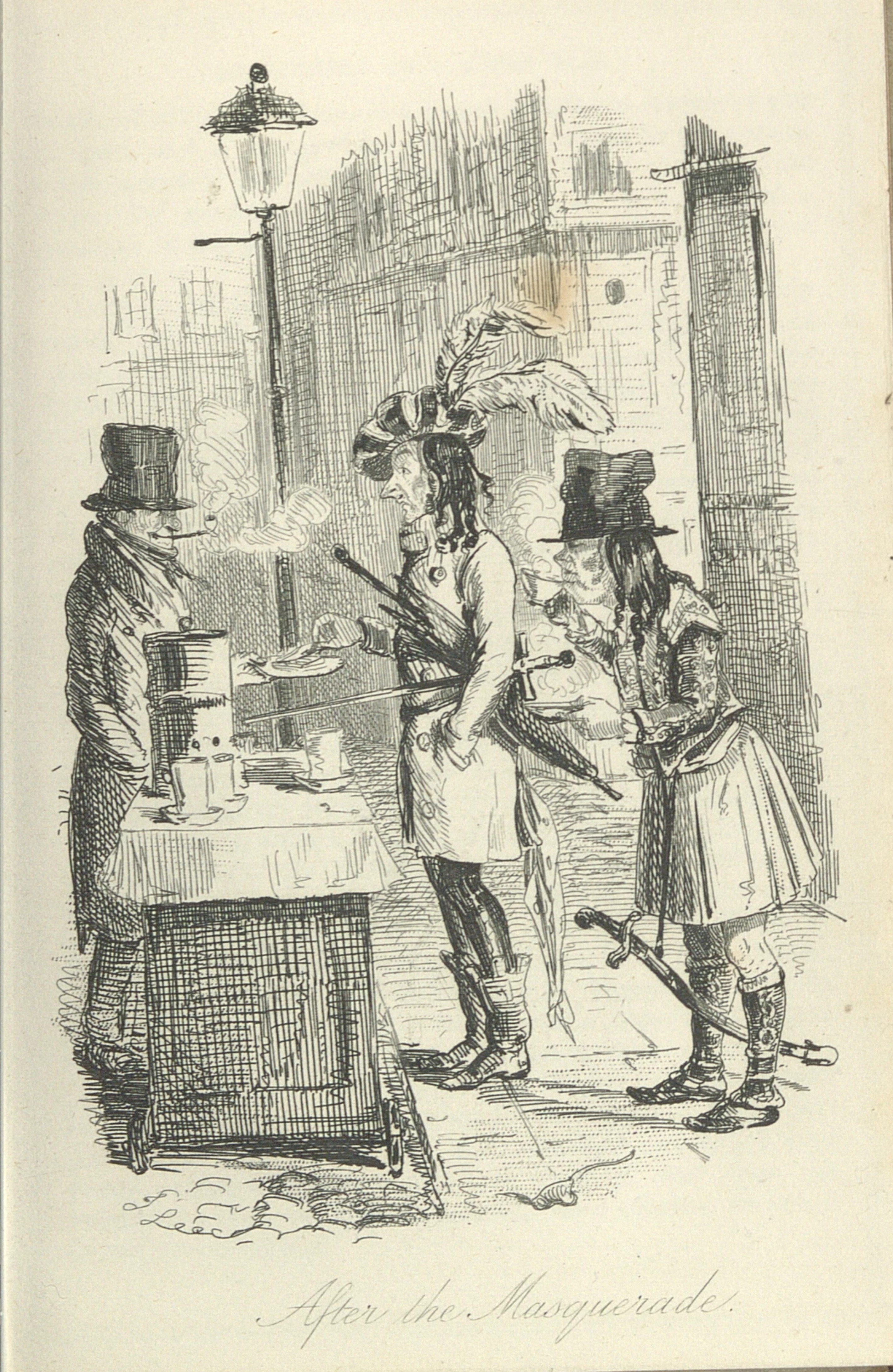
Determined to meet the views of the sage, if I possibly could, I resolved on going to the last fancy ball, either as a fool or as a philosopher ; but having read the proceedings of the British Association for the advancement of science,[Comment by SL] : This organisation was founded in September 1831 with the aim of promoting and encouraging the development of the sciences in Great Britain. The organisation remains extant, but has been known as the British Science Association since 2009. For further information, see A. D. Orange, 'The Origins of the British Association for the Advancement of Science,’ The British Journal for the History of Science 6, no. 2 (1972): 152-76. it struck me that the two characters — I mean, of course, the philosopher and the fool — could very easily be united. I, therefore, purchased a clown’s dress, and wrapping myself up in the mental Taglioni of philosophy, I sallied forth to the last masquerade of the season, determined to think for myself, and thus assert the dignity of British cogitation.
I regret to acknowledge that philosophy deserted me, and I commenced playing the fool with some energy. I shall, however, pass over the ball itself, and state in a few words what became of some of the principal characters. Macbeth retired with Jane Shore to a neighbouring oyster-shop ; and Ivanhoe fell helplessly intoxicated into the arms of Mr. Superintendent Mallalieu ;[Comment by SL] : Likely a reference to Francis Mallalieu, a superintendant of the R Division (i.e. Greenwich Divsion) of the London Metropolitan Police. Mallalieu appears to have been a respected and well-known individual within government and legislative circles in the nineteenth century. For example, in the wake of the Slavery Abolition Act of 1833, he was appointed Inspector-General of Barbados by a special act, thereby ensuring him a lead role in the reorganisation of the Barbados police force. For further information see Georgina Sinclair, Colonial Policing and the Imperial Endgame 1945-1980: 'At the End of the Line' (Manchester University Press, 2006), 13. Richard the Third rushed frantically into Covent Garden Market, offering his kingdom for a kidney pudding ; and one of the Two Gentlemen of Verona pelted policeman K 555, with summer cabbages ; Napoleon the Great seated himself in a tub of native oysters ; and Reginald Front de Bœuf insisted on exchanging cards with a Smithfield Drover, of whom the knight was demanding in broken accents the satisfaction of a gentleman. But the most lamentable picture of all was that of Mark Antony seated in a public-house, pouring forth an eloquent oration over the beer of Barclay and Perkins. As for myself, it took me till the afternoon of the next day to get home, for I believe that, somehow or other, I went round by Bow-street, and paid five shillings more than the regular fare that would have sufficed, had I taken a cab direct to my own residence.
↑
- 150 -
{f.150}
 EVENINGS IN RAMSGATE.
I shall not disguise the fact of my having stolen the idea of Evenings in Ramsgate from Moore’s “Evenings in Greece.” Ramsgate, where the scene is laid, was a watering-place even so early as the time of Hengist, but nobody seemed to be aware of it. Egbert never resided there, nor was it a favourite resort in the time of the Heptarchy. During the Commonwealth the bathing is believed to have been almost as good as it is now ; and probably an odd Puritan or two might have indulged in a dip on the coast of Kent, but there is no reason to believe that Ramsgate had the preference. There is a good deal of learning on the subject in the Sixpenny Guide Books, to which I refer the curious.
The silver moon adorns the sky ;
The gallant coast-guard, on the cliff,
Strains through a telescope his eye.
The sea puts forth its glittering charms,
Keeping its moonlit waves in motion ;
The Pier is stretching forth its arms,
As if it would embrace the ocean ;
The beacon-tower with its light,
Doth warn the mariner of danger ;
Its clock proclaims the time of night
Unto the lounging London stranger.
How beautiful is evening’s hour !
When Nature sends the moon at full
To rob the garish gas of power,
And make the public lamps look dull.
Like the bright brilliance born of oil,
When placed between a pair of dips,
Their small effect ’tis sure to spoil,
Their paltry light it must eclipse.
Or rather ’tis perched on the top of a rock.
Old novels the shelves of its reading-room fill ;
Clocks, vases, et cetera, serve for its stock.
And though those old novels belong to the past,
The pliant subscribers keep reading them on ;
So those very old novels preserve to the last
All the value of new when their novelty’s gone.
Of goodly composition sixes ;
Upon the company around
His eye the old librarian fixes.
He takes the dice-box in his hand,
The dice within he loudly rattles ;
A sale he trusts thus to command
For many of his goods and chattels.
He looks towards a bright-eyed girl,
What does his eager glance reveal ?
It bids the maiden give a twirl
To Fortune’s ever-changing wheel.
She turns it with a nimble hand,
So fair and delicate her fingers,
That amid those who pass the stand,
One captive youth beside her lingers.
He softly murmurs in her ear,
And she replies in accents thrilling ;
That gentle murmuring, I fear,
Has cost the captive youth a shilling.
Alas ! that man should court his doom,
Seeking the loveliness which cheats him ;
E’en as the gnat in evening’s gloom,
Flies smack into the mouth that eats him !
Or, even as the silly fly,
When summer with its sunbeam crowns him,
Though not particularly dry,
Blunders into the milk that drowns him.
All others in that gay bazaar ;
A creature fair — a creature young —
A creature such as poets sung
When they described the fairest features
That grac’d the loveliest of creatures —
She was a thing of life and light,
That look’d extremely well at night.
Her well-macassared raven tresses
Hung o’er her
Which the most low of low-neck’d dresses
Kindly revealed to all beholders.
The centres of her cheeks disclose
The deep vermilion of the rose ;
While at the sides, that lovely girl
Wears the rich powder of the pearl,
Adding, by its unequalled whiteness,
Unto the deep vermilion’s brightness.
Her eye-brows (truth ’twere vain to blink)
Are partly made of Indian ink.
But oh ! has India aught too rare
To lavish on a maid so fair ?
Her form would shame the sculptor’s art —
No stone, no chisel, could impart
The beauty of that wasp-like waist
When that sweet girl is tightly laced.
Her waist, to sculpture, all must own
Would only be a waste of stone.
A beautiful ballad of feeling and grace —
Are played on a Broadwood piano — a square —
With several notes out of tune in the bass.
And there, on the top of a kind of a box —
A platform they term it — a maiden there sits,
Who gives the piano such violent knocks,
They threaten to break all the keys into bits.
- 153 - {f.153}
But, carried away by the words she is saying,
So heavy her fist on the instrument falls,
She must dream, on a marble piano she’s playing.
For whom those notes are not too loud,
Rivetted to the spot he stands
Clapping together both his hands,
And when that lovely girl has gone
The youth still keeps applauding on ;
Till, with enthusiastic roar,
He bellows out a wild “encore !”
His words are answered by a shout
Of — “Turn that silly fellow out.”
Bursts from the cork that corked it,
Did the youth turn to the quarter
Which in tone insulting balked it —
When, with enthusiastic roar,
He bellowed out a wild encore.
Oh, fatal beauty ! must thy charms
Be still the cue for war’s alarms ?
Must Smith and Johnson madly fight
Because Amelia’s neck is white ?
Must Snobson boldly Thomson dare
Because Matilda Jones is fair ?
Must Snooks and Buggins come to blows
About Eliza’s Roman nose ?
Must angry kith contend with kin
About Lucretia’s dimpled chin ?
Alas, that beauty e’er should be
The cause of mortal enmity !
Appeared on vengeance firmly bent :
Offering to any six a thrashing
Who wouldn’t tell him what they meant.
The room his rage was nearly clearing,
The old librarian seemed to doubt
A moment — then the hot youth nearing,
The old librarian kick’d him out.
The raffling still went calmly on :
Still did the wheel of fortune turn ;
Still did the pound of sixes burn ;
Still were the idle loungers willing
Sixpence to win — and lose a shilling.
With patience, too, they looked about,
Indulging still the futile hope
That they could take their tickets out
In anything but squares of soap.
And once again the maiden sung,
But ere the song was finished half
She missed the stranger bold and young,
And burst into a frantic laugh.
In vain the audience kindly cheer’d —
She got no further than the middle —
And some one present volunteer’d
A grand concerto on the fiddle.
On the youth who encored her repeatedly calls,
While thumping a cottage piano she sits,
Still dreaming she’s dwelling in marble halls.
When Nature seems to seek repose ;
The busy bee has left the flower,
And in the hive begins to dose.
- 155 - {f.155}
His merry chirp on all around,
But in his nest serenely snores,
While breezes mock the tuneful sound.
’Tis twilight — in the gay marquee
’Tis rather difficult to see ;
Though still, with paper in his hands
Some spectacled subscriber stands,
Now coming closer to the door ;
And now, the chilly air unheeding,
He stands on the unshelter’d shore
Determin’d to continue reading.
The vex’d attendant feigns a cough,
Expecting thus to get him off ;
Takes in the chairs — and shuts the tent ;
But still upon the journal bent
The spectacled subscriber stays,
Conning the Times with aspect solemn
As if he wouldn’t miss a phrase —
A single word — in any column :
As, at a chop-house poor and cheap,
Where papers are exceeding rare,
One customer the Times will keep,
So that none else the news can share ;
Then, having kept it long enough,
To him that ’s suffer’d next to win it
He hands it ; while, in accents bluff,
He coolly says — “there ’s nothing in it.”
Worn as a necklace by the sheep :
Sweet is the lowing in the dell
Of heifer, falling off to sleep :
Sweet is the hum of passing gnat,
Whizzing at eve our heads above ;
But sweeter, sweeter e’en than that
Is the first gush of woman’s love.
- 156 - {f.156}
The margin of the roaring sea,
Humming unto himself, a song
Of wild, unequal melody.
That youth betrays upon his hair,
Of grey precocious, just an inkling
As if the pepper-box of care
Had given it a little sprinkling.
A partial stooping in his gait
Would hint to casual beholders,
That grief had found, to bear its weight,
A porter’s knot upon his shoulders.
A furrow on his manly brow
Betray’d the track of sorrow’s plough ;
And on his feelings any one
Might see that mangling had been done.
Down to the shore — one of the grandest flights
That human enterprise did ever dare ;
When, having in its eye a wondrous stair,
High on the topmost step a form is seen
In bonnet close, and veil of muslin green ;
Down — down — descending in a style could cope
With the light bounding of the antelope.
But stay ! the brain a better image crosses ;
The form descends like one of Astley’s horses,
Which trots down stairs with action free and natty,
When tutor’d by the skilful hand of Batty.
As o’er the stone stairs she is actively bounding.
The footsteps now are heard no more,
They ’re muffled by the sandy shore.
And now the youth upon the sand
Waving with vehemence his hand,
- 157 - {f.157}
Who to his arms prepares to spring.
Another moment more reveals,
A father at his daughter’s heels,
Who, standing very near the water,
Addresses thus his wayward daughter :
“Was it for this, my daughter dear,
That I indulged a father’s fooling,
Paying some forty pounds a year
For extra masters and for schooling ?
Was it for this, that I allow’d
For learning French a pound a quarter ?
Was it for this, I always vowed
To make a lady of my daughter ?
Was it for this ?” — He might have gone
In such a style much longer on,
But that the youth did place his toe
Behind the anxious father’s heel
And in an instant laid him low ;
The sands were very soft, and so
It was not probable the blow
He would severely feel.
And some time after that old man
To cure him of a fit of vapour,
Was conning o’er the morning paper,
And in the marriages he found
His daughter was in wedlock bound.
Is seen impatiently to stand ;
Again a form with footstep light,
Descends that formidable flight.
A father she has been to seek,
After the absence of a week,
- 158 - {f.158}
That husband waiting on the sands ;
The father cordially shakes him,
At once — by both — yes, both his hands.
The tears are standing in the old man’s eyes,
“There, take her,” feelingly the old man cries,
“But you must keep, remember, within bounds —
At present only fifty thousand pounds.
But, when into the chest of Davy Jones,
I throw my very venerable bones,
Then you shall have” — “Oh prithee say no more”
Exclaims the happy youth upon the shore,
“I’m strong and I can work, nor am I loth
To do the very best I can for both.”
But the poet alas the truth must tell,
The youth on the shore was an idle talker ;
He thought of the cash, and aside there fell,
From the lips of the youth a muttered — “Walker.”
And now at Ramsgate near the gay marquee,
A group of seven little children play, —
Whose can those seven little children be ?
They do belong to him who stood of yore
Waiting a sylphlike form upon the shore ;
That sylphlike form, ’twere idle now to flatter,
Has grown, alas, considerably fatter.
He, who an ardent youth, would wait for hours
In summer’s scorching sun or winter’s showers,
Attends no more the coming of his wife ;
He makes her wait for him — but such is life.
THE OXFORD READING MAN TO HIS CHUM.
Dear Ned,
I have been owing you a letter for these three weeks ; but if you were here yourself, I don’t think you could bring yourself to write. Perhaps it is something in the air. I came
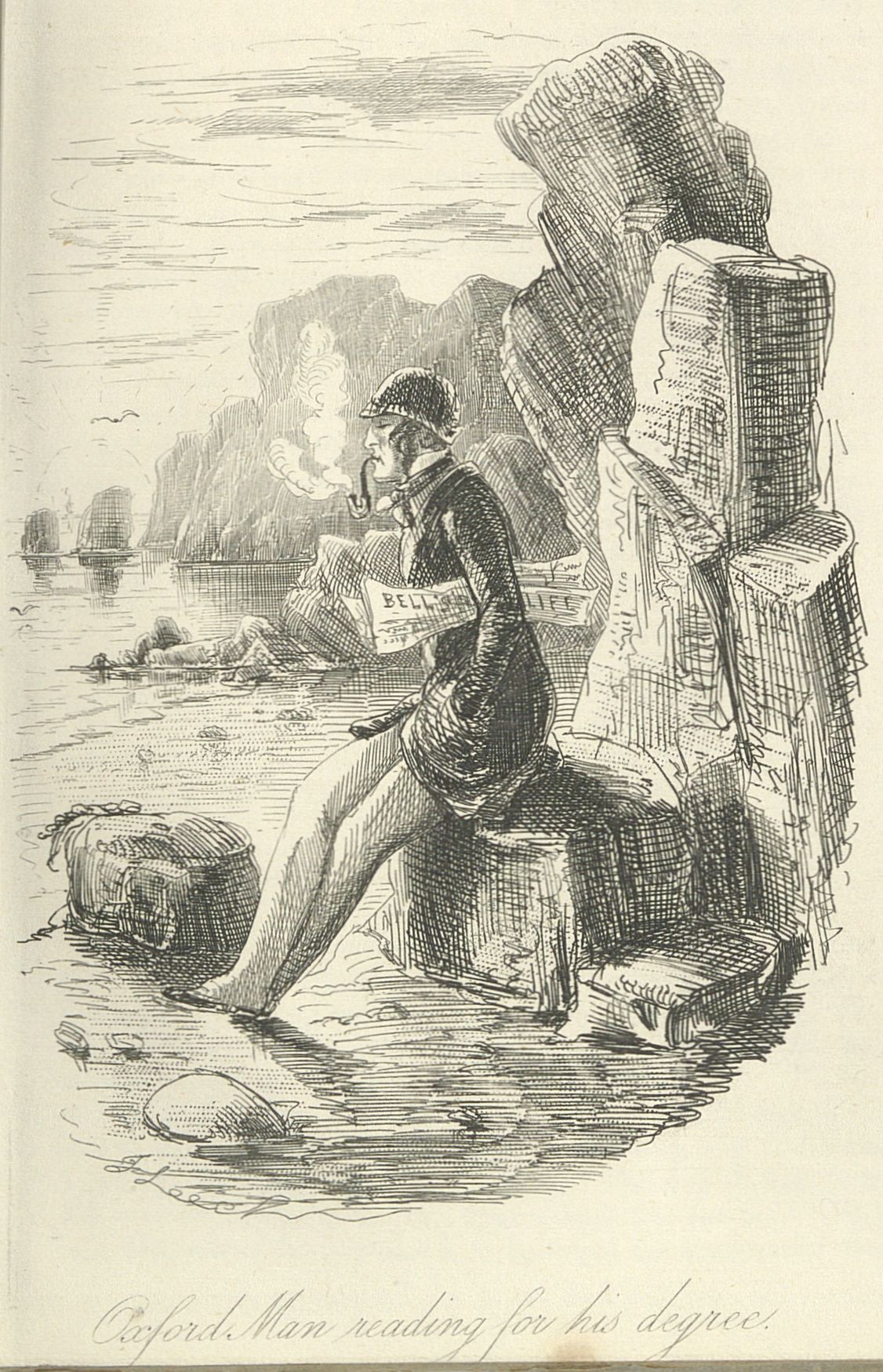
Yours sincerely,
Vincent Dormer.
P. S. I weighed 11½ st. when I left Oxford ; now I should think I must be 12 st. How about Caxton’s pointer ? I see that the odds for the sweepstakes are 2 to 1 against Coningsby.
From the Same to the Same.
Dear Ned,
So you thought I should never get to work ? You are out, my boy. I began reading this morning (by Jove, how it has been raining all day !) and have been walking into Euripides like a brick, cramming Medea in style. By the by, what are the odds for the St. Leger against “Jason ?” I ’ll bet you what you like I get up the play in a week, though those choral odes are deuced up-hill work ; and every now and then a fellow comes to a regular dead lock. Talking of that, how did you settle about the cab your tilbury ran against ? Oh ! and how about the cup that is to be rowed for next term ? the
- 160 -
↑
{f.160}
allusion to the Argonauts put me in mind of it this morning : what a lark it would be to pull some day for a golden fleece ! A propos of fleece, were any of our men in for it through Running Rein ? I was all right, having taken care to hedge, which just saved my bacon. Bacon, I may observe, is a thing that you get here in perfection. The scenery is allowed to be very fine ; but the ground is rough and uneven ; there ’s no room for a canter anywhere, except here and there on the downs, and a gallop cross country is out of the question. With the exception of one tolerable pony, I hav’n’t seen a decent animal. Κατὰ news, the only thing worth mentioning is, that there is a regatta coming off to-morrow at Cowes, which, I calculate, as the Yankees say, I shall go and see, and will send you due particulars. But jam satis ! so adieu for the present, old fellow, and believe me,
Sincerely yours,
V. D.
P. S. I wish you could send us down a box of cigars and the Era.[Comment by SL] : Established by a body of licensed publicans, The Era commenced in 1838 as a general weekly newspaper targeted at those within the industry. Originally a liberal-leaning publication, it later became more conservative. A relatively expensive purchase, it was regarded highly for its sports coverage and theatrical content. For further information see ‘The Era,’ The British Newspaper Archive.
DOMESTIC HINTS.
Salt of sorrel will expel the stains of ink ; but oh ! what salt will cure the summer-freckles ?
How very nice are boiled soles, and how much cheaper they come than fried ! What a pity it is that families so seldom have them.
How very dear are black crape trimmings, how soon they are spoiled by damp, and how distressing it is to see nice mourning fade ! Fair widow, in thine evening walk, bethink thee of the dew, and let a parasol, at least, be the companion of thy loneliness.
We know too well how heat affects the hand. When thou goest to church, wear the old gloves to the crowded evening service ; reserve the best for thy devotions in the morning.
↑
- 161 -
{f.161}
 ATTORNIES.
An Invective.
by a victim.
The liberty to warn ye
Against that universal scourge,
A rascally Attorney.
The first thing you discern is
A plate of brass, with letters large,
Some “Rogue and Co., Attornies.”
The thought a constant thorn is,
All others may be satisfied,
But never the Attornies.
As any babe new-born is,
The wretch may call his soul his own —
His skin is his Attorney’s.
Whose name my bitterest scorn is ;
To yield him to that deeper curse,
The friendship of Attornies.
My first prayer in the morn is,
Oh keep me from all evil things !
But still more from Attornies.
It always my concern is,
To finish with a bumper-toast,
“Confusion to Attornies.”
That, when to die my turn is,
My soul may find a resting place,
Where there are no Attornies.
↑
- 162 -
{f.162}
 THE ECCENTRICITIES OF GENIUS.
We remember hearing an amiable old lady say, in her strong admiration for Dickens, that it was not astonishing he wrote so well, considering it was his invariable habit to associate with the class he intended to depict. “I have been told,” said she, “that on one occasion he wore a paper cap and a white apron, and sold penknives with fourteen blades for a whole week at the Elephant and Castle, purposely to study, at his leisure, the characteristics of Tigers[Comment by BQ] : Tiger were liveried grooms or footmen, usually young boys, often seen riding outside of fashionable carriages as part of their duties. and Omnibus-Cads.”[Comment by SL] : Now an obsolete term used in the nineteenth century to refer to a bus conductor. See: ‘Omnibus Cad, N,’ Oxford English Dictionary, March 2025. We were so struck with this extraordinary fact, which we do not recollect having heard before, that we applied to the same old lady to oblige us with some more particulars of authors, which, after the outlay of a few white compliments, she readily consented to do. The following are the most peculiar of her private communications : —
Mr. Grant, she told us, when he was writing his celebrated work of The Great Metropolis, used to spend four hours regularly every day in visiting the different coffee-shops in London. He drank a cup of tea and coffee, and ate one, if not two, thick slices of bread and butter, at every shop, so as to be able to report, conscientiously, on the respective merits of each. He spent a little fortune in this way, and he has now such a violent antipathy to tea, in consequence of the horrible quantities he drank then, that he cannot come into a room, where there is a tea-caddy, without immediately fainting away. This antipathy to tea is to be the more regretted as it necessarily prevents Mr. Grant mixing in those little coteries of which he was formerly no less the pride than the ornament. Such, alas ! are the sacrifices literature exacts from the delicate-minded sons of Genius !
Mr. Harrison Ainsworth wrote his celebrated Turpin’s Ride to York between the acts at Astley’s Theatre. He was so struck, when visiting that place of entertainment, with Mr. Hillier’s Courier of St. Petersburgh that the thought involuntarily came into his mind to give literature, and his forthcoming work, the benefit of his new impressions. The whole of
- 163 -
{f.163}
the graphic description was written in pencil, on the crown of his hat, entirely on the back of play-bills, and he filled no less than six, at a penny a piece, in this way.
Lord William Lennox is so particular about the composition of his novels that he generally engages a secretary to read aloud to him The Antiquary, Tylney Hall, or some other popular work, whilst he is dictating to another. This was the plan he pursued when he wrote his very cleverly compiled, original work, The Tuft-Hunter. He has been heard to boast, that there is not a comma’s difference between similar descriptions in that work and those above mentioned. His memory in fact is so retentive, that he can tell the author of every passage through the whole three volumes. This confession in a literary man cannot, on account of its candour, be called less than wonderful !
Mr. Benjamin D’Israeli, weeks before writing his Coningsby, never missed a day without religiously going through Holywell Street. He would frequently take an old waistcoat, or a seedy pair of trowsers, with him, as an excuse to enter a shop, and get into conversation with any of the venerable patriarchs in that street. In fact, it is said that a certain Mr. Solomons, who gave Mr. D’Israeli a bullfinch for a last year’s paletot, is the identical prototype of “Sidonia ;”[Comment by SL] : Sidonia is a character from the mid-Victorian political novel, Coningsby (1844), written by Benjamin Disraeli (1804-1881). As an educated and wealthy Spanish Jew, Sidonia encourages the eponymous hero of the novel to develop a new vision of English greatness based on Jewish values and character. Robert O'Kell refutes the common claim (perhaps alluded to satirically in this passage) that D'Israeli's Sidonia was modelled upon Baron Solomon de Rothschild, with whom Disraeli had become acquainted in Paris in 1842. Sidonia has also been interpreted as a fictionalised portrait of Baron Lionel Nathan de Rothschild (1808-1879) and of the author himself. For further information, see Robert O’Kell, ‘Disraeli’s “Coningsby”: Political Manifesto or Psychological Romance?’ Victorian Studies 23, no. 1 (1979): 57–78. but as again it is said that Mr. D’Israeli himself is the original of that great character, who can decide ?
Mrs. Ellis,[Comment by SL] : Sarah Stickney Ellis (1799–1872) was a writer and educationist who published a wide range of materials, including verse, fiction, and travel writing. During her own lifetime, her most celebrated works were conduct books, such as Daughters of England (1842), which is mentioned here. For further information, see H. S. Twycross-Martin, ‘Ellis [née Stickney], Sarah (1799–1872), Writer and Educationist,’ Oxford Dictionary of National Biography, 23 September 2004. in her ardour for literature, went so far as to enter as a maid-of-all-work in a young ladies’ boarding school, at Hammersmith. This she did for two quarters, purposely to have daily opportunities of studying the female character for her celebrated Daughters of England. She used to write down her impressions every night, in bed, when all the candles were put out. It is said she convened a council of monthly nurses, to glean information for her no less celebrated Mothers, but the particulars she got in this way were so astounding that she was afraid to use them.
Alfred Crowquill frequently makes his sketches on his left thumb-nail. On one occasion, when dining out, a very hot
- 164 -
↑
{f.164}
plate was handed to him. In the agony of pain he put the burnt finger into his mouth, and lost, to his inconsolable regret, the best likeness of a brewer’s drayman he had ever drawn.
Buckstone, whenever he has a genteel character to act, walks about the streets till he finds the most promising-looking gentleman, and then invites him home to supper. On one occasion, however, he suffered sadly from his enterprising hospitality — for, having spent half a night in studying a gentleman-at-arms, he fell asleep from sheer exhaustion, and discovered the next morning he had lost a couple of spoons, a pair of sugar-tongs, a brandy bottle quite full, a miniature set with diamonds, and three old wigs. It must be stated, though, in favour of Buckstone’s gentleman, that the wigs were sent back the following day.
EXTRACT
from
The Report of the Commission appointed to inquire into the
progress and prospects of the English Language.
Professor Downy, of St. Giles’s in the Fields, examined : —
Perfectly recollects the time when the expressions “shocking bad hat” and “flare up” were in constant use. Did not think highly of either, but is of opinion that “flare up” was the best. Is sure they are entirely gone by, and that no one, with the slightest regard for fashion, would now utter them. Thinks “Has your mother sold her mangle” is nearly obsolete, and, therefore, considers the Prize Comedy, in which this phrase was so conspicuous, as behind its age. Remembers the expression “Things are getting rather screwy” in the same work, but considers it altogether illegitimate, and not sanctioned by any authority. Looks upon “Rum ti tum with the chill off” as a very happy and facetious assemblage of words, but has no clear notion what it means. Is certain, however, that it cannot mean the Spectator newspaper, as that periodical always has the chill on. Looks upon the rapid progress of
- 165 -
{f.165}
“fast” and “slow,” conveying a sense of praise and dispraise, as altogether unprecedented, except by that of the word “shy,” signifying “indifferent.” Considers “This is the slowest thing I ever clapped eyes on,” as applied to the generality of modern five-act plays, to be a most felicitous expression. Is not sure whether he would rather call the ballet of Zelia “slow” or “shy,” but is inclined to think he would call it both. Once heard a Westminster scholar call a low person a “sky,” but is convinced the word never got into general usage. Is proud to express his firm belief that the phrases “No great shakes,” “brace of shakes,” “Walker,” and “I’m blow’d,” are immortal, and beyond the influence of fashion. Thinks that what is said of
Mr. Peregrine, of the Travellers’ Club, examined.
Has frequently been to New York. Has occasionally read the “New York Herald,” but feels great contrition on account of the same, and does not intend to read it again. Has heard the phrases “loafer” and “rowdy,” and at New York, the former signifying a vagabond, and the latter a kicker-up of disturbances. Is sure these words have never been current in this country. Does not conceive it would be a great national blessing if they were. Looks upon “opinionate” as a very superfluous word, inasmuch as all its functions may be performed by “opine,” and has no great notion of “screamer” as a complimentary expression. Thinks highly of “slanting-dicular,” and as we have no corresponding word in England, believes it might be imported with advantage. Does not know whether such importation would be found facilitated by Sir Robert Peel’s New Tariff, such affairs not being his “look-out.” Is perfectly aware of the financial sense of the word “repudiate.” Has often illustrated the doctrine it implies on his own private creditors, indeed many of his travels have been undertaken in consequence. Does not know whether a slang expression is to language what an appoggiatura is to music, not having the remotest notion what an appoggiatura may be.
↑
- 166 -
{f.166}
 THE SYNCRETICS’ COMMON-PLACE BOOK ;
or, few things in many words.
How beautiful is nature, and how comparatively ugly is art. Can all the artificers of Axminster produce a carpet like the green grass ? Echo answers that the attempt would be utterly ridiculous.
The mountain torrent, with its stream of gushing liquid, beats hollow the paltry fountain in the temple ; and who would think of comparing Mont Blanc with the dome at the top of the National Gallery ? The sky with its variegated hues, the rainbow with its many colours, cast into shade the gaudiest of shop-shutters, which only seem to mock the plumage of that peacock who is indebted to nature for a tail which art could never grace him with.
How vast is time compared with the clocks by which we are in the habit of counting it. How immeasurable is space, and how contemptible is the foot-rule by which alone we form all our ideas of measurement.
Wisdom is like oats : there is a good deal of chaff to be beaten out of it, and the soundest philosopher is he who best can bear the soundest thrashing.
Friendship, like pickled onions, will keep a long time, but a bad pickle is trying to both, for neither can be well preserved under such circumstances.
SONGS OF THE ADVERTISERS.
For entering a family that ’s pious,
Fun to the morals may be deleterious,
So I prefer a situation serious.
Mirth may a levity of mind provoke,
Give me a master who can’t make a joke.
Wages expected, forty pounds a year,
My clothes, and half a crown a week for beer.
To join the fam’ly twice a day in prayers,
It can’t be done for less — and for the price
About the sect I sha’n’t be over-nice.
Protestant creeds I charge the same all round,
If Cath’lic I expect an extra pound.
Accustomed wooden floors to scrub,
Can roast a joint or make a pie,
Have no objection to the tub.
Am of a sentimental turn,
Detest the busy heartless crowd,
The tales of love I proudly spurn,
And wish “no followers allow’d.”
They throw no magic spell around me,
But for propriety so rare
My tea and sugar must be found me.
Of love I never felt the flame,
To say it I may well be proud,
The candle ends I always claim,
When I’ve “no followers allow’d.”
No missus e’er will find me tripping,
Unto myself I always keep,
I, by-the-by, expect the dripping.
I’ve often turned in scorn aside
When milkmen have affection vow’d,
And I have said with honest pride
“There ar’n’t no followers allow’d.”
THE FAMILY LACON.
Black satinet may be renovated by gin and water ; but pause ere you entrust the operation to the laundress. Oh
- 168 -
↑
{f.168}
that the self-same fluid would renew the satinet of the bosom !
Wouldst thou prevent the white kid glove, whilst laid by, from turning yellow ? wrap it up in blue paper. But when beauty is laid up, (especially on the shelf,) what envelope will preserve her complexion ?
How difficult, to a lady, is the task of cleaning her silk stockings ! How much more difficult to her husband to find the money to pay for them !
THE CHIEFTAIN’S ONSLAUGHT.[Comment by SL] : This narrative parodies the early nineteenth-century 'National Tale' - a type of fiction that sought to celebrate the distinct cultural history and landscape of the diverse nations of the newly formed United Kingdom of Great Britain and Ireland. A popular mode of fiction pioneered by celebrated Romantic-era authors such as Maria Edgeworth, Sydney Owenson, and Walter Scott, the National Tale had become rather shopworn by 1845. For further information, see Ina Ferris, The Romantic National Tale and the Question of Ireland (Cambridge University Press, 2002).
A Fragment.
The Mac Higginbottoms, encamped in a time-worn recess, scooped in the steep side of Ben-Haverstock, awaited the approach of the enemy. Couched at the head of his clan, amid the verdant kail, lay Vich Ian Stubbs, supporting himself on his splenchan. Presently the martial coronach of Clan Mullins was heard swelling up Glen Chalkfarm, mingling with a terrific hiss, produced apparently by a column of vapour emitted from some unseen source. “Curragh, my tulips !” shouted Vich Ian Stubbs, and his followers were instantly on their legs. The feudal foes were now confronted, separated only by a narrow brae. Vich Ian Stubbs saw that not a moment was to be lost. “Gaberlunzie for Mac Higginbottom !” he exclaimed, “flare up to the fore !” and his followers, impetuously pressing before their leader, dashed, yelling the pibroch of “Polly Hopkins,” upon Clan Mullins. They met, hand to hand, foot to foot, in a ravine intersecting the Haverstock Trosach. Terrific was the struggle that ensued. Baylis of the Chambers cleft Hodder of the Lodgings to the brisket, and Allen of the Buildings fell a victim to Tomlins of the Rents ; whilst in another part of the field, Pearson of the Passage was felled by Tully of the Alley ; and Postans of the Two-pair-back, overthrew Ponny of the Front Parlour. At length, the Mac Higginbottoms appeared to give ground. Vich Ian Stubbs had hitherto been a passive spectator of the conflict ; but the
- 169 -
↑
{f.169}
lion was now fairly roused. “Tullochgorum, my bricks !” he shouted, in a voice of thunder — “Cock-a-leekie to the rescue !” Thus raising his native war-cry, he brought his target to a level, wrapped his claymore around him, drew his philabeg, and rushed into the thickest of the fray. * * *
MORAL REFLECTIONS ON BILLS.
Was it not Mr. Ikey Solomons who, when sentenced to be transported for twenty years, called for a bill-stamp that he might accept the same for a thousand pounds ? And was it not the late lamented Lord Ellenborough who asked the prisoner for what he wanted the said bill-stamp ? And then and there, leaning over the Old Bailey dock, was it not Solomons who made this memorable reply — “For vot do I vont a bill-stamp, my lord ? — vy, I’ll tell you ; to cut the twenty year short : for I never know’d a man accept a bill that the time didn’t fly away like vinkin.”
No : it was not Ikey who uttered this profound truth ; neither was it Lord Ellenborough who put the curious query. No matter ; truth is truth by whomsoever uttered. No lips can defile it.
Therefore, reader, consider that Her Majesty’s stamp — all innocent though it seem — is a charm to steal away your golden months. Write on a three months’ document, “Accepted, John Green,” and ere you can turn three times comfortably in bed, the bill is what is called matured, that is, ripe for dropping upon you. The banker’s clerk knocks at the door ; leaves a square bit of paper in which you are politely requested to send the money — (pooh, pooh ! ridiculous !) — “between the hours of two and five.” You laugh hysterically at the invitation, and even ere the laugh has subsided, a short, concise epistle is forwarded from some benevolent attorney, who tells you that the money must be settled by twelve o’clock, “or” —
No : not the ingenious handicraftsman who first crammed a service of plate into a cherry-stone, —
Not the fine calligrapher who once penned an Act of Parliament in the circle of a silver penny, —
- 170 -
{f.170}
Not he who crammed the whole Iliad into a book that he afterwards crammed into a walnut shell, —
Not one of these ever did or could compress such a multitude of things — such a world of most significant meaning in such little space — as may be crowded in that attorney’s monosyllabic
“Or” —
There is in it writ — execution ! All the stones of the Queen’s Bench may be in those two magic letters — that all-comprehensive “or.” It may also contain that modest fabric, the Insolvent Court, Portugal-street ; it may, moreover, — according to the digestion or rather indigestion of the Commissioner — enshrine a retirement of three months in the sweet vicinity of St. George’s Fields. How much shame, wretchedness, self-abasement, downright cutting heartache, may exist in that — “or !”
And therefore, if it be possible — nay, whether it be possible or not, for to do what is impossible makes the real genius — if it be possible, never give a bill. No : cheat the revenue of the stamp duty, and pay ready money.
Our reflections are on Bills ; and it may be, we speak to some callow youth : to some ingenuous youngling in his vernal greenness. As yet to him shaving is a new experiment. He knoweth little of the ways of life, and the misery of a blunt razor. He hath come rejoicingly from school. At home — in the cabinet of his mother — is his silver medal for penmanship — a Telemachus bound in calf for moral conduct. Unhappy wretch ! how many silver medals, with the Queen’s gracious face upon them, shall his writing cost him ! Had he been only able to make his mark, he had been saved : but he falls a victim to his round-hand — he is doomed by his fine strokes up, and his thick strokes down.
This youth has a friend — such a friend ! — what would he not do for him ? For the friend knows life ! The best taverns ; the best-mixed punch ; the best oyster-shops ; the best theatres ; the best way of doing everything. This friend approaches the
- 171 -
{f.171}
youth — baby let us call him, although in the stern eye of the law he is of the age of acceptance, being one-and-twenty last week ; he approaches him with a bill stamp, and — the youth sees them not, but there are twenty little devils peeping over the friend’s shoulder, rubbing their hands, and twirling their barbed tails for very glee, —— it is done ! The youth — heaven help him ! — is down, “accepted.” It is “but a form,” says the friend, and he says truly. Hanging, too, is but a form !
My son, “accommodate” is a good word, see that you abuse it not. Of house and board give to your friend all that the word in its largest hospitality implies. Accommodate with ready money, if — happy man ! — the coin be yours. But accommodate not upon paper. An accommodation bill is no other than an accommodation pillory ; with this difference ; that whereas the pillory commonly accommodates but for an hour, the bill may have “renewed” and “renewed” accommodation for months and months. Alas ! that renovare dolorem !
Lay these things to your heart, my son, and be instructed. And when the friend of your bosom, or rather of your pocket, shall approach you with a bill-stamp, handing to you a quill with the self-same grace with which (it is upon record) the Devil handed Dr. Faustus an iron pen dipped in penal brimstone, to sign away his soul — then, my son, take from your poke this little book, your constant bosom companion, and, opening it at this very page, lay your finger on the words below — a golden maxim made over to you by Punch : —
“He who accepteth a bill for another is, if alone in the world, merely an ass. He who flieth a kite for another, and yet is not alone, is an ass with this difference, — he may also be a robber.”
And so much for accommodation, according to the stamp act !
Nevertheless — for who will be instructed ? — it may happen that, being of a sanguine nature, you have not paid ready money ; no, you have given a bill. Time flies — he never flies so fast as when his wings have stamps upon them — and the bill is due. You cannot possess yourself of that stinging bit of paper. You desire renewal, wherefore the following form
- 172 -
↑
{f.172}
of letter to the holder, may possibly, with some advantage, be adopted : —
Form of Application for the Renewal of a Bill.
My dear Sir — Dear Sir — or Sir [as the case may be],
My little bit of paper is due on Thursday next. An unforeseen circumstance, indeed an accident of a somewhat remarkable nature, will, I fear — for I am not yet positive upon the point — make it desirable for me to have the favour renewed. It would be somewhat painful for me to ask anybody but yourself this trifling indulgence : but there are persons of whom to solicit a favour is to feel — not an annoyance, no, but a gratification. You, sir, are of these persons : you, sir — but I will say no more. The self-same nature that ever prompts you to assist your friends, makes you reject even all lawful laudation. Therefore, we will, if you please, say for three months ; and, in the meantime,
Believe me, yours very truly and obliged,
—— ——.
Probable Answer to the foregoing.
Sir,
I have paid your bill away. Where it is, I know not. It will, however, be duly presented, and therefore, as a friend, I would advise you to be provided for it.
I remain, your obedient servant,
—— ——.
And therefore, my son, we say again — “Cheat the Revenue of the Stamp Duty, and always pay ready money.”
AN INTERLINEAR JOE MILLER.
The following are a few specimens of a new work, which is intended for the use of persons who wish to joke in two languages. Our readers will intuitively see they are translations of some of the choicest beauties of our national humourist, Joe Miller. The work, which has been most carefully
- 173 -
{f.173}
revised by M. Jules Janin, the celebrated linguist, is the first production, we understand, of a young gentleman “who has learnt French without a master.”
Les Ouvrages de Monsieur Joseph Miller.
Un fleuri Compliment. — Un joli Baronne, de Grosvenor
Square, asking a young nobleman, which he thought the
Carré, demandant un jeune seigneur, quel il pensa le
prettiest flowers, roses or tulips, he replied, with great
plus joli fleurs, roses ou tulipes, il repliquea, avec immense
gallantry, “Your ladyship’s two-lips
courage, “Votre dame deux lèvres avant tous le roses
in the world.”
dans le monde.”
Mademoiselle Pape était disant dans le vert chambre de
Drury Lane, that Garrick had an eye that would pene-
Drury Ruelle, que Garrick avais un œil que voudrait pene-
trate through a deal board. “Yes,” said Wewitzer, “I
trer a travers un beaucoup navire. “Oui,” dit Vevitzer, “Je
see : it is what we call a gimlet-eye.”
vois : il est quoi nous appeler un vrille
Harmonique Pointe. — Un Monsieur Georges Aigu regar-
ing rather dull one evening, a friend observed, G. Sharp
was in rather a low key. “Oh !” replied a young lady
était dans plutôt un bas clef. “Oh !” repliqué un jeune dame
sarcastically, “Any one can see that G. Sharp
un manière satirique, “Quelque un peut voir que G. Aigu
is A flat.”
est un plat.”
THE MYSTERIES OF LONDON.
le natif de paris.
His Birth. — The “Natif de Paris” is always born in London. Its fogs are proverbially the most favourable for him to acquire the true Parisian accent : Holborn is the hereditary place of his birth. The Seven Dials are his Chaussée D’Antin, and the Rookery his Champs Elysées. The “Natif de Paris” glories in having a father, who, he takes very good care to tell you, died at Waterloo, after giving three cheers “pour l’Empereur,” and yet is not too proud to beat carpets and run London errands. He is blest with a worthy mother, too, who, according to his version, has been decorated six times by Louis Philippe, and received at the Tuilleries, and yet does not object to sell hard-bake for her living at the corner of the Little Turnstile, Holborn.
- 175 -
{f.175}
His Education. — The “Natif de Paris” never goes by any accident to an Université. A school at a penny a day is his College ; and he only loses his diploma as “Professeur de Français,” by being sent away because he is two weeks’ payment in arrear. From this, our “Natif de Paris” goes into the service of an original English dramatist, and learns, at the age of nineteen, the first words of his native tongue by reading the titles of the vaudevilles his master is translating. He then studies Nugent’s Dictionary, and travels through Merlet’s French Grammar. He soon knows as much as his master ; but, in his ambition, wishing to rival him by translating the same piece, he is thrown again upon the wood-pavement of London, without a countryman or a sou to help him. In his distress, he offers to teach a butcher’s daughter French in exchange for a dinner for each lesson. He teaches himself in teaching her, and, by the time he has grown fat in the daughter’s tuition, has become quite a proficient Frenchman. He purchases a copy of Télémaque, and, with the aid of a dictionary at a bookstall, draws up the following advertisement : —
“
M ONSIEUR GUILLAUME STYLES, Natif de Paris, donne leçons en Français, pour six sous une leçon. Tirez la troisième cloche, à la droite, No. 3, Le Parc de Whetstone.”
His fortune is made. He gets one pupil. Encouraged by this, he registers his name with his compatriote, Monsieur Fenwick de Porquet. He gets a situation in a school at Islington, upon the strength of some testimonials from French Professors, written by a Medical Student in London who had walked the hospitals and theatres at Paris for three years, and acquired his surgery and his French at the Chaumière. Our “Natif de Paris” cultivates a moustache, wears frogs to his coat, tweed trowsers, and long hair ; leaves off shaving, takes snuff, distinguishes himself with British high-lows and Berlin gloves, abuses “perfidious Albion,” talks broken English, and gets a sprinkling of pupils.
His Habits. — The most characteristic trait about the “Natif de Paris” is his scrupulously avoiding all Frenchmen. He cannot bear the sight of one of his countrymen, and will not, under
- 176 -
↑
{f.176}
any pretence, speak to any one but an Englishman. His favourite haunt is the Surrey Theatre, where he prefers the indigenous productions of Fitzball and Wilkes to those of his national poets, Victor Hugo, and Corneille, of whose names he has never heard. His reading is chiefly confined to “Bell’s Life” and Jack Sheppard, and he has a very happy memory for the popular comic songs of the day. He is fond of tripe, and retains to the last a strong affection for the violent misapplication of the “v’s,” “w’s,” and “h’s,” which distinguished his childhood. There is one great peculiarity about the Natif de Paris — by no accident does he ever visit Paris. He lives and dies near the place of his birth, — London.
LINES TO AN UNFORTUNATE SCHOOLBOY,
taken shopping during the christmas holidays.
My boy, I pity thee ;
I recollect, in days of yore,
What shopping was to me :
I know thy heart is far away
Either in mischief or at play.
My cloudy-visaged one,
Or flinging snowballs ; — any how,
At some good game of fun ?
“Leap-frog,” “stag-out,” or “high-spy-high ?”
I know thou’lt say, “Ah, wouldn’t I !”
Along with other boys ;
Not with mamma to spend the day.
Are these thy Christmas joys ?
Thus to be perched upon a stool !
— I’m sure thou’dst rather be at school.
To bid the cracker pop,
To twang thy bow, my youthful ’squire,
Or lash thy whirling top ?
Thou wilt reply ; of course thou must,
“Just don’t I rather — don’t I just !”
THOUGHTS AND MAXIMS ON PUBLIC DINNERS.
by the duke of cambridge.
How sweet is a dinner — a public dinner ! Beautiful is the Crown, but how much more beautiful blended with the Anchor ! What a noble fraternity are the Freemasons — but how much nobler their Tavern ! Sweet is a thatched cottage — but sweeter still a Thatched House ! Glorious is London — but is not the London Tavern at once the eye and heart of the Great Metropolis ?
What a lovely thing is Charity, when accompanied with real turtle ! How ecstatic the emotions of the benevolent heart, when bounding to Champagne corks ! How serene, yet mellow, the feelings engendered by iced punch ! How do men, like melons, ripen under glasses !
When man has dined, he is, or ought to be, at peace with all the world ! His heart swims in a sea of content : his pulses, sweetly as the notes of a musical snuff-box, play “There’s nothing in life can sadden us.” Daily care sits relaxed in his countenance, and whatever “speculation” he may have in his “eyes” on the Exchange, he has none at the genial board ; albeit, after a certain hour, he may see double.
How very subtle the nervous mechanism between the heart and the breeches-pocket ! A great truth this, that I have learned as Chairman. Mr. Harvey only discovered the circulation of the blood — that it flowed through and through the heart. I have since discovered that it also carries with it “the circulating medium.” Thus, before a man has dined, his blood moves languidly ; it is like a duck-pond mantled with weeds : and then is his breeches-pocket close as a cockle. But
- 178 -
{f.178}
dine him — dine him ! Warm his arterial liquid with eating and drinking, and the stream will sparkle like rubies in the sun — will flow like a summer brook. And lo ! then will his breeches-pocket open — yea, gape like a thirsty oyster ! And his gold will dance like fairies ; and, in the intensity of his delight, he will groan for the time when the paper shall come round, that he may book himself for a hundred.
I have known men who, after dinner, have had their hearts drawn by their cheque-books in their breast-pockets — ay, drawn, even as with a blister ! Therefore, beautiful is a dinner. Surely Charity was born with a knife and fork in her hand, and a napkin under her double chin !
Beautiful is Non nobis, sung by Messrs. Bedford, Stansbury, and Hawes ! Very solemn was the Poculum Poculorum of the late lamented Mr. Bellamy !
How sublime it is to give “The Queen,” and “The rest of the Royal Family !” What emotions stir within the Englishman’s breast ; and, forgetful of impressment, and such trifles, he knocks the mahogany with his fist, and is, for the moment, very sure that Britons never — never — never — never will be slaves !
[Comment by SL] : This humorous reference to the famous chorus of the eighteenth-century British patriotic song 'Rule Britannia' unintentionally underscores the hypocrisy and contradictions underscoring Punch's conventional pro-imperialist stance. Sweet it is to toast the Church, and sweeter still to have a very short speech of thanks “in return for the honour.”
How delightful, too, when we want to get rid of them, is it to give “The Ladies !” How more than interesting to see them trying to smile all sorts of acknowledgments ; whilst, in their hearts, they think us brutes “for the honour we have done them.” They go to coffee, and take “our characters” along with them.
Like the cooing of the dove is the voice of toast-master Toole ! Sweeter than nectar the contents of the “loving cup.”
MAXIMS.
I. When you go to a public dinner, always take with you your worst hat ; unless, being of an eccentric turn of mind, you would have a good beaver changed for a bad one. Men so inclined, are rarely disappointed.
- 179 -
{f.179}
II. At the dinner, if possible, sit next to a gentleman of the press. The landlord knows him, and purely out of respect for his vocation gives him the best. The other company may in their drink be “going it very sloe,” whilst you and he shall be swallowing bee’s-wing.
III. During the speeches of the Chairman and others, drink — but drink silently. Otherwise, orators are so long-winded, it is impossible, in the time allowed, to get drunk like a gentleman.
IV. Cry “Hear, hear,” and huzza, but moderately. If you have dined as you ought to have dined, much cheering disarranges the gastric juice, and hastens intoxication.
V. When the list of subscriptions is being read over, if you have only given a guinea, cough hard or blow your nose at “John Timkins, Esq. — one guinea,” that nobody may hear the precise amount. People may then think it a hundred.
VI. When you retire from the tavern, eschew oyster-shops, and go straight home. Neither visit your customary hostel “for one” — “for only one more glass.” Else, in the thoughts of your family, the Freemasons may suffer for what the Cock and Bottle has really done. This is cruel.
VII. Whilst sober, carefully separate your gold from the silver, dropping the costlier metal into your watch-fob. Otherwise, you may be liberal and not know it till the morning ; having given the cabman forty shillings for two.
VIII. If, with prophetical forecast, you have made up your mind to be drunk, you have, of course, taken the latch-key. If not, and your wife lets you in, immediately begin to quarrel with the door-mat. This burst of temper will at once indicate your dangerous condition. When a quarrel must happen between man and wife, it is always best to have the first word.
IX. Before you go to bed, take a manly resolution never to get drunk again ; also take one spoonful of carbonate of soda.
X. In the morning, begin as soon as you awake to call yourself “an ass” — “a fool” — “a nincompoop.” This remorse will disarm your wife, and she will incontinently pity your headache.
XI. When you go to business looking very ill, say “You
- 180 -
↑
{f.180}
can’t think what ails you — it must be the weather.” Ask now and then “If there is n’t thunder in the air ?”
XII. Return home punctually to dine. Take mutton-broth. Go early to bed. Next morning, agree with your wife “that it is very silly for men to make such fools of themselves.” All right again for another public dinner.
We have given these maxims according to the MS. ; but where the Royal Duke obtained the wisdom enshrined in them, it passes our wit to discover. Doubtless, it is intuitive.
FARMING FOR LADIES.
This is the last new step in the march of mind. Surely no persuasion can be necessary to allure ladies to the practice of husbandry. The beneficial influence of country air and exercise on the complexion must alone be a sufficient inducement to quit the needle for the coulter. True, with reference to this point, apprehension may whisper “Freckles ;” but ingenuity triumphantly replies “Parasol.” How pleasing the task, how interesting the sight of the well-dressed footman, assiduously shading, whilst he respectfully follows, youth and loveliness at the plough-tail ! The fairy foot how aptly associated with the fallows ! Talk not of the difficulty of the thing ; we have often seen it surmounted by Cerito. The scene of the pas involves no prejudice to the chaussure.
Here the question presents itself, whether the ladies should be adapted to their occupation, or it to them ? We are decidedly for the latter alternative. The office of woman is to adorn life ; and of course she cannot adorn life, rustic or urban, without being well dressed. Let the female agriculturist be a Ceres attired by the Graces. Let the same deities preside over her occupation and its implements. We recommend that the ploughshare should be gilt, and its handle padded with crimson velvet. We would have the flail inlaid with ivory, and its connecting ligament made of coloured leather. The pitchfork ought to be enamelled ; the cart-whip
- 181 -
↑
{f.181}
variegated, and bound with gold and silver wire. The cart and wagon themselves should resemble a fashionable equipage ; and the ladies should go in the same style to harvest-home as that in which they are driven to Almack’s.
When we consider the different employments of ploughing, harrowing, sowing, reaping, mowing, thrashing, winnowing, carting guano, and feeding the pigs ; and reflect on the varied attitudes which they admit of, and the elegance which may be communicated to each, we shall see that practical agriculture, under female management, will speedily assume the character of one grand ballet. Thus the poetry of motion will be blended with the business of life. The barn will be approximated to the ball room ; the hayloft to the salon, and elegance will be imparted to the most ordinary job. How charming the idea of beauty riding Dobbin, with a side-saddle, to water !
After the above observations, we beg to propose, as a toast at all future agricultural dinners, “The Fair Farmer.”
STATISTICS OF THE GREAT FIRE OF LONDON.
We have been favoured by a very particular friend at the Surrey Zoological Gardens with the following statistics of the property that was consumed at the above historical calamity : —
| Turpentine | 3 gallons. |
| Canvass | 45 yards. |
| Tow | 16 lbs. |
| Lucifers | 2 halfpenny boxes. |
| Straw | 1 truss. |
| Crackers | 1 bundle. |
| Gunpowder | ½ lb. |
| Roman Candles | 6 |
| Shavings | 3 sacks. |
| Rockets | 10 to 15. |
Our friend has forgotten to inform us in what office the Thames was insured on the above occasion.
↑
- 182 -
{f.182}
 GUY’S MODERN GEOGRAPHY.
young england.
Young England is situate in Curzon-street, May Fair, and the parishes thereabouts. Its capital is the Carlton Club House. It was founded by a small colony of adventurers, who, having quarrelled with the old Tories, emigrated from Conservatism in the year 1842, and settled in the fashionable streets and squares of St. James’s, to try their own fortune.
The founder of this new colony was one Benjamin D’Israeli,[Comment by SL] : During the mid-Victorian era, Benjamin Disraeli (1804-1881) took a lead role in the new conservative movement known as 'Young England'. Repeated allusions to Disraeli in this 1845 pocket book arguably reflect the growing profile of the movement in this period, which was largely due to his attempt to popularise the Young England movement through novels such as Coningsby (1844), Sybil (1845), and Tancred (1847). Disraeli would later serve as the British Prime Minister in 1868 and again from 1874-1880. Born into a Jewish émigré family, Disraeli is described here in pejorative terms through the use of anti-semitic tropes. For further information, see Jonathan Parry, ‘Disraeli, Benjamin, earl of Beaconsfield (1804–1881), Prime minister and Novelist,’ Oxford Dictionary of National Biography. 19 May 2011. better known as “Young Ben.” Very few accounts of this Hebraic Columbus have been handed down to us. Portraits of the period, however, as drawn by a celebrated artist, called “H. B.,” represent him with long ringlets, and a nose built in the Mosaic style of architecture just over the bridge. His principal merit seems to have been in wearing six or seven hats, all on the top of one another, and in writing a curious work, now quite lost to posterity, called “Coningsby ; or the Jew’s Own Book.” It was much laughed at at the time.
The population of Young England is not very numerous. It consists, at present, of twenty-five souls, three of whom, according to the last census, are married men, ten single, and the rest little boys and children. They return only two members to Parliament, but have the privilege of sending as many representatives as they please to Almack’s.
The possessions of Young England are not very rich or numerous. Their wealth consists principally in novels, poems, pamphlets, speeches, and contributions to albums and annuals, which generally meet with a ready sale in the literary markets of Colburn and Bentley. Besides these, Young England has a newspaper not yet published.
Their territory extends from the N. W. side of Grosvenor Square on the west, to the opposition benches of the House of Commons on the south. They are bounded northwards by the Whigs ; and on the east by the Radicals, but they carry on very little commerce with either. In fact, the only articles they exchange with their neighbours, are civilities.
- 183 -
↑
{f.183}
Their habits are exceedingly simple. Their great haunts are, the House of Commons, fashionable parties, poor men’s lectures, Clubs, public and private dinners, and Fops’ Alley, during the engagements of Grisi and Elssler. They may be seen, too, at the French Plays, at Ascot, Epsom, and other Races ; and in the ring in Hyde Park, during the fashionable season. They like a little jewellery, and a well-built cab, and are especially greedy of newspaper praise, which they will devour positively raw.
Their dress consists of a white waistcoat, polished boots, white kid gloves, surtout from Stulz, and a chapeau Français with the last Parisian brim. They never appear without a walking-stick, or a riding-whip, providing they have not a petition, or a speech, or a copy of one of their own works under their arm.
This infant colony is still called “Young England,” as it has not yet arrived at years of discretion.
PROVERBS FOR SCOTCHMEN.
A kid glove cleaned is a kid glove saved.
It is hard to forgive, but much harder to give.
Whoever lends to a friend, loses not only his friend, but his money too.
A dinner to a dead poet is better than a crust of bread to a living one.
A friend in need is a fool indeed.
Count fifty before you put your hand to your pocket once.
Keep your supper for your breakfast, and you ’ll die a rich man.
Nothing venture, nothing lose.
The English are like fiddlestrings, the more you screw them the more you ’ll get out of them.
Every Scotchman for himself, and England for us all.
↑
- 184 -
{f.184}
 ADVERTISEMENTS FOR FANCY FAIRS.
In order to prevent the necessity for personal “touting” at Fancy Fairs, which must be very disagreeable to the ladies of fashion who feel themselves in charity bound to practise it, the following forms of advertisements are respectfully submitted to the fair stall-keepers : —
The public attention invites to a lot
Of elegant articles, pretty and rare,
Manufactured expressly to sell at the fair :
The loveliest butterflies — delicate things,
With bits of embroidered silk velvet for wings.
They ’re cheap, I assure you ; ’twere pity to lose them,
If you ’re only particular never to use them.
Pen-wipers they’re called ; but of course if you soil them
With ink from the pens, you ’ll be certain to spoil them :
Their cheapness must tempt you to purchase, for oh !
They ’re marked at a figure excessively low.
But six shillings each, all the butterflies round ;
Or, as a temptation, say four for a pound.
’Tis presumed that the public don’t need to be told,
The fair advertiser takes nothing but gold :
Of thorough politeness ’twere out of the range,
If a beau were to talk to a lady of change.”
The following form of a prose advertisement may be found serviceable to the aristocratic shopwoman : —
“The Duchess of Datchet begs leave to remind the frequenters of Fancy Fairs that her stall will be opened to supply the public with Fancy Goods at Fancy Fair prices.
“The following scale of charges, the Duchess humbly hopes, will meet the approbation of her customers.
| £ | s. | d. | |
| A good useful Hand-screen, from (that is to say a long way from) | 0 | 7 | 6 |
|
- 185 -
↑
{f.185}
| 0 | 5 | 0 |
| A Bottle of Eau de Cologne, with a label pasted on by the Duchess’s own hand | 0 | 10 | 0 |
| Superior do., for mixing | 1 | 0 | 0 |
| A good, stout, serviceable, highly-embroidered Woollen Rug, for a tea-urn, from | 0 | 10 | 0 |
| A ditto, extra stout, from | 0 | 15 | 0 |
| A tastefully-worked white Muslin Kettle-holder | 0 | 10 | 0 |
“The Duchess has also a large assortment of articles, of which she is unable to describe the use, including every variety of Nothing constructed of card, curiously worked in silk, after no particular designs of the Old Masters, by some of the young Misses.”
BANK OF ENGLAND PILLS.
Englishmen are a pill-taking people. It may be their boast, that as they eat more roast beef and plum-pudding than any other nation, so do they, with a courage peculiar to themselves, bolt more drugs, mineral and vegetable, than the rest of the world beside. Indeed, make anything into a pill, and John Bull will swallow it. Verily, he hath a courageous stomach !
The British government, too, overtly aids and abets the medicinal doings of its children, who have good leave to experimentalize on their intestinal machinery, so that they pay for it. By virtue of a stamp, a man may take the safest and most legal cut from this world into the next. If, with a criminal contempt of the pill-vendor, he jumps into the Thames or inserts his neck into a noose, — what a fuss there is with the coroner, the jury, the witnesses — what reflections upon the sanity of the deceased ! Now, let him make away with himself by means of pills, and he goes out of the world like a respectable man — pays Government duty for his death — and there is no beadle to summon a meddling coroner, and curious jury. Hence, our advice is, to all weary of this rate-and-tax-paying
- 186 -
{f.186}
world, not to bring any discredit upon themselves by a rash appeal to water or rope, but to subside from life in a quiet, reputable manner, paying a government duty for death, and thus emulating the self-devotion of the old Roman. Dulce et decorum est pro patria mori ! It is a sweet and gracious thing to die for the Stamp Office !
The Bank of England Pills, however, have a peculiar operation upon the stomach : but their greatest influence — and mighty it is — is upon the pocket ! As other Pills exterminate any or all of the three thousand two hundred and ninety-seven diseases — for such is the present number, and it is continually being added to — that assail the flesh, so do the Bank of England Pills utterly eradicate that one malady which contains in itself all the other maladies of the world — Poverty ! What the Pills of Morrison will do for a disordered stomach, the Bank of England Pills will effect for a low pocket. Deranged secretions and deranged affairs are — we stake our reputation on the fact — equally put to rights by one and the other. It is an allowed truth that spendthrift habits, idleness, and a careless, uncalculating mind, result from imperfect biliary secretions. Now the Bank of England Pill nourishes the pocket through the liver, and is the safest, the most valuable medicine ever yet bestowed upon mankind !
The Bank of England Pills are the legacy of Mr. John Elwes, familiarly known to a scoffing world as Old Elwes, the Miser. The prescription, fairly written upon a piece of ass’s skin, was found with other treasures, after his death, in a tea-pot. It fell into the hands of a broker, who, ignorant of his good fortune, sold it to the town attorney, who at the time was in the most dreadful state — the most hopeless condition of poverty — but who, by constantly taking the Pills, became richer and richer, and at length died worth a million. We trust nobody is so criminally volatile as to doubt this. Indeed, who, when they read of the miracles performed by Morrison and others of his kidney, can for a moment doubt the corresponding efficacy of the Bank of England bolus ?
Happily, however, we have hundreds of letters — a very mountain of testimonials — to prove the wondrous virtues of
- 187 -
{f.187}
the Bank of England Pill, and as these may speak more openly upon their excellence than it befits us to do, we shall without preface lay them before the reader :
i.
To the Proprietors of the Bank of England Pills.
Gentlemen,
I should have less feeling, less gratitude than a brute beast, were I not to return to you my heart and pocket-felt thanks for the miraculous effects of your Pills. I was, as you shall allow, in the most hopeless condition, when the miracle — for I can call it no other — fell upon me.
I had run through a fortune of £10,000, and was at least that amount in debt. I was in the Queen’s Bench, having been remanded from the Insolvent Court for what they were pleased to call a fraudulent schedule. I was sentenced to six months’ imprisonment from the date of the vesting order. I had not a shilling — my friends had given me up. Nay, I was so dreadfully changed that some of my most intimate companions — men with whom I had formerly drunk and played — did not know me.
In this state, accident led me to try the Bank of England Pills. The effect was miraculous. In a few days, I was enabled to leave the prison ; and in another week, there was not one of my old friends who did not immediately recognise me. From that time, Gentlemen, I have constantly taken your invaluable medicine ; and it is my most serious belief, that anybody who possesses a supply of the Bank of England Pills, possesses a never-failing remedy for the greatest malady of life. I never travel without them ; and am
Your obedient and very grateful servant,
John Jones.
ii.
Gentlemen,
In an evil hour I took my money out of the safe three-and-a-halfs, and handed it over to the drab-coloured men of Pennsylvania. They were to pay me very handsomely indeed for the preference I gave them. Gentlemen,
- 188 -
{f.188}
they never paid me a single cent. Whereupon, my pocket suddenly declined, and I felt myself in an alarming condition. I sought advice — I put my case before the world. I wrote letters to the Morning Chronicle ; yet all I could do did me no good — my condition remained as low as ever.
At this time, the Bishop of ——, a very dear friend of mine, recommended to me your wonderful medicine. I have only taken one boxful, and am as well as can be. My bilious attack, excited by the drab-coloured men, has entirely subsided. My pocket is in a remarkably healthy state, and, indeed, I am a new man. All this I owe to your wonderful Pills ; and owing so much, I cannot but acknowledge it.
Yours, very gratefully,
Sydney Pith.
P. S. Several of my acquaintance, troubled with Pennsylvanian bonds, having taken a sufficient dose of the Bank of England Pills, are entirely recovered.
iii.
Gentlemen,
I have been long a dreadful sufferer : for some years past I thought my case incurable. My illness, indeed, commenced with the building of Waterloo Bridge. I then contracted the disease of shares, and have never had a moment’s health until last month. Every half-year, when the Bridge dividends were declared, I was seized with cold shivers. My circulation was very slow — my pulse gone to nothing — with a dreadful sinking of my money-bag. Every fresh attack left me weaker and weaker ; and I am positive that I could not have stood it another twelvemonth, had I not, in a happy moment, been recommended to try your Pills.
Oh, gentlemen, how can I express my gratitude ! I had taken only three boxes, when the last half-yearly dividend came on. My cold shivers had left me — my pulse beat a healthful tune — my money-bag looked promising — I was altogether a new man.
I have — as I think it a duty to my fellow-creatures —
- 189 -
{f.189}
recommended the Bank of England Pills to a friend of mine, very ill indeed with Kensington railway shares. He tells me he is fast recovering, and joins his gratitude with mine.
Your obedient servant,
John Robinson.
iv.
Gentlemen,
You are doubtless aware that, the year before last, I took Covent Garden Theatre. It was my malady to be infected with management — I was very bad indeed. You may possibly recollect that our seasons were very intermittent. We had one every other week. The treasury became lower and lower : the house closed, and, in fine, I cannot tell how much I suffered. I was bled excessively, and for many months remained in the very weakest condition. A few weeks ago, however, I tried a box of your Pills. They were recommended to me by a brother actor, who had suffered severely from a bad benefit, and who had been wonderfully relieved by your invaluable medicine. I took but one box — I say one box ! — and I am now as hearty as ever. I feel no effect from my recent loss of blood, but am in every respect restored by your wonderful Bank of England Pills.
I remain, your obedient servant,
Henry Wallack.
P. S. There cannot be a finer medicine for all managers — London and Provincial.
v.
Mr. James Silk Buckingham, feeling that the British and Foreign Institute is daily getting worse and worse, earnestly requests of the proprietors that they will immediately forward to him a gross of boxes of their Bank of England Pills.
To these the proprietors might add innumerable testimonials, but modesty and want of space prevent them. Therefore,
- 190 -
↑
{f.190}
it will be sufficient to state, that the Pills are to be had at the Mint, the Bank of England, and at all respectable bankers’, London and country, in boxes, at the price of one sovereign to one thousand.
N. B. — No Pill is genuine unless marked with either “Georgius” or “Victoria.”
PROFESSOR SLOWCOACH ON THE RISE AND
FALL OF CHIMNEY ORNAMENTS.
We regret to observe that the Decorative Society, who hold their meetings in a back parlour at the West End, have not had fair-play from the press, which has cruelly hushed its reports, and exhibited a callous indifference to all its papers. In vain has Professor Slowcoach preferred statistical tables on the subject of handsome chairs ; in vain has he lavished his learning on the rise, progress, and ultimate fall of the Bell-rope in Great Britain.
But we cannot do ample justice to the claims of Slowcoach without inserting an entire paper from his able
Paper on Chimney Ornaments. Read at a Meeting of the Decorative Society. Professor Slowcoach, President. Present, several Members at first. Ultimately, Slowcoach solus.
The Chimney is one of the earliest of our institutions. Cobbett speaks of it with veneration in his Cottage Economy, and later as well as earlier writers have alluded to it. It will be expected that I should go into the beginning of the Chimney, and I am happy to have it in my power to throw some light upon it.
When fires were first invented as the means of warmth, they were lighted in huts ; and, as may be supposed, the smoke was disagreeable to the inmates. Some ingenious person —
- 191 -
{f.191}
probably a Pict — alluded to the possibility of getting rid of the smoke, when one of his contemporaries — no doubt a Goth — threw cold water on the project, and, in the heat of the moment, contemptuously called it a chimera. “Chimera, indeed !” cried the Pict, “Marry come up. Chimera, eh !” and by constant playing on the word Chimera, we ultimately, by the common change of n into r, get Chimena — Chim’na — Chimney.
It is very possible that Chimneys were anterior to Chimney-pieces, which are said to have been first constructed of rude bits of plank thrust into the wall, for our Saxon grandfathers to place their drinking horns upon, in their moments of fireside conviviality.
From the drinking-horn we naturally get to the vase, but we can see no connecting link between that and the tea-cup, which implies a sudden leap of some centuries on the part of civilisation, for it carries us at once later than the introduction of tea ; since it is quite clear that tea must have been known before the invention of vessels to drink it out of.
Having got thus far into the subject, I come at once to porcelain poodles and was Ribston pippins as ornaments for the chimney-piece. But I ought, perhaps, to have glanced at the era when white china cows, with green trees growing out of their tails, were first recognised on our mothers’ mantel-pieces. Card-racks were, I take it, the offshoots of the spirit that prevailed about the time of the Inquisition ; for I can trace the word rack to no other source whatever. This brings me down to the present century, when black velvet chimney-sweeps were found figuring as chimney ornaments, probably on account of the connection then opening with India, which gave us a kindlier feeling towards the coloured population.
I now come ———
At this point, Professor Slowcoach was interrupted by the housekeeper, who came to intimate that the room was going to be locked up for the night ; and the Professor, muttering something about “unfair treatment,” hastily retired.
↑
- 192 -
{f.192}
 ESSAY WRITTEN DURING THE INTERVALS OF
BUSINESS. By an Attorney.
on natural history.
Whereas, Harmony pervades Creation, one would expect to find analogies between Nature and the Law, whether common or statute — nor is the said expectation disappointed. The young Cuckoo, to wit, as is well known, serves an ejectment on the young Hedge-sparrow, co-tenant of the same nest with himself, the said Cuckoo ; though it may be doubted whether, in so doing, he does not commit an assault. There is no question that the old Cuckoo, parent of the young Cuckoo aforesaid, in laying and depositing her egg in the said nest, the property of Hedge-sparrow the elder, is guilty of a trespass on the said property. In this case, however, there is no remedy ; which shows the superiority of the British over the merely Natural Law. Rooks are said to distrain upon each other’s nests. The hawk, owl, weasel, polecat, ferret, and other carnivora, serve writs of capias on their prey ; and I recollect many years ago witnessing, with interest, the apprehension of a chicken by a kite, on mesne process, the abolition of which, in cases of debt, is so deeply to be regretted.
lines suggested by seeing the evening star.
Beautiful little Evening Star :
Now dimly bright — now brightly dim —
Now circled by a misty rim ;
Now twinkling with a dubious light,
Now gone completely out of sight.
How like to fading hopes you are,
Beautiful little Evening Star.
Beautiful Star !